Department of Nutrition, Institute of Basic Medical Sciences, University of Oslo, P.O.Box 1046, Blindern, 0317, Oslo, Norway.
Department of Nursing and Health Promotion, Faculty of Health Sciences, OsloMet - Oslo Metropolitan University, 0130, Oslo, Norway.
BMC Pediatr. 2020 Jun 5;20(1):279. doi: 10.1186/s12887-020-02181-y.
Existing literature shows that there is an inverse association between socioeconomic position and screen time among adolescents. What is less known is the mechanism behind these differences. The study aimed to explore individual, interpersonal and neighborhood environmental correlates of total screen time (TST) among adolescents and to assess their mediating role in the association between parental education and TST.
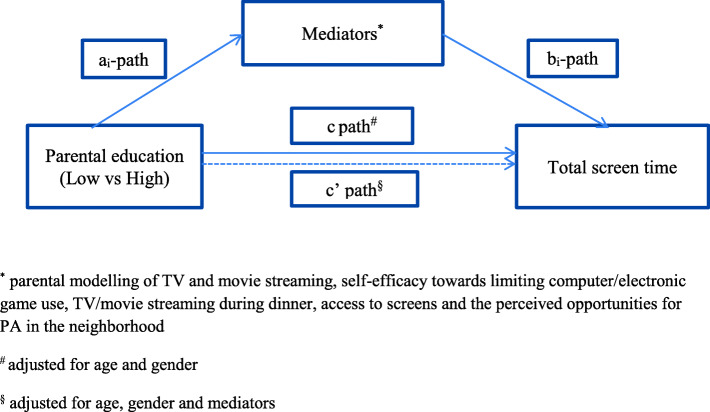
A cross-sectional study including 706 adolescents (mean age of 13.6 (SD = 0.3)) was used to collect data at schools through an online questionnaire. Multiple regression analyses were used to explore factors associated with TST. Mediation analyses were conducted to assess whether these factors mediated the association between parental education and TST.
Multiple linear regression analyses, adjusted for gender and age, showed that parental modelling of TV and movie streaming, TV/movie streaming during dinner and access to screens were positively related to TST. Self-efficacy towards limiting TV and movie streaming, self-efficacy towards limiting computer/electronic game use, and the perceived opportunities for physical activity in the neighborhood were inversely related to total screen time. All of these factors except self-efficacy towards limiting TV and movie streaming mediated the association between parental education and TST.
The study identified several modifiable factors at the individual, interpersonal and neighborhood environmental levels that can be targeted in interventions aimed at decreasing screen time among youth in general and among those with a low socioeconomic position in particular.
现有文献表明,青少年的社会经济地位与屏幕时间呈负相关。但人们对造成这种差异的机制知之甚少。本研究旨在探讨青少年总屏幕时间(TST)的个体、人际和邻里环境相关因素,并评估其在父母教育与 TST 之间的关联中的中介作用。
本横断面研究共纳入 706 名青少年(平均年龄 13.6(SD=0.3)岁),通过在线问卷在学校收集数据。采用多元回归分析探讨与 TST 相关的因素。采用中介分析评估这些因素是否在父母教育与 TST 之间的关联中起中介作用。
经性别和年龄调整的多元线性回归分析显示,父母对电视和电影流媒体、晚餐时看电视/电影以及接触屏幕的榜样作用与 TST 呈正相关。限制电视和电影流媒体使用的自我效能感、限制电脑/电子游戏使用的自我效能感以及邻里体育活动机会感知与总屏幕时间呈负相关。除限制电视和电影流媒体使用的自我效能感外,所有这些因素均在父母教育与 TST 之间的关联中起中介作用。
本研究确定了个体、人际和邻里环境层面上的几个可改变的因素,这些因素可以作为干预目标,以减少青少年,特别是社会经济地位较低的青少年的屏幕时间。