Wang Ziran, Hao Zhuang, Yu Shifeng, Huang Cong, Pan Yunlu, Zhao Xuezeng
Key Laboratory of Micro-Systems and Micro-Structures Manufacturing, Harbin Institute of Technology, Ministry of Education, Harbin 150080, China.
School of Mechatronics Engineering, Harbin Institute of Technology, Harbin 150001, China.
Nanomaterials (Basel). 2020 Jul 31;10(8):1503. doi: 10.3390/nano10081503.
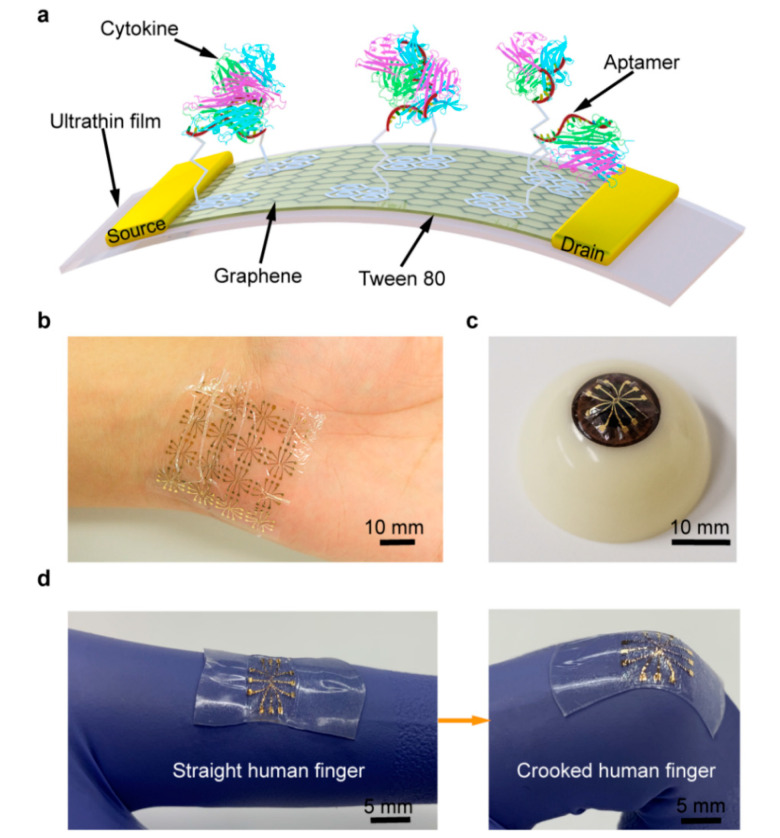
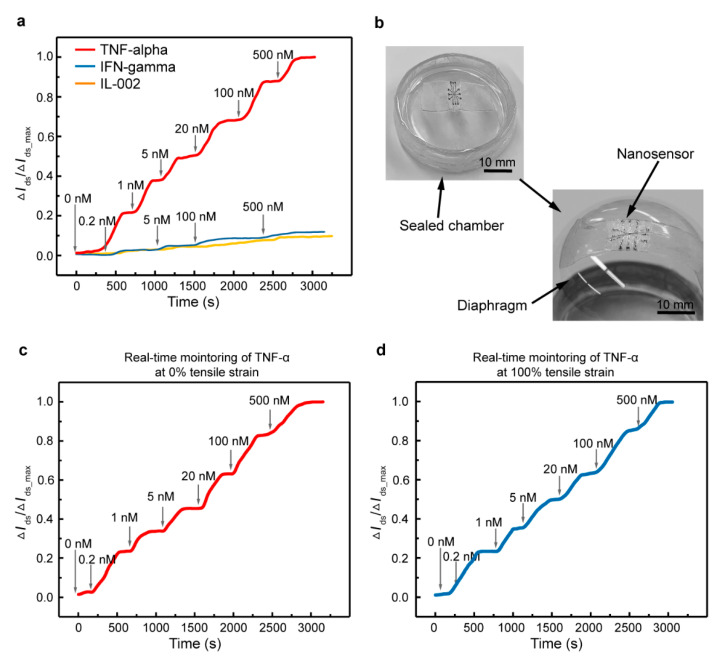
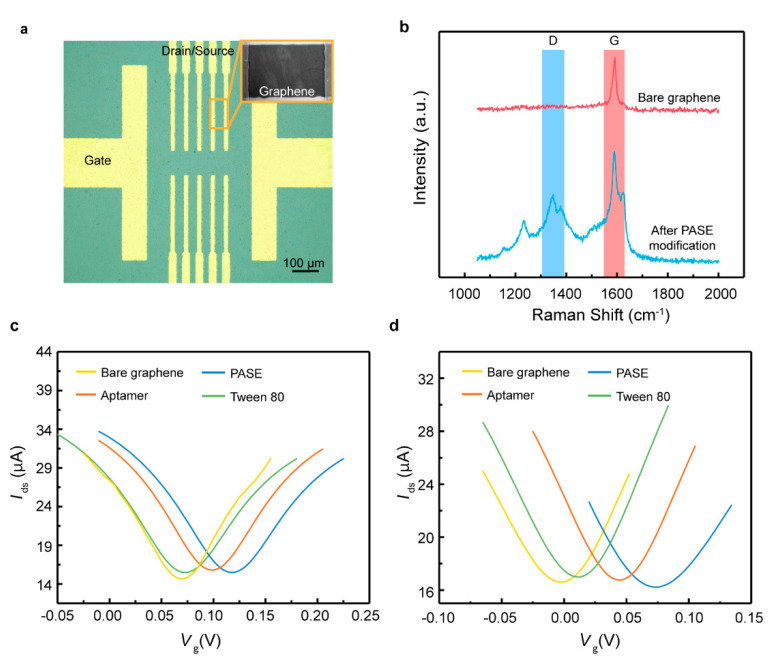
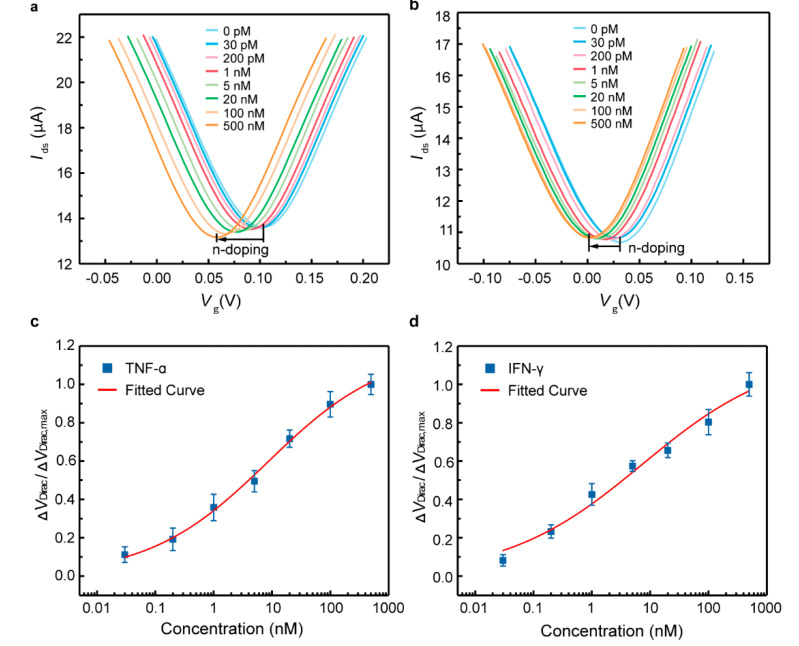
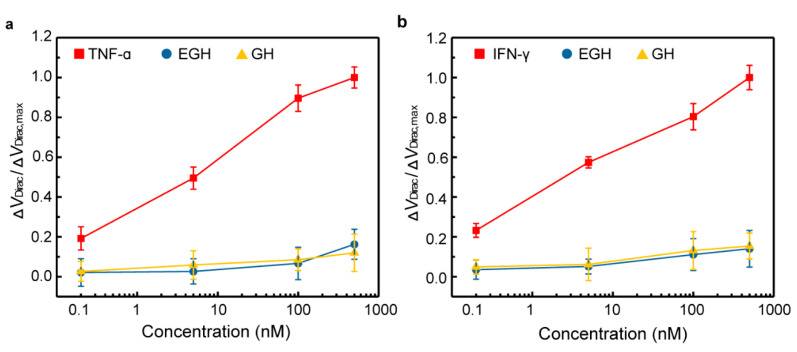
A wearable and deformable graphene-based field-effect transistor biosensor is presented that uses aptamer-modified graphene as the conducting channel, which is capable of the sensitive, consistent and time-resolved detection of cytokines in human biofluids. Based on an ultrathin substrate, the biosensor offers a high level of mechanical durability and consistent sensing responses, while conforming to non-planar surfaces such as the human body and withstanding large deformations (e.g., bending and stretching). Moreover, a nonionic surfactant is employed to minimize the nonspecific adsorption of the biosensor, hence enabling cytokine detection (TNF-α and IFN-γ, significant inflammatory cytokines, are used as representatives) in artificial tears (used as a biofluid representative). The experimental results demonstrate that the biosensor very consistently and sensitively detects TNF-α and IFN-γ, with limits of detection down to 2.75 and 2.89 pM, respectively. The biosensor, which undergoes large deformations, can thus potentially provide a consistent and sensitive detection of cytokines in the human body.
本文展示了一种可穿戴且可变形的基于石墨烯的场效应晶体管生物传感器,该传感器使用适配体修饰的石墨烯作为导电通道,能够对人体生物流体中的细胞因子进行灵敏、一致且具有时间分辨能力的检测。基于超薄基板,该生物传感器具有高度的机械耐久性和一致的传感响应,同时能够贴合非平面表面,如人体表面,并能承受较大变形(如弯曲和拉伸)。此外,采用非离子表面活性剂来最小化生物传感器的非特异性吸附,从而能够在人工泪液(作为生物流体代表)中检测细胞因子(以重要的炎性细胞因子TNF-α和IFN-γ作为代表)。实验结果表明,该生物传感器能够非常一致且灵敏地检测TNF-α和IFN-γ,检测限分别低至2.75和2.89 pM。因此,这种能够承受较大变形的生物传感器有可能对人体中的细胞因子进行一致且灵敏的检测。