Wu Xin, Angkititrakul Sunpetch, L Richards Allen, Pulsrikarn Chaiwat, Khaengair Seri, Keosengthong Amphone, Siriwong Supatcharee, Suksawat Fanan
Ecotoxicology, Natural Resources and Environment Project, Khon Kaen University, Khon Kaen 40002, Thailand.
College of Veterinary Medicine, Yunnan Agricultural University, Kunming 650051, China.
Antibiotics (Basel). 2020 Aug 4;9(8):477. doi: 10.3390/antibiotics9080477.
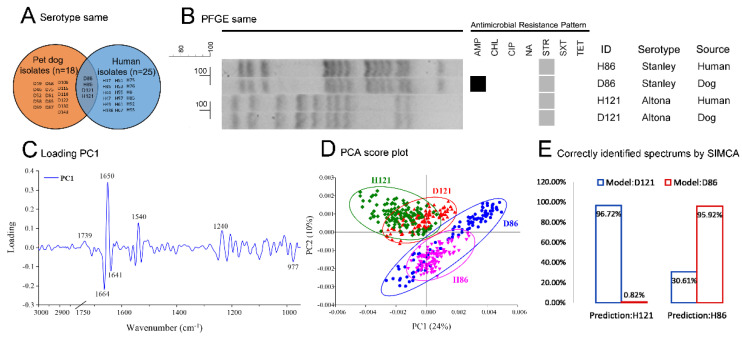
To explore the risk of antimicrobial resistant (AMR) non-typhoidal during asymptomatic infection passage between pet dogs and human caregivers in Khon Kaen, Thailand, one hundred forty paired fecal samples ( = 280) were obtained from companion dogs and their human caregivers, interviewed from 140 households during 2019-2020. The purified isolates were serotype-identified and tested for antimicrobial resistance against ampicillin, ciprofloxacin, chloramphenicol, nalidixic acid, streptomycin, sulfamethoxazole-trimethoprim, and tetracycline. The homologous isolate pairs (suggesting infections may have been due to passage between each one of the pair, or derived from the same source) were subsequently characterized by serotype screening, pulsed field gel electrophoresis (PFGE), and Synchrotron Fourier transform infrared spectroscopy (SR-FTIR). The prevalence observed in dogs, 12.86% (18/140), was not significantly different from that observed in humans, 17.86% (25/140) using McNemar's test. The AMR patterns (the patterns among the isolates of pet dogs and caregivers) and the serotypes (thirteen serotypes with 18 isolates from pet dogs plus thirteen serotypes with 25 isolates from humans) between pet dogs and humans were not significantly different using Pearson's chi-squared test. The homologous isolates from the -present households was 5.13% (2/39). This study demonstrated that the hypothesis that there is a high risk of infection passage between dogs and humans with close contact in Khon Kaen is doubtful. Only 5.13% of homologous isolates from -present households were found in Khon Kaen, Thailand, although the prevalence of -positive samples, serotypes, and antimicrobial resistance patterns were quite similar among the two populations.
为探究泰国孔敬市宠物狗与其人类照料者之间无症状感染传播过程中耐抗菌药物(AMR)非伤寒沙门氏菌的风险,在2019 - 2020年期间,从140户家庭的伴侣犬及其人类照料者处采集了140对粪便样本(共280份)。对纯化后的沙门氏菌分离株进行血清型鉴定,并检测其对氨苄西林、环丙沙星、氯霉素、萘啶酸、链霉素、磺胺甲恶唑 - 甲氧苄啶和四环素的耐药性。随后,通过血清型筛查、脉冲场凝胶电泳(PFGE)和同步加速器傅里叶变换红外光谱(SR - FTIR)对同源沙门氏菌分离株对(表明感染可能是由于该对中的每一个之间传播,或源自同一来源)进行特征分析。使用麦克尼马尔检验,犬类中观察到的沙门氏菌流行率为12.86%(18/140),与人类中观察到的17.86%(25/140)无显著差异。使用皮尔逊卡方检验,宠物狗和照料者分离株之间的AMR模式(宠物狗和照料者分离株中的模式)和血清型(宠物狗的18株分离株有13种血清型加上人类的25株分离株有13种血清型)无显著差异。来自当前家庭的同源沙门氏菌分离株为5.13%(2/39)。本研究表明,关于在孔敬市密切接触的狗和人之间存在沙门氏菌感染传播高风险的假设值得怀疑。在泰国孔敬市,仅发现5.13%的来自当前家庭的同源沙门氏菌分离株,尽管在这两个人群中沙门氏菌阳性样本的流行率、血清型和抗菌药物耐药模式相当相似。