Blake Amanda B, Cigarroa Annalis, Klein Hannah L, Khattab Mohammad R, Keating Theresa, Van De Coevering Patti, Lidbury Jonathan A, Steiner Jörg M, Suchodolski Jan S
Gastrointestinal Laboratory - Texas A&M University, College Station, Texas, USA.
Guide Dogs for the Blind, San Rafael, California, USA.
J Vet Intern Med. 2020 Nov;34(6):2345-2356. doi: 10.1111/jvim.15928. Epub 2020 Oct 13.
The fecal microbiota, fecal bile acid concentrations, and abundance of Clostridium perfringens and Clostridium difficile are altered in acute and chronic gastrointestinal disease in adult dogs. However, less is known in young puppies.
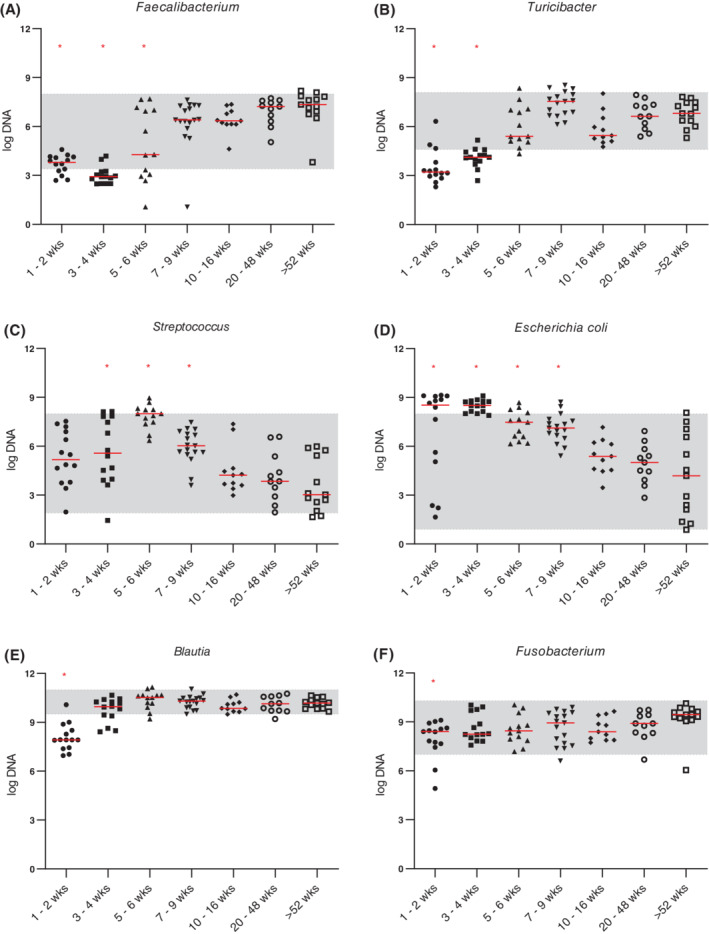
HYPOTHESIS/OBJECTIVES: To determine composition of the fecal microbiota, assess development of fecal bile acid profiles, and determine the abundance of Clostridial species in puppies, young adult dogs, and adult dogs.
Healthy puppies from a whelping kennel (n = 53) and healthy client-owned dogs <1 year old (n = 20) were separated into 6 age groups, then compared to client-owned dogs over 1 year of age (n = 13).
Prospective observational study. Naturally voided fecal samples were analyzed by quantitative polymerase chain reaction to measure bacterial abundances. Fecal bile acids were quantified using gas chromatography-mass spectrometry.
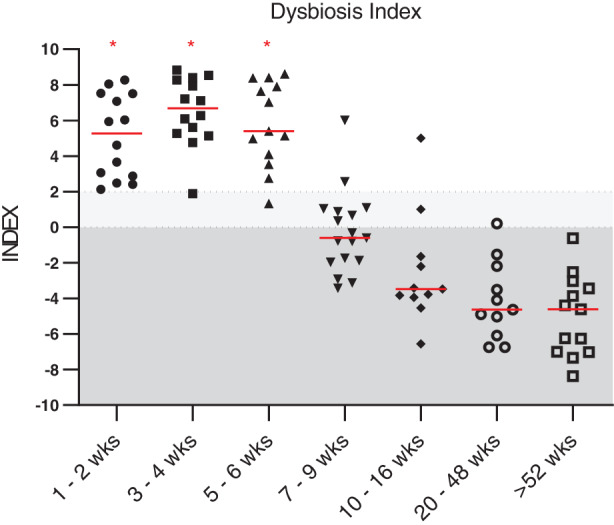
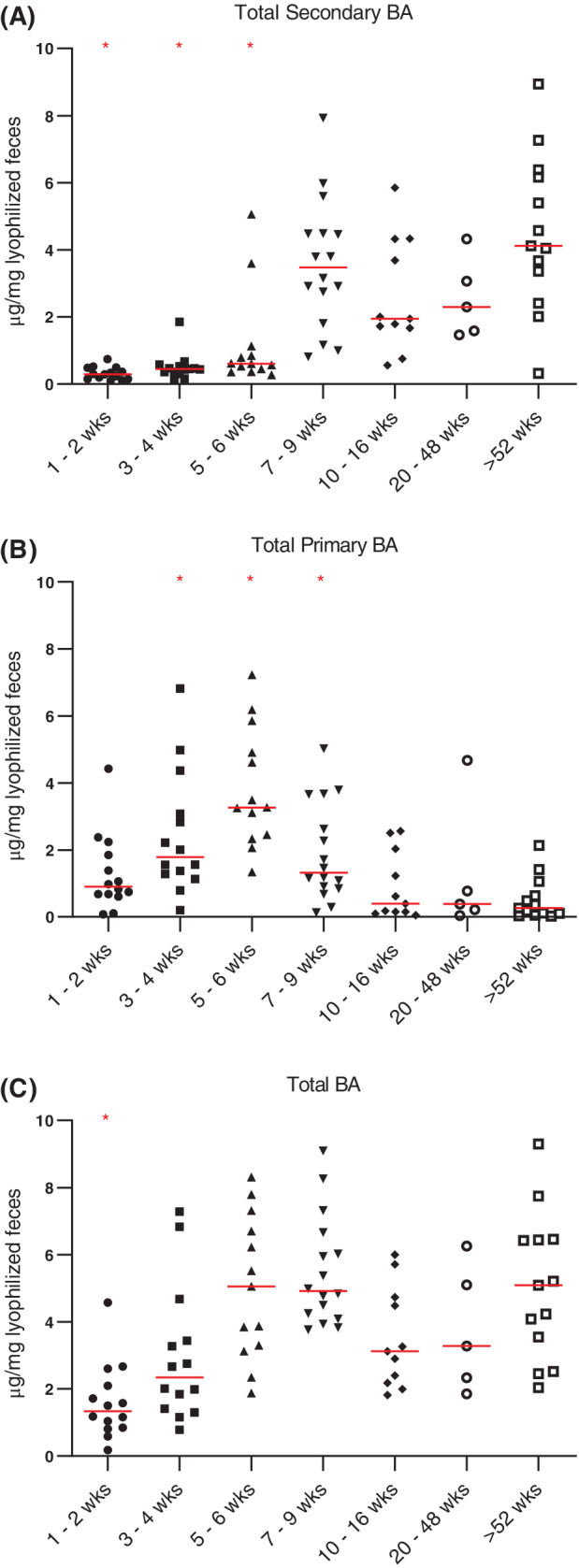
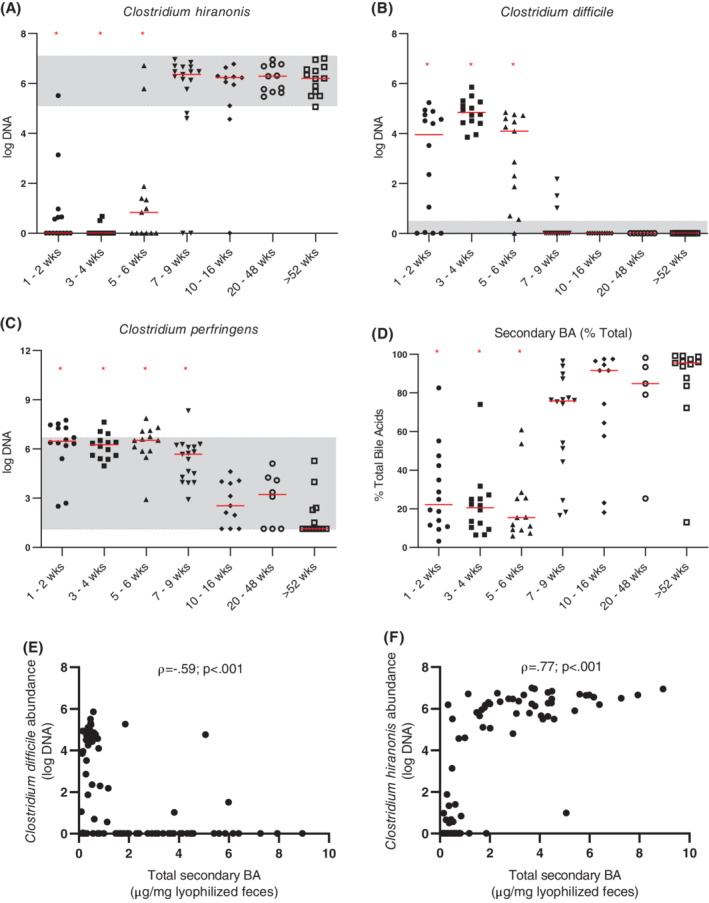
Puppies up to 5 to 6 weeks of age had increased Dysbiosis Index (median [min-max]: 5.39 [1.32-8.6], P < .001), increased abundance of C. difficile (4.1 [0.01-4.85] log DNA, P < .001), decreased secondary bile acid concentrations (0.61 [0.28-5.06] μg/mg, P = .006), and decreased abundance of C. hiranonis (0.84 [0.01-6.71], P = .005) compared to adult dogs (-4.62 [-8.36 to -0.61], 0.01 [0.01-0.01], 4.12 [0.32-8.94], and 6.02 [5.06-7.00], respectively). Secondary bile acid concentration positively correlated with C. hiranonis abundance (ρ = 0.77; P < .001).
The increase in secondary bile acids and simultaneous decrease of C. difficile and C. perfringens after 5 to 6 weeks of age warrants further investigation into regulatory impacts that secondary bile acids could have on clostridial species in dogs.
成年犬急性和慢性胃肠道疾病中,粪便微生物群、粪便胆汁酸浓度以及产气荚膜梭菌和艰难梭菌的丰度会发生改变。然而,幼犬的相关情况了解较少。
假设/目的:确定幼犬、青年犬和成年犬粪便微生物群的组成,评估粪便胆汁酸谱的发育情况,并确定梭菌属物种的丰度。
来自产仔犬舍的健康幼犬(n = 53)和健康的1岁以下客户拥有的犬(n = 20)被分为6个年龄组,然后与1岁以上客户拥有的犬(n = 13)进行比较。
前瞻性观察研究。通过定量聚合酶链反应分析自然排出的粪便样本,以测量细菌丰度。使用气相色谱-质谱法定量粪便胆汁酸。
与成年犬相比(分别为-4.62 [-8.36至-0.61]、0.01 [0.01 - 0.01]、4.12 [0.32 - 8.94]和6.02 [5.06 - 7.00]),5至6周龄以下的幼犬失调指数增加(中位数[最小值 - 最大值]:5.39 [1.32 - 8.6],P <.001),艰难梭菌丰度增加(4.1 [0.01 - 4.85] log DNA,P <.001),次级胆汁酸浓度降低(0.61 [0.28 - 5.06] μg/mg,P =.006),以及平冢梭菌丰度降低(0.84 [0.01 - 6.71],P =.005)。次级胆汁酸浓度与平冢梭菌丰度呈正相关(ρ = 0.77;P <.001)。
5至6周龄后次级胆汁酸增加,同时艰难梭菌和产气荚膜梭菌减少,这值得进一步研究次级胆汁酸对犬梭菌属物种可能产生的调节影响。