Ma Zhijie, Li Jingyu, Cao Fang, Yang Jiahui, Liu Rong, Zhao Dewei
Faculty of Electronic Information and Electrical Engineering, School of Biomedical Engineering, Dalian University of Technology, No. 2 Linggong Road, Ganjingzi District, Dalian, Liaoning 116024, China.
Orthopaedic Department Affiliated ZhongShan Hospital of Dalian University, No. 6 Jiefang Street, Zhongshan District, Dalian, Liaoning 116001, China.
Regen Biomater. 2020 Jun 18;7(5):453-459. doi: 10.1093/rb/rbaa021. eCollection 2020 Oct.
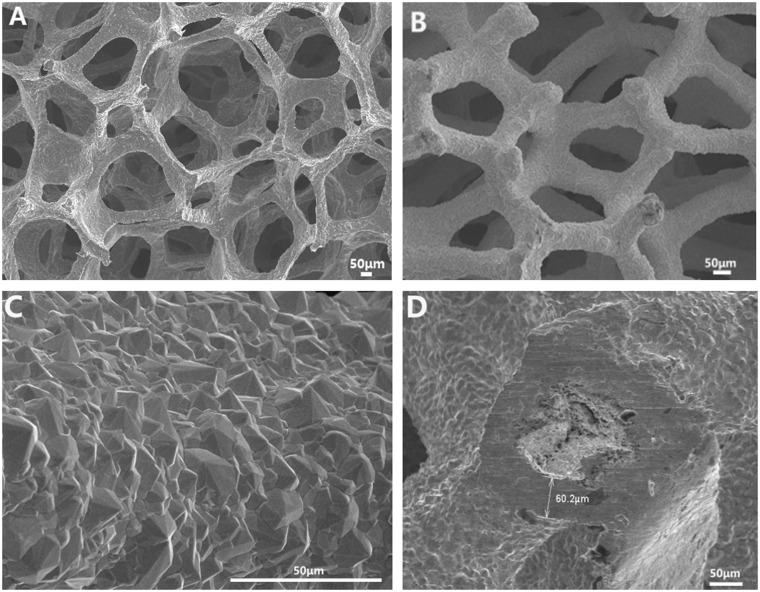
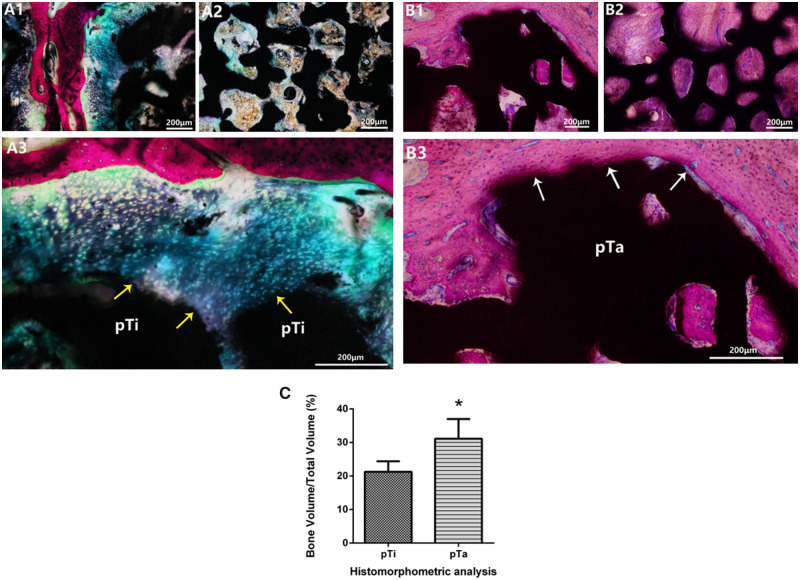
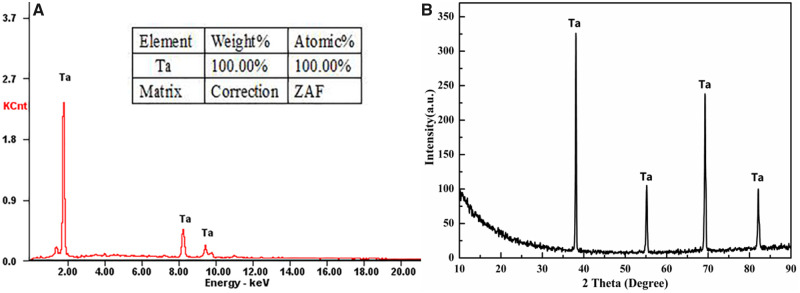
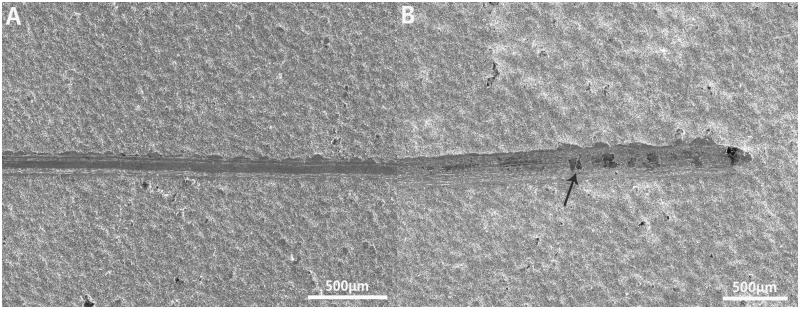
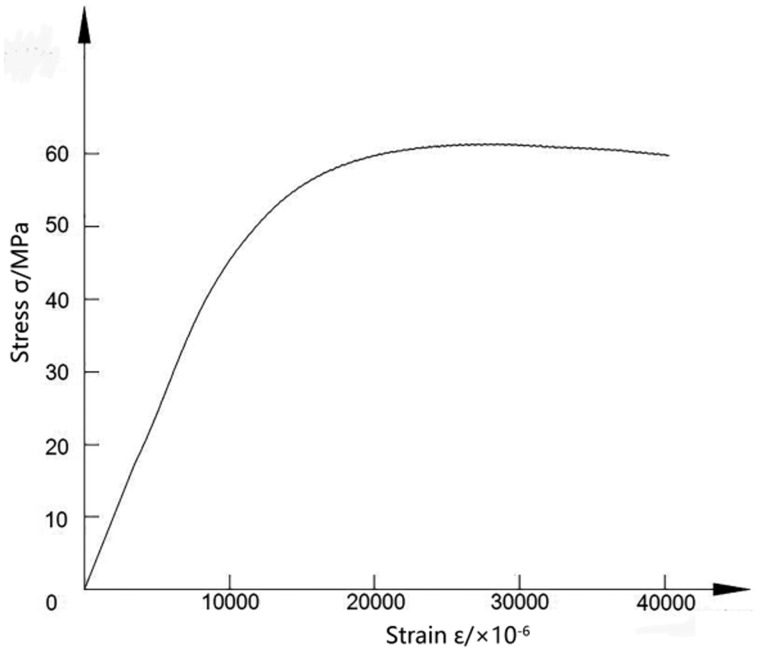
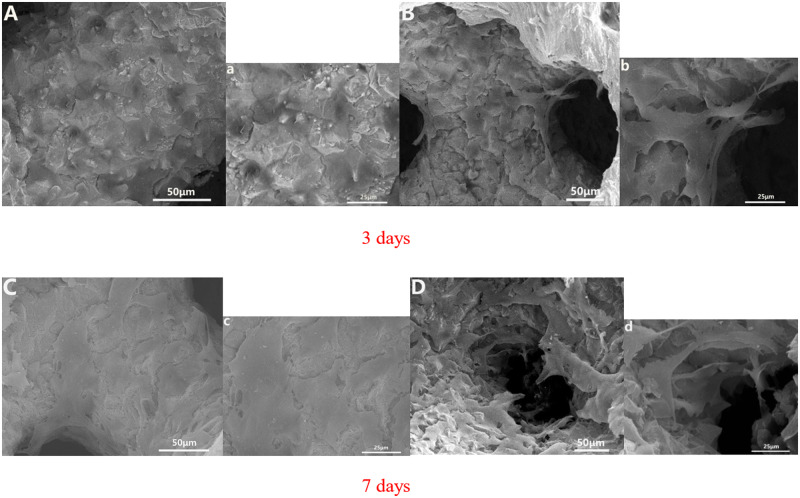
Porous silicon carbide (SiC) has a specific biomorphous microstructure similar to the trabecular microstructure of human bone. Compared with that of bioactive ceramics, such as calcium phosphate, SiC does not induce spontaneous interface bonding to living bone. In this study, bioactive tantalum (Ta) metal deposited on porous SiC scaffolds by chemical vapour deposition was investigated to accelerate osseointegration and improve the bonding to bones. Scanning electron microscopy indicated that the Ta coating evenly covered the entire scaffold structure. Energy-dispersive spectroscopy and X-ray diffraction analysis showed that the coating consisted of Ta phases. The bonding strength between the Ta coating and the SiC substrate is 88.4 MPa. The yield strength of porous SiC with a Ta coating (pTa) was 45.8 ± 2.9 MPa, the compressive strength was 61.4 ± 3.2 MPa and the elastic modulus was ∼4.8 GPa. When MG-63 human osteoblasts were co-cultured with pTa, osteoblasts showed good adhesion and spreading on the surface of the pTa and its porous structure, which showed that it has excellent bioactivity and cyto-compatibility. To further study the osseointegration properties of pTa. PTa and porous titanium (pTi) were implanted into the femoral neck of goats for 12 weeks, respectively. The Van-Gieson staining of histological sections results that the pTa group had better osseointegration than the pTi group. These results indicate that coating bioactive Ta metal on porous SiC scaffolds could be a potential material for bone substitutes.
多孔碳化硅(SiC)具有与人体骨骼小梁微观结构相似的特定生物形态微观结构。与生物活性陶瓷(如磷酸钙)相比,SiC不会诱导与活骨的自发界面结合。在本研究中,对通过化学气相沉积法沉积在多孔SiC支架上的生物活性钽(Ta)金属进行了研究,以加速骨整合并改善与骨骼的结合。扫描电子显微镜表明,Ta涂层均匀覆盖了整个支架结构。能量色散光谱和X射线衍射分析表明,涂层由Ta相组成。Ta涂层与SiC基体之间的结合强度为88.4MPa。涂覆Ta的多孔SiC(pTa)的屈服强度为45.8±2.9MPa,抗压强度为61.4±3.2MPa,弹性模量约为4.8GPa。当MG-63人成骨细胞与pTa共培养时,成骨细胞在pTa表面及其多孔结构上表现出良好的粘附和铺展,这表明它具有优异的生物活性和细胞相容性。为了进一步研究pTa的骨整合特性。分别将pTa和多孔钛(pTi)植入山羊股骨颈12周。组织切片的Van-Gieson染色结果表明,pTa组的骨整合优于pTi组。这些结果表明,在多孔SiC支架上涂覆生物活性Ta金属可能是一种潜在的骨替代材料。