Combarros-Fuertes Patricia, Fresno José M, Estevinho Maria Manuela, Sousa-Pimenta Mário, Tornadijo M Eugenia, Estevinho Leticia M
Department of Food Hygiene and Technology, Faculty of Veterinary Science, University of León, Campus de Vegazana, 24071 León, Spain.
Department of Biomedicine, Unit of Pharmacology and Therapeutics, Faculty of Medicine, University of Porto, 4200-319 Porto, Portugal.
Antibiotics (Basel). 2020 Nov 4;9(11):774. doi: 10.3390/antibiotics9110774.
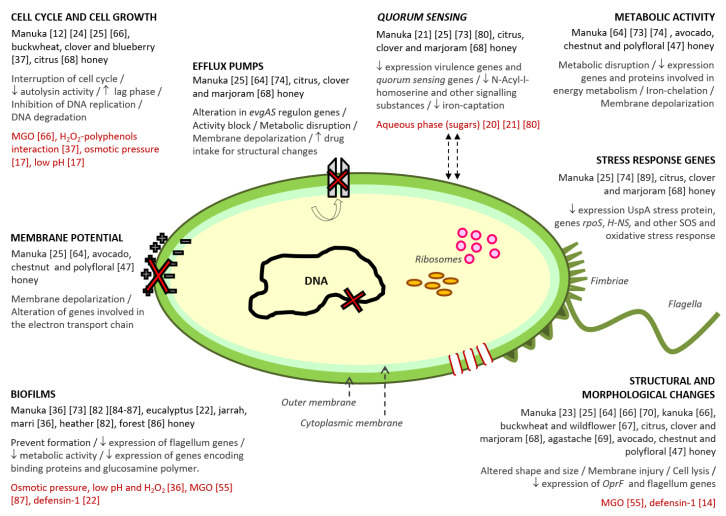
Antibacterial resistance has become a challenging situation worldwide. The increasing emergence of multidrug-resistant pathogens stresses the need for developing alternative or complementary antimicrobial strategies, which has led the scientific community to study substances, formulas or active ingredients used before the antibiotic era. Honey has been traditionally used not only as a food, but also with therapeutic purposes, especially for the topical treatment of chronic-infected wounds. The intrinsic characteristics and the complex composition of honey, in which different substances with antimicrobial properties are included, make it an antimicrobial agent with multiple and different target sites in the fight against bacteria. This, together with the difficulty to develop honey-resistance, indicates that it could become an effective alternative in the treatment of antibiotic-resistant bacteria, against which honey has already shown to be effective. Despite all of these assets, honey possesses some limitations, and has to fulfill a number of requirements in order to be used for medical purposes.
抗菌耐药性已成为全球面临的一个具有挑战性的问题。多重耐药病原体的不断出现凸显了开发替代或补充抗菌策略的必要性,这促使科学界研究抗生素时代之前使用的物质、配方或活性成分。蜂蜜传统上不仅被用作食物,还具有治疗用途,特别是用于慢性感染伤口的局部治疗。蜂蜜的内在特性和复杂成分包含了不同的具有抗菌特性的物质,使其成为一种在对抗细菌时有多个不同靶点的抗菌剂。这一点,再加上难以产生对蜂蜜的耐药性,表明它可能成为治疗抗生素耐药菌的有效替代品,蜂蜜已被证明对这些耐药菌有效。尽管有所有这些优点,但蜂蜜也有一些局限性,并且为了用于医疗目的必须满足一些要求。