Department of Medicine, University of California, San Francisco.
Department of Urology, University of California, San Francisco.
JAMA Netw Open. 2020 Nov 2;3(11):e2021701. doi: 10.1001/jamanetworkopen.2020.21701.
Erectile dysfunction, especially in younger men, is an early sign of cardiovascular disease and may decrease quality of life. Men may be motivated to adopt a healthy dietary pattern if it lowers their risk of erectile dysfunction.
To assess the association between adherence to a diet quality index based on healthy dietary patterns and erectile dysfunction in men.
DESIGN, SETTING, AND PARTICIPANTS: This population-based prospective cohort study included men from the Health Professionals Follow-up Study with follow-up from January 1, 1998, through January 1, 2014. Participants included US male health professionals aged 40 to 75 years at enrollment. Men with erectile dysfunction or a diagnosis of myocardial infarction, diabetes, stroke, or genitourinary cancer at baseline were excluded. Analyses were completed in February 2020.
A food frequency questionnaire was used to determine nutrient and food intake every 4 years.
Diet quality was assessed by Mediterranean Diet score and the Alternative Healthy Eating Index 2010 score, with higher scores indicating healthier diet. Dietary index scores were cumulatively updated from 1986 until men developed erectile dysfunction, cardiovascular disease, died, or were lost to follow-up. Incident erectile dysfunction was assessed with questionnaires in 2000, 2004, 2008, and 2012. Hazard ratios (HRs) by prespecified categories or quintiles of dietary index scores were estimated using Cox proportional hazards regression analyses stratified by age.
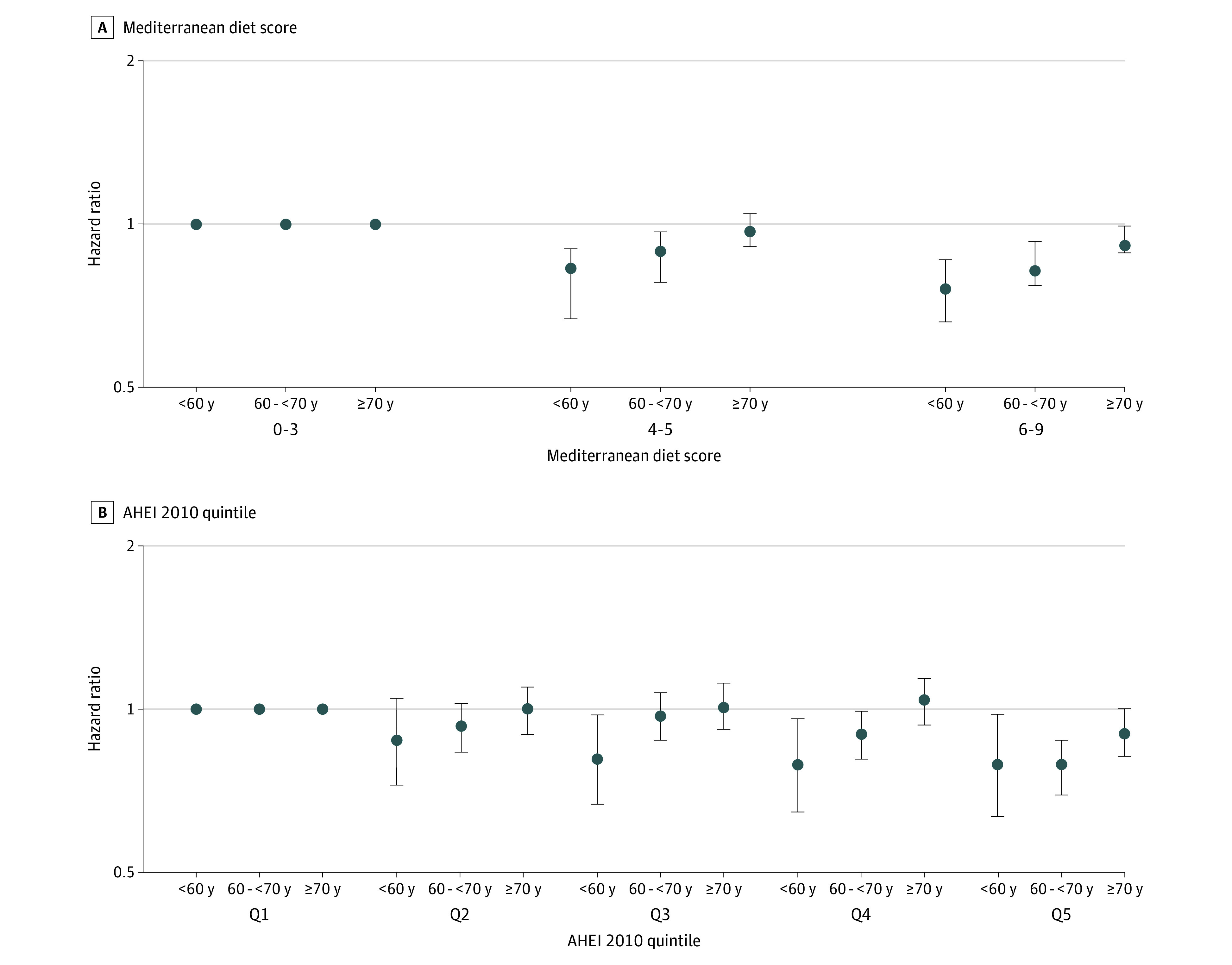
Among 21 469 men included in analysis, mean (SD) age at baseline was 62 (8.4) years. During a mean (SD) follow-up of 10.8 (5.4) years and 232 522 person-years, there were 968 incident erectile dysfunction cases among men younger than 60 years, 3703 cases among men aged 60 to less than 70 years, and 4793 cases among men aged 70 years or older. Men younger than 60 years and in the highest category of the Mediterranean Diet score had the lowest relative risk of incident erectile dysfunction compared with men in the lowest category (HR, 0.78; 95% CI, 0.66-0.92). Higher Mediterranean diet scores were also inversely associated with incident erectile dysfunction among older men (age 60 to <70 years: HR, 0.82; 95% CI, 0.76-0.89; age ≥70 years: HR, 0.93; 95% CI, 0.86-1.00). Men scoring in the highest quintile of the Alternative Healthy Eating Index 2010 also had a lower risk of incident erectile dysfunction, particularly among men age younger than 60 years (quintile 5 vs quintile 1: HR, 0.78; 95% CI, 0.63-0.97).
This cohort study found that adherence to healthy dietary patterns was associated with a lower risk for erectile dysfunction, suggesting that a healthy dietary pattern may play a role in maintaining erectile health.
勃起功能障碍,尤其是在年轻男性中,是心血管疾病的早期迹象,可能会降低生活质量。如果健康的饮食模式可以降低勃起功能障碍的风险,男性可能会有动力采用这种饮食模式。
评估基于健康饮食模式的饮食质量指数与男性勃起功能障碍之间的关联。
设计、地点和参与者:这是一项基于人群的前瞻性队列研究,纳入了参加健康专业人员随访研究的男性,随访时间从 1998 年 1 月 1 日至 2014 年 1 月 1 日。参与者包括在入组时年龄为 40 至 75 岁的美国男性健康专业人员。基线时有勃起功能障碍或心肌梗死、糖尿病、中风或泌尿生殖系统癌症诊断的男性被排除在外。分析于 2020 年 2 月完成。
使用食物频率问卷每 4 年确定一次营养素和食物摄入量。
通过地中海饮食评分和替代健康饮食指数 2010 评分评估饮食质量,得分越高表示饮食越健康。从 1986 年开始累积更新饮食指数评分,直到男性出现勃起功能障碍、心血管疾病、死亡或失访。通过 2000 年、2004 年、2008 年和 2012 年的问卷调查评估新发勃起功能障碍。使用 Cox 比例风险回归分析按年龄分层,按预先指定的饮食指数评分类别或五分位数估计 HR。
在纳入分析的 21469 名男性中,基线时的平均(SD)年龄为 62(8.4)岁。在平均(SD)随访 10.8(5.4)年和 232522 人年期间,60 岁以下男性中有 968 例新发勃起功能障碍,60 岁至<70 岁男性中有 3703 例,70 岁及以上男性中有 4793 例。与最低类别相比,60 岁以下和最高类别的地中海饮食评分的男性新发勃起功能障碍的相对风险最低(HR,0.78;95%CI,0.66-0.92)。较高的地中海饮食评分也与老年男性新发勃起功能障碍呈负相关(60 岁至<70 岁年龄组:HR,0.82;95%CI,0.76-0.89;年龄≥70 岁:HR,0.93;95%CI,0.86-1.00)。得分最高的替代健康饮食指数 2010 五分位数的男性新发勃起功能障碍的风险也较低,尤其是 60 岁以下的男性(五分位数 5 与五分位数 1:HR,0.78;95%CI,0.63-0.97)。
这项队列研究发现,遵循健康的饮食模式与勃起功能障碍风险降低相关,这表明健康的饮食模式可能在维持勃起健康方面发挥作用。
