Cheng Lianghui, Kiewiet Mensiena B G, Logtenberg Madelon J, Groeneveld Andre, Nauta Arjen, Schols Henk A, Walvoort Marthe T C, Harmsen Hermie J M, de Vos Paul
Immunoendocrinology, Division of Medical Biology, Department of Pathology and Medical Biology, University Medical Center Groningen, University of Groningen, Groningen, Netherlands.
Laboratory of Food Chemistry, Wageningen University & Research, Wageningen, Netherlands.
Front Microbiol. 2020 Oct 30;11:569700. doi: 10.3389/fmicb.2020.569700. eCollection 2020.
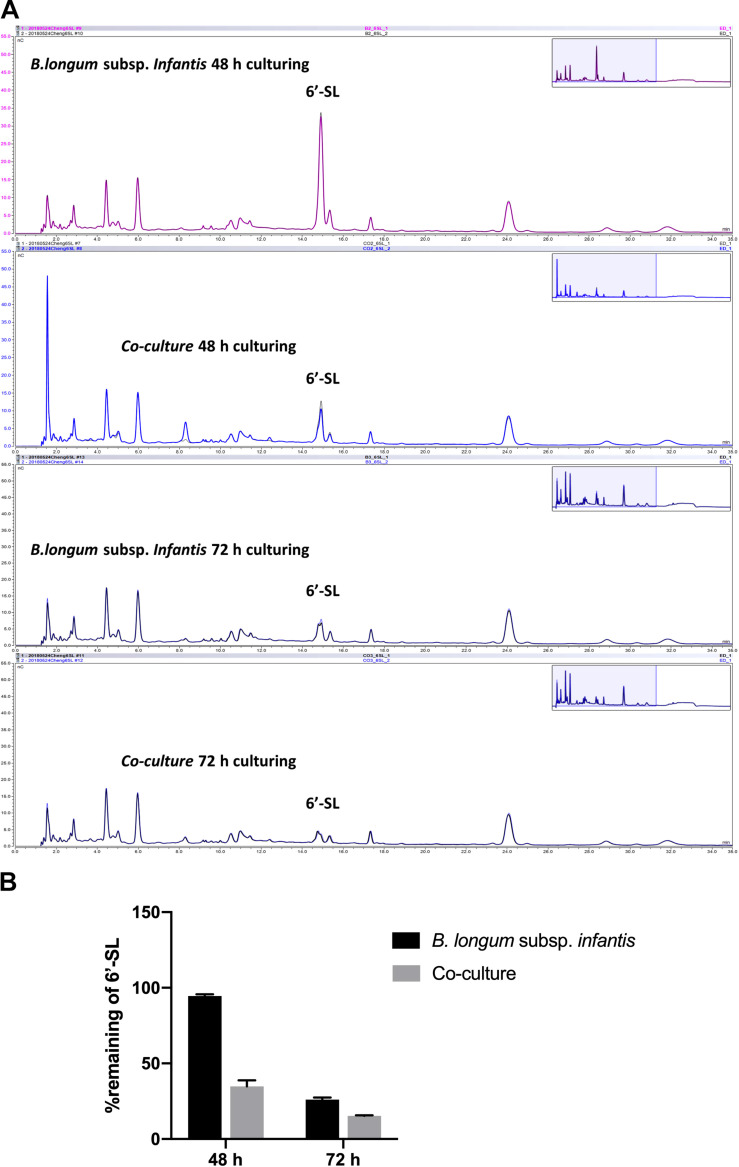
Human milk oligosaccharides (hMOs) are important bioactive components in mother's milk contributing to infant health by supporting colonization and growth of gut microbes. In particular, genus is considered to be supported by hMOs. Approximately 200 different hMOs have been discovered and characterized, but only a few abundant hMOs can be produced in sufficient amounts to be applied in infant formula. These hMOs are usually supplied in infant formula as single molecule, and it is unknown which and how individual hMOs support growth of individual gut bacteria. To investigate how individual hMOs influence growth of several relevant intestinal bacteria species, we studied the effects of three hMOs (2'-fucosyllactose, 3-fucosyllactose, and 6'-sialyllactose) and an hMO acid hydrolysate (lacto-N-triose) on three and one and introduced a co-culture system of two bacterial strains to study possible cross-feeding in presence and absence of hMOs. We observed that in monoculture, subsp. could grow well on all hMOs but in a structure-dependent way. reached a lower cell density on the hMOs in stationary phase compared to glucose, while subsp. and were not able to grow on the tested hMOs. In a co-culture of subsp. with , different effects were observed with the different hMOs; 6'-sialyllactose, rather than 2'-fucosyllactose, 3-fucosyllactose, and lacto-N-triose, was able to promote the growth of subsp. . Our observations demonstrate that effects of hMOs on the tested gut microbiota are hMO-specific and provide new means to support growth of these specific beneficial microorganisms in the intestine.
人乳寡糖(hMOs)是母乳中的重要生物活性成分,通过支持肠道微生物的定殖和生长,对婴儿健康有益。特别是,[具体菌属]被认为受到hMOs的支持。已发现并鉴定了约200种不同的hMOs,但只有少数几种含量丰富的hMOs能够大量生产,以应用于婴儿配方奶粉中。这些hMOs通常以单分子形式添加到婴儿配方奶粉中,目前尚不清楚单个hMOs如何以及支持哪些个体肠道细菌的生长。为了研究单个hMOs如何影响几种相关肠道细菌的生长,我们研究了三种hMOs(2'-岩藻糖基乳糖、3-岩藻糖基乳糖和6'-唾液酸基乳糖)和一种hMO酸水解产物(乳糖-N-三糖)对三种[具体细菌]和一种[具体细菌]的影响,并引入了两种细菌菌株的共培养系统,以研究在有和没有hMOs的情况下可能的交叉喂养。我们观察到,在单培养中,[具体亚种]在所有hMOs上都能良好生长,但方式依赖于结构。与葡萄糖相比,[具体细菌]在稳定期的hMOs上细胞密度较低,而[具体亚种]和[具体细菌]在测试的hMOs上不能生长。在[具体亚种]与[具体细菌]的共培养中,不同的hMOs观察到不同的效果;6'-唾液酸基乳糖,而不是2'-岩藻糖基乳糖、3-岩藻糖基乳糖和乳糖-N-三糖,能够促进[具体亚种]的生长。我们的观察结果表明,hMOs对测试的肠道微生物群的影响具有hMO特异性,并为支持这些特定有益微生物在肠道中的生长提供了新方法。