Neuroscience Graduate Program, University of Washington, Seattle, WA 98195, USA; Department of Ophthalmology, University of Washington, Seattle, WA 98109, USA; Center for Visual Science, University of Rochester, Rochester, NY 14627, USA.
Department of Ophthalmology, University of Washington, Seattle, WA 98109, USA.
Curr Biol. 2020 Dec 7;30(23):R1409-R1410. doi: 10.1016/j.cub.2020.10.010.
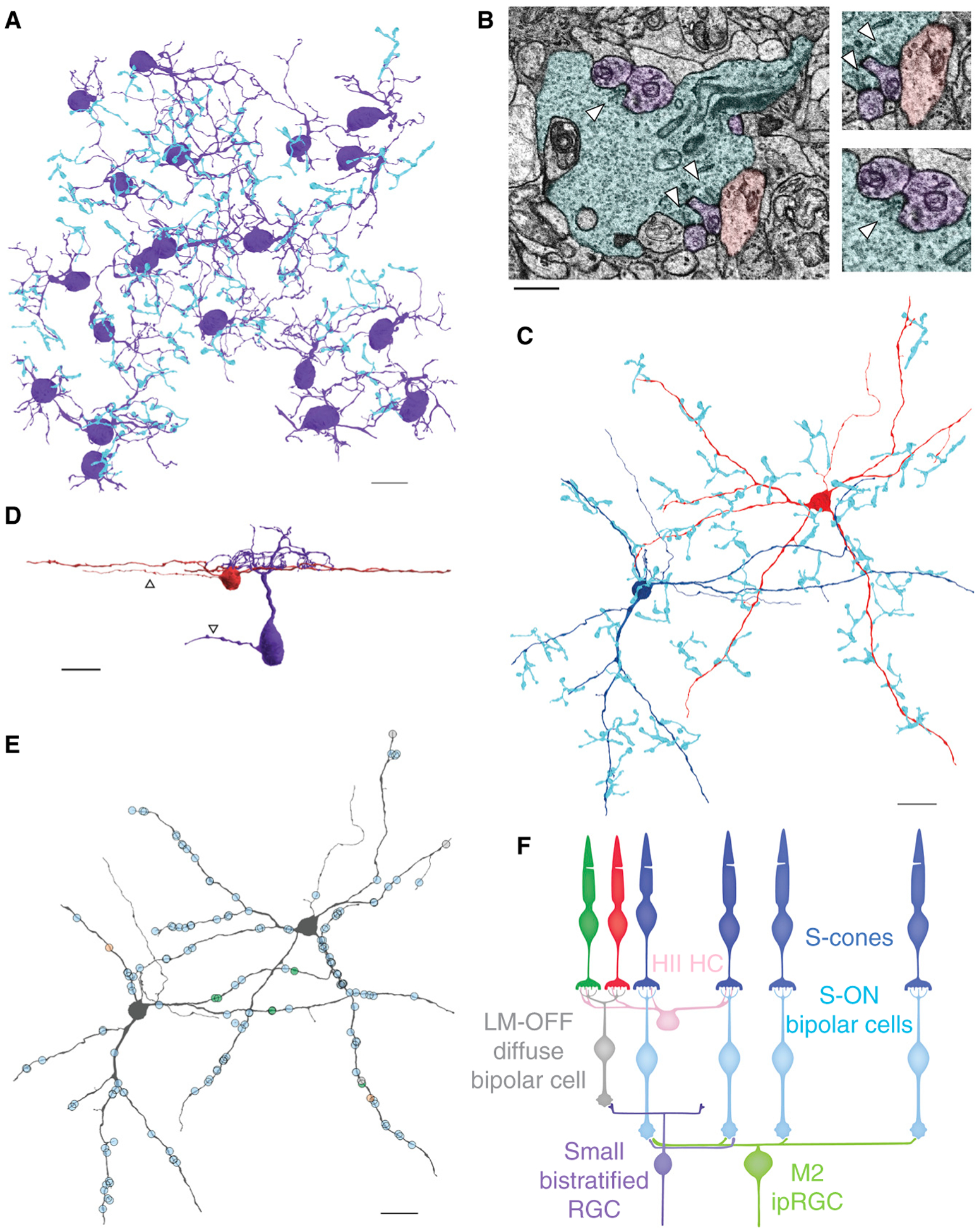
A classic and highly influential model of visual processing proposes that the role of the retina is to compress visual information for optimal transmission to the brain [1]. Drawing on ideas from information theory, an efficient retinal code could be defined as one that reduces redundancy to communicate as much information as possible, given the optic nerve's limited capacity. From this redundancy reduction hypothesis, a theory of retinal color coding emerged in which the three most common retinal ganglion cell (RGC) types captured much of the variance in natural spectra [2]. Within this compact code, the 'Blue-ON' small bistratified RGC was thought to be the only pathway necessary for comparing short (S) wavelength-sensitive cones to long (L) and medium (M) wavelength-sensitive cones [3,4]. Here, we discovered a new wide-field RGC type receiving the same cone-opponent input as the small bistratified RGC, indicating that there is more redundancy in the retinal color code than previously appreciated.
一个经典且极具影响力的视觉处理模型提出,视网膜的作用是压缩视觉信息,以便将其以最优的方式传输到大脑[1]。受信息论思想的启发,高效的视网膜编码可以定义为在视神经的有限容量下,减少冗余以尽可能多地传递信息的编码。基于这种减少冗余的假设,出现了一种视网膜颜色编码理论,其中三种最常见的视网膜神经节细胞(RGC)类型捕获了自然光谱中大部分的变化[2]。在这个紧凑的编码中,被认为是唯一的比较短(S)波长敏感的视锥细胞与长(L)和中(M)波长敏感的视锥细胞的“蓝-ON”小双分层 RGC 途径[3,4]。在这里,我们发现了一种新的宽视野 RGC 类型,它接收与小双分层 RGC 相同的视锥细胞对立输入,这表明视网膜颜色编码比以前认为的更具冗余性。