Kowalczuk Krystyna, Krajewska-Kułak Elżbieta, Sobolewski Marek
Department of Integrated Medical Care, Medical University of Bialystok, Bialystok, Poland.
Faculty of Management, Rzeszow University of Technology, Rzeszow, Poland.
Front Psychiatry. 2020 Dec 3;11:591957. doi: 10.3389/fpsyt.2020.591957. eCollection 2020.
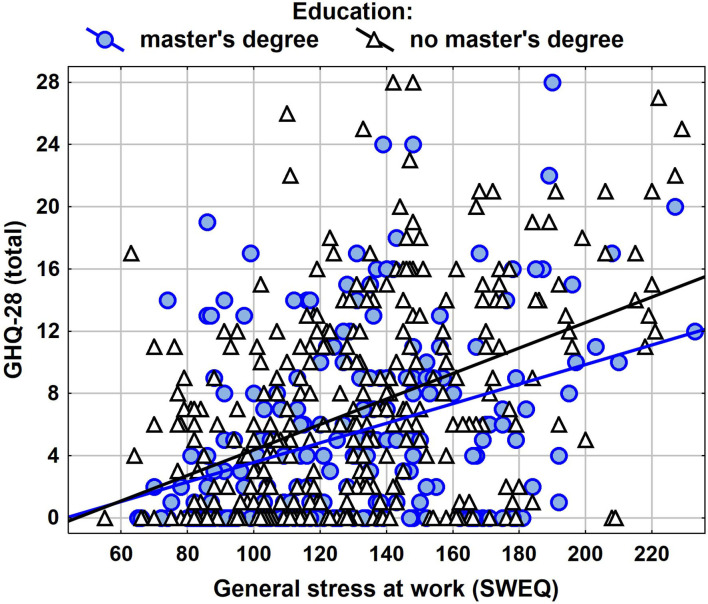
Nursing is considered one of the most stressful professions in the world. The high emotional burden associated with excessive workload in qualitative and quantitative terms, exposure to existing and emerging infectious diseases, daily confrontation with the suffering of individuals and their families and low social support leads to the development of numerous stress reactions among nurses, resulting in the development of anxiety, insomnia, social dysfunction and depression. Indeed, somatic and mental stress-related disease rates are higher among nurses than in the general population. To determine the impact of subjective work characteristics on the mental health of nurses in relation to demographic and occupational factors. The research was carried out among 558 nurses working in hospitals in Podlaskie Voivodeship, and used the Subjective Work Evaluation Questionnaire (SWEQ) and Goldberg's GHQ-28 Questionnaire. As measured by SWEQ, and as self-assessed by means of the GHQ-28 questionnaire, negatively affects the nurses' health ( = 18.7%). Among the partial measures of the SWEQ questionnaire, had strong and the and had weak negative effect on the overall mental health assessment of nurses ( = 19.2%). The measure was an exception that had a positive impact on the nurses' well-being. Among occupational and demographic factors, only higher education in relation to secondary education in interactions with the measure and had a positive effect on the overall mental health self-assessment of nurses ( = 20.7%). The results of our study provide a clear message to the hospital management that improving the work organization and atmosphere of nurses by reducing perceived work overload and increasing the responsibility of nurses can have a positive impact on their mental health. Encouraging nurses to improve their education can result not only in an obvious improvement in staff qualifications, but also in better resistance to stressors in the workplace and, consequently, in better staff well-being. Both measures can have a positive impact on the quality of care provided by nurses and on reducing staff turnover.
护理被认为是世界上压力最大的职业之一。从质和量的角度来看,与过重工作量相关的高情感负担、接触现有的和新出现的传染病、每天面对个人及其家庭的痛苦以及社会支持不足,导致护士中出现大量应激反应,进而引发焦虑、失眠、社会功能障碍和抑郁。事实上,护士中与身心压力相关的疾病发生率高于普通人群。为了确定主观工作特征对护士心理健康的影响,并与人口统计学和职业因素相关联。该研究在波德拉谢省医院工作的558名护士中进行,使用了主观工作评价问卷(SWEQ)和戈德堡的GHQ - 28问卷。通过SWEQ测量,并通过GHQ - 28问卷进行自我评估,对护士的健康有负面影响(= 18.7%)。在SWEQ问卷的部分测量指标中,对护士的整体心理健康评估有强烈的负面影响,而和有较弱的负面影响(= 19.2%)。测量指标是个例外,对护士的幸福感有积极影响。在职业和人口统计学因素中,只有与中等教育相比的高等教育,在与测量指标和的相互作用中,对护士的整体心理健康自我评估有积极影响(= 20.7%)。我们的研究结果向医院管理层传达了一个明确的信息,即通过减少感知到的工作过载和增加护士的责任感来改善护士的工作组织和氛围,对他们的心理健康会产生积极影响。鼓励护士提高教育水平不仅会使员工资质明显提高,还会使他们在工作场所对压力源有更好的抵抗力,从而使员工幸福感更高。这两项措施都可以对护士提供的护理质量以及减少员工流失产生积极影响。