Khan Aman Ullah, Melzer Falk, Hendam Ashraf, Sayour Ashraf E, Khan Iahtasham, Elschner Mandy C, Younus Muhammad, Ehtisham-Ul-Haque Syed, Waheed Usman, Farooq Muhammad, Ali Shahzad, Neubauer Heinrich, El-Adawy Hosny
Friedrich-Loeffler-Institut, Institute of Bacterial Infections and Zoonoses, Jena, Germany.
Department of Pathobiology, College of Veterinary and Animal Sciences, Jhang, Pakistan.
Front Vet Sci. 2020 Dec 2;7:594498. doi: 10.3389/fvets.2020.594498. eCollection 2020.
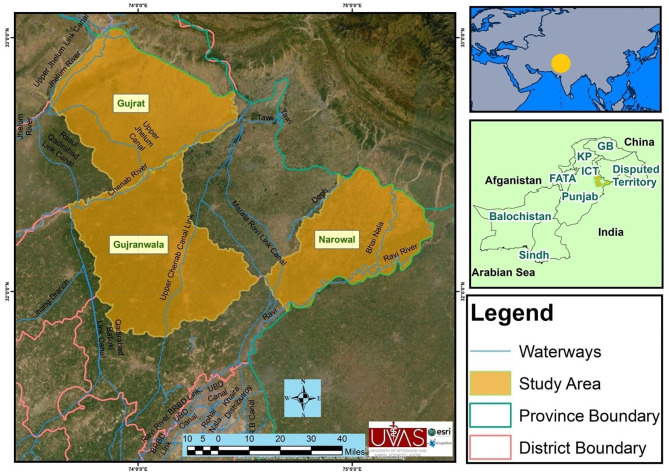
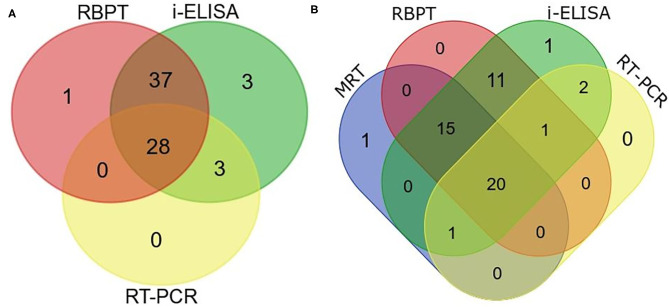
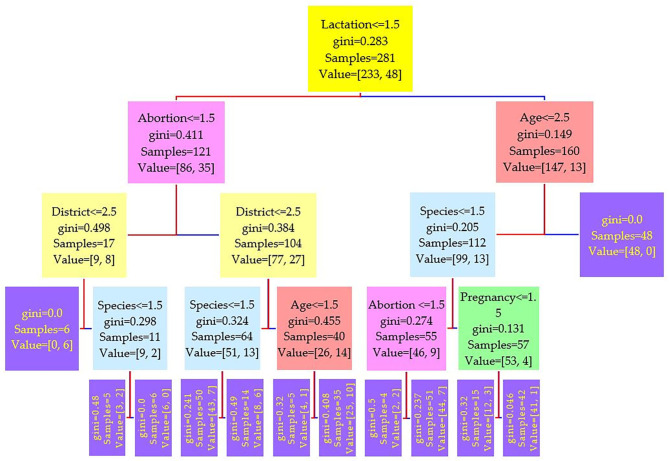
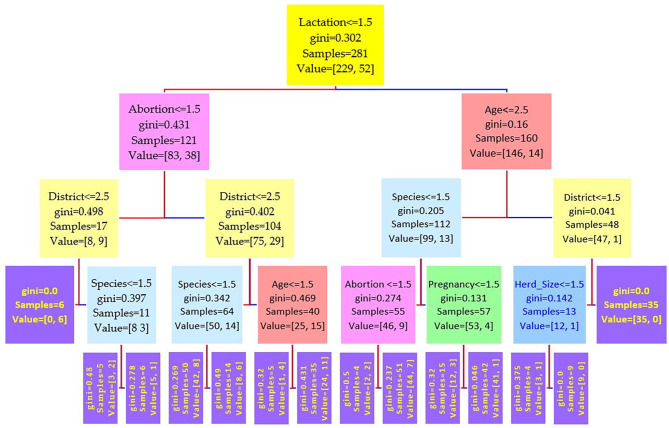
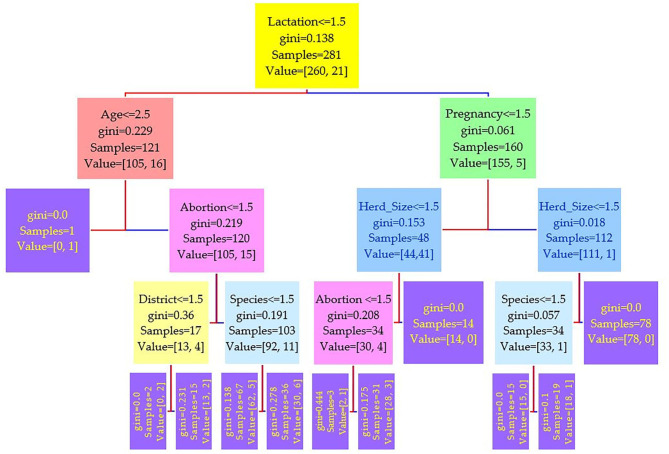
Bovine brucellosis is a global zoonosis of public health importance. It is an endemic disease in many developing countries including Pakistan. This study aimed to estimate the seroprevalence and molecular detection of bovine brucellosis and to assess the association of potential risk factors with test results. A total of 176 milk and 402 serum samples were collected from cattle and buffaloes in three districts of upper Punjab, Pakistan. Milk samples were investigated using milk ring test (MRT), while sera were tested by Rose-Bengal plate agglutination test (RBPT) and indirect enzyme-linked immunosorbent assay (i-ELISA). Real-time PCR was used for detection of DNA in investigated samples. Anti- antibodies were detected in 37 (21.02%) bovine milk samples using MRT and in 66 (16.4%) and 71 (17.7%) bovine sera using RBPT and i-ELISA, respectively. Real-time PCR detected DNA in 31 (7.71%) from a total of 402 bovine sera and identified as . Seroprevalence and molecular identification of bovine brucellosis varied in some regions in Pakistan. With the use of machine learning, the association of test results with risk factors including age, animal species/type, herd size, history of abortion, pregnancy status, lactation status, and geographical location was analyzed. Machine learning confirmed a real observation that lactation status was found to be the highest significant factor, while abortion, age, and pregnancy came second in terms of significance. To the authors' best knowledge, this is the first time to use machine learning to assess brucellosis in Pakistan; this is a model that can be applied for other developing countries in the future. The development of control strategies for bovine brucellosis through the implementation of uninterrupted surveillance and interactive extension programs in Pakistan is highly recommended.
牛布鲁氏菌病是一种具有重要公共卫生意义的全球性人畜共患病。在包括巴基斯坦在内的许多发展中国家,它都是一种地方病。本研究旨在估计牛布鲁氏菌病的血清流行率并进行分子检测,评估潜在风险因素与检测结果之间的关联。从巴基斯坦旁遮普省上游三个地区的牛和水牛中总共采集了176份牛奶样本和402份血清样本。牛奶样本采用牛奶环状试验(MRT)进行检测,血清则通过玫瑰孟加拉平板凝集试验(RBPT)和间接酶联免疫吸附测定(i - ELISA)进行检测。实时荧光定量聚合酶链反应(Real - time PCR)用于检测所调查样本中的DNA。使用MRT在37份(21.02%)牛牛奶样本中检测到抗抗体,使用RBPT和i - ELISA分别在66份(16.4%)和71份(17.7%)牛血清中检测到抗抗体。实时荧光定量聚合酶链反应从总共402份牛血清中检测到31份(7.71%)的DNA,并鉴定为……巴基斯坦部分地区牛布鲁氏菌病的血清流行率和分子鉴定情况有所不同。通过机器学习,分析了检测结果与年龄、动物种类/类型、畜群规模、流产史、妊娠状态、泌乳状态和地理位置等风险因素之间的关联。机器学习证实了一个实际观察结果,即泌乳状态被发现是最显著的因素,而流产、年龄和妊娠在显著性方面位列其次。据作者所知,这是首次在巴基斯坦使用机器学习来评估布鲁氏菌病;这是一个未来可应用于其他发展中国家的模型。强烈建议通过在巴基斯坦实施不间断监测和互动推广项目来制定牛布鲁氏菌病的控制策略。