Department of Medicine, Atlantis Medical University College, 0560 Oslo, Norway.
Institute of Physical Performance, Norwegian School of Sport Sciences, 0863 Oslo, Norway.
Nutrients. 2020 Dec 30;13(1):110. doi: 10.3390/nu13010110.
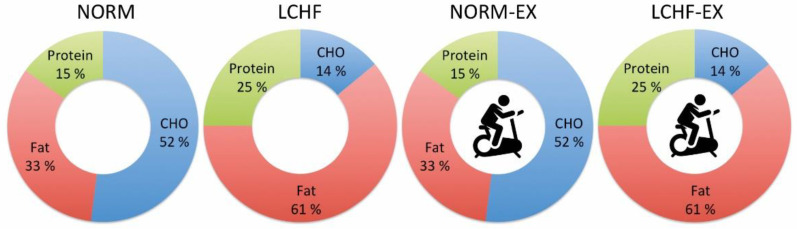
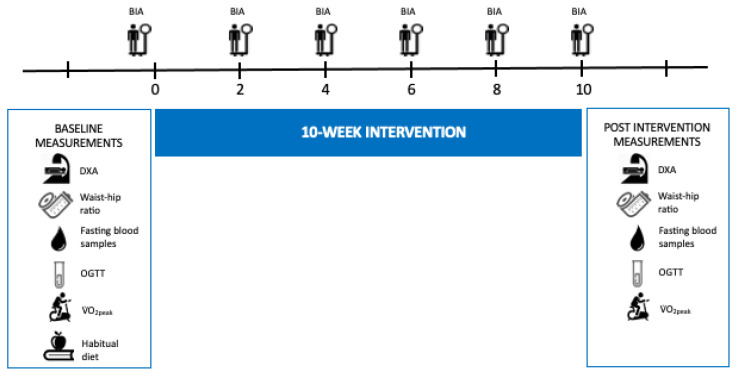
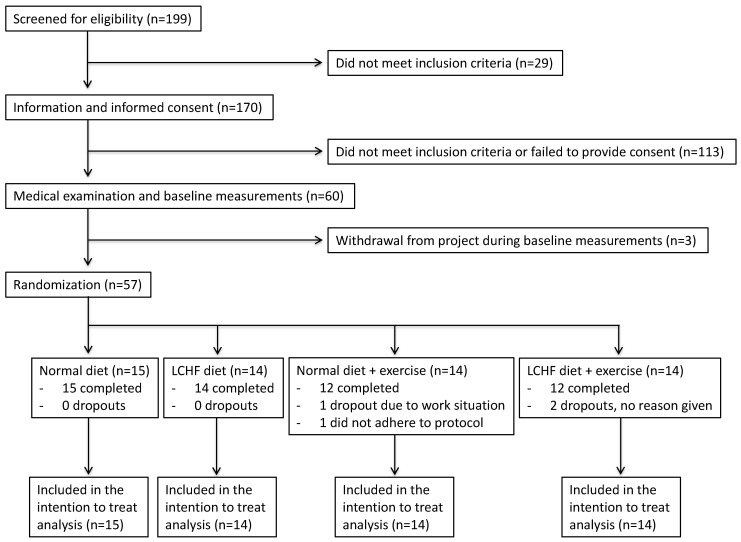
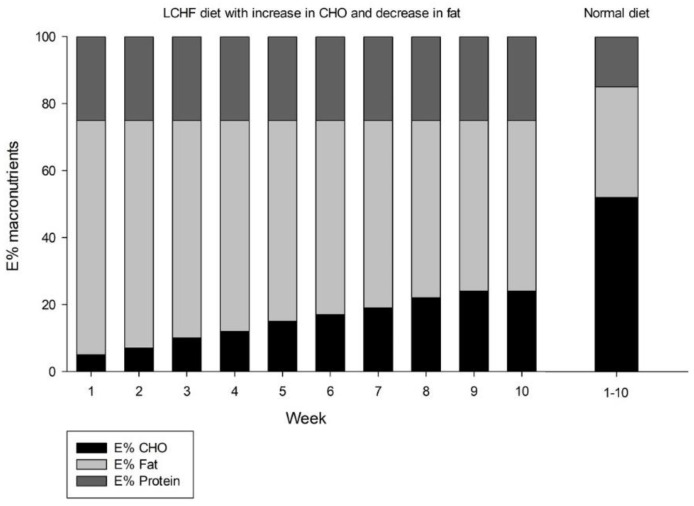
We assessed the effect of weight-loss induced with a low-carbohydrate-high-fat diet with and without exercise, on body-composition, cardiorespiratory fitness and cardiovascular risk factors. A total of 57 overweight and obese women (age 40 ± 3.5 years, body mass index 31.1 ± 2.6 kg∙m) completed a 10-week intervention using a low-carbohydrate-high-fat diet, with or without interval exercise. An equal deficit of 700 kcal∙day was prescribed, restricting diet only, or moderately restricting diet and adding exercise, producing four groups; normal diet (NORM); low-carbohydrate-high-fat diet (LCHF); normal diet and exercise (NORM-EX); and low-carbohydrate-high-fat diet and exercise (LCHF-EX). Linear Mixed Models were used to assess between-group differences. The intervention resulted in an average 6.7 ± 2.5% weight-loss ( < 0.001). Post-intervention % fat was lower in NORM-EX than NORM (40.0 ± 4.2 vs. 43.5 ± 3.5%, = 0.024). NORM-EX reached lower values in total cholesterol than NORM (3.9 ± 0.6 vs. 4.7 ± 0.7 mmol/L, = 0.003), and LCHF-EX (3.9 ± 0.6 vs. 4.9 ± 1.1 mmol/L, = 0.004). Post intervention triglycerides levels were lower in NORM-EX than NORM (0.87 ± 0.21 vs. 1.11 ± 0.34 mmol/L, = 0.030). The low-carbohydrate-high-fat diet had no superior effect on body composition, V˙O or cardiovascular risk factors compared to a normal diet, with or without exercise. In conclusion, the intervention decreased fat mass, but exercise improved body composition and caused the most favorable changes in total cholesterol and triglycerides in the NORM-EX. Exercise increased cardiorespiratory fitness, regardless of diet.
我们评估了低碳水化合物高脂肪饮食结合或不结合运动诱导的体重减轻对身体成分、心肺功能和心血管危险因素的影响。共有 57 名超重和肥胖女性(年龄 40 ± 3.5 岁,体重指数 31.1 ± 2.6kg·m)完成了一项为期 10 周的干预,采用低碳水化合物高脂肪饮食,结合或不结合间歇运动。规定了相同的 700 卡路里热量的热量缺口,仅限制饮食,或适度限制饮食并增加运动,产生了四个组;正常饮食(NORM);低碳水化合物高脂肪饮食(LCHF);正常饮食和运动(NORM-EX);以及低碳水化合物高脂肪饮食和运动(LCHF-EX)。线性混合模型用于评估组间差异。干预导致平均 6.7 ± 2.5%的体重减轻(< 0.001)。与 NORM 相比,NORM-EX 的脂肪百分比较低(40.0 ± 4.2% vs. 43.5 ± 3.5%,= 0.024)。NORM-EX 的总胆固醇值低于 NORM(3.9 ± 0.6 比 4.7 ± 0.7mmol/L,= 0.003),也低于 LCHF-EX(3.9 ± 0.6 比 4.9 ± 1.1mmol/L,= 0.004)。与 NORM 相比,NORM-EX 的甘油三酯水平在干预后较低(0.87 ± 0.21 比 1.11 ± 0.34mmol/L,= 0.030)。与正常饮食相比,低碳水化合物高脂肪饮食无论是否结合运动,对身体成分、V˙O 或心血管危险因素均无优势。总之,干预降低了脂肪量,但运动改善了身体成分,并使 NORM-EX 中的总胆固醇和甘油三酯发生了最有利的变化。运动增加了心肺功能,无论饮食如何。