Janzi Suzanne, Ramne Stina, González-Padilla Esther, Johnson Linda, Sonestedt Emily
Nutritional Epidemiology, Department of Clinical Sciences Malmö, Lund University, Lund, Sweden.
Cardiovascular Research, Department of Clinical Sciences Malmö, Lund University, Lund, Sweden.
Front Nutr. 2020 Dec 23;7:603653. doi: 10.3389/fnut.2020.603653. eCollection 2020.
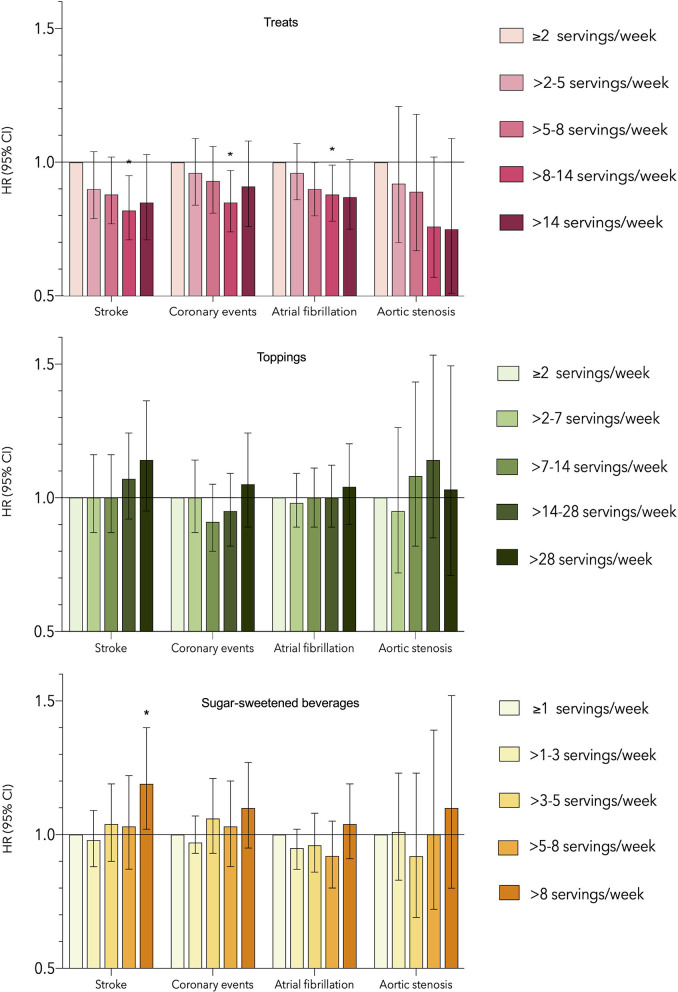
Although diet is one of the main modifiable risk factors of cardiovascular disease, few studies have investigated the association between added sugar intake and cardiovascular disease risk. This study aims to investigate the associations between intake of total added sugar, different sugar-sweetened foods and beverages, and the risks of stroke, coronary events, atrial fibrillation and aortic stenosis. The study population consists of 25,877 individuals from the Malmö Diet and Cancer Study, a Swedish population-based prospective cohort. Dietary data were collected using a modified diet history method. National registers were used for outcome ascertainment. During the mean follow-up of 19.5 years, there were 2,580 stroke cases, 2,840 coronary events, 4,241 atrial fibrillation cases, and 669 aortic stenosis cases. Added sugar intakes above 20 energy percentage were associated with increased risk of coronary events compared to the lowest intake category (HR: 1.39; 95% CI: 1.09-1.78), and increased stroke risk compared to intakes between 7.5 and 10 energy percentage (HR: 1.31; 95% CI: 1.03 and 1.66). Subjects in the lowest intake group for added sugar had the highest risk of atrial fibrillation and aortic stenosis. More than 8 servings/week of sugar-sweetened beverages were associated with increased stroke risk, while ≤2 servings/week of treats were associated with the highest risks of stroke, coronary events and atrial fibrillation. The results indicate that the associations between different added sugar sources and cardiovascular diseases vary. These findings emphasize the complexity of the studied associations and the importance of considering different added sugar sources when investigating health outcomes.
尽管饮食是心血管疾病主要的可改变风险因素之一,但很少有研究调查添加糖摄入量与心血管疾病风险之间的关联。本研究旨在调查总添加糖摄入量、不同含糖食品和饮料与中风、冠心病事件、心房颤动和主动脉狭窄风险之间的关联。研究人群包括来自瑞典基于人群的前瞻性队列“马尔默饮食与癌症研究”的25877名个体。使用改良的饮食史方法收集饮食数据。利用国家登记处确定研究结果。在平均19.5年的随访期间,有2580例中风病例、2840例冠心病事件、4241例心房颤动病例和669例主动脉狭窄病例。与最低摄入量类别相比,能量百分比超过20%的添加糖摄入量与冠心病事件风险增加相关(风险比:1.39;95%置信区间:1.09 - 1.78),与7.5%至10%能量百分比的摄入量相比,中风风险增加(风险比:1.31;95%置信区间:1.03至1.66)。添加糖摄入量最低组的受试者患心房颤动和主动脉狭窄的风险最高。每周饮用超过8份含糖饮料与中风风险增加相关,而每周食用≤2份甜食与中风、冠心病事件和心房颤动的最高风险相关。结果表明,不同添加糖来源与心血管疾病之间的关联各不相同。这些发现强调了所研究关联的复杂性以及在调查健康结果时考虑不同添加糖来源的重要性。