PARCC, INSERM, Radiology Department, AP-HP, Hopital europeen Georges Pompidou, Université de Paris, F-75015, Paris, France.
European Imaging Biomarkers Alliance (EIBALL), European Society of Radiology, Vienna, Austria.
Eur Radiol. 2021 Aug;31(8):6001-6012. doi: 10.1007/s00330-020-07598-8. Epub 2021 Jan 25.
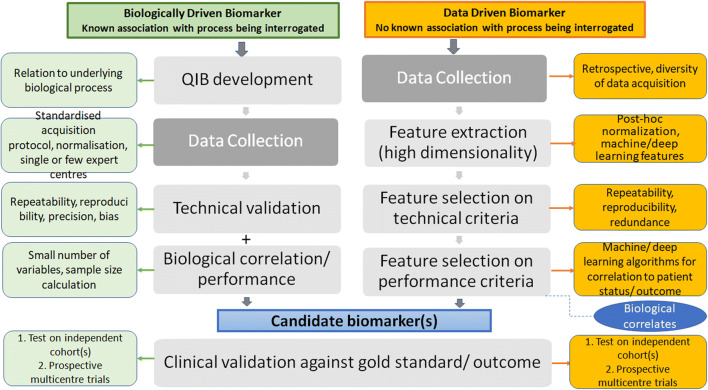
Existing quantitative imaging biomarkers (QIBs) are associated with known biological tissue characteristics and follow a well-understood path of technical, biological and clinical validation before incorporation into clinical trials. In radiomics, novel data-driven processes extract numerous visually imperceptible statistical features from the imaging data with no a priori assumptions on their correlation with biological processes. The selection of relevant features (radiomic signature) and incorporation into clinical trials therefore requires additional considerations to ensure meaningful imaging endpoints. Also, the number of radiomic features tested means that power calculations would result in sample sizes impossible to achieve within clinical trials. This article examines how the process of standardising and validating data-driven imaging biomarkers differs from those based on biological associations. Radiomic signatures are best developed initially on datasets that represent diversity of acquisition protocols as well as diversity of disease and of normal findings, rather than within clinical trials with standardised and optimised protocols as this would risk the selection of radiomic features being linked to the imaging process rather than the pathology. Normalisation through discretisation and feature harmonisation are essential pre-processing steps. Biological correlation may be performed after the technical and clinical validity of a radiomic signature is established, but is not mandatory. Feature selection may be part of discovery within a radiomics-specific trial or represent exploratory endpoints within an established trial; a previously validated radiomic signature may even be used as a primary/secondary endpoint, particularly if associations are demonstrated with specific biological processes and pathways being targeted within clinical trials. KEY POINTS: • Data-driven processes like radiomics risk false discoveries due to high-dimensionality of the dataset compared to sample size, making adequate diversity of the data, cross-validation and external validation essential to mitigate the risks of spurious associations and overfitting. • Use of radiomic signatures within clinical trials requires multistep standardisation of image acquisition, image analysis and data mining processes. • Biological correlation may be established after clinical validation but is not mandatory.
现有的定量成像生物标志物(QIBs)与已知的生物组织特征相关,并且在将其纳入临床试验之前,经过了技术、生物学和临床验证的良好验证。在放射组学中,新的数据驱动过程从成像数据中提取了许多肉眼无法察觉的统计特征,而无需对其与生物学过程的相关性做出任何先验假设。因此,选择相关特征(放射组学特征)并将其纳入临床试验需要额外的考虑因素,以确保有意义的成像终点。此外,测试的放射组学特征数量意味着,如果根据生物学关联进行测试,那么计算出的样本量将无法在临床试验中实现。本文研究了标准化和验证数据驱动的成像生物标志物的过程如何与基于生物学关联的过程不同。放射组学特征最初最好在代表不同采集协议、不同疾病和正常发现多样性的数据集上进行开发,而不是在具有标准化和优化协议的临床试验中进行,因为这可能会导致选择与成像过程而不是病理学相关的放射组学特征。离散化和特征协调是必不可少的预处理步骤。在确定放射组学特征的技术和临床有效性之后,可以进行生物学相关性分析,但并非必需。特征选择可以是特定于放射组学的试验中的发现部分,也可以是既定试验中的探索性终点;甚至可以将先前验证过的放射组学特征用作主要/次要终点,特别是如果与临床试验中靶向的特定生物学过程和途径相关联的关联得到证明。要点:
与样本量相比,数据驱动过程(如放射组学)由于数据集的高维性而存在假阳性发现的风险,因此数据的充分多样性、交叉验证和外部验证对于减轻虚假关联和过拟合的风险至关重要。
在临床试验中使用放射组学特征需要对图像采集、图像分析和数据挖掘过程进行多步骤标准化。
生物学相关性可以在临床验证后建立,但不是必需的。