Chen Chuming, Wang Haihui, Liang Zhichao, Peng Ling, Zhao Fang, Yang Liuqing, Cao Mengli, Wu Weibo, Jiang Xiao, Zhang Peiyan, Li Yinfeng, Chen Li, Feng Shiyan, Li Jianming, Meng Lingxiang, Wu Huishan, Wang Fuxiang, Liu Quanying, Liu Yingxia
Department of Infectious Diseases, Shenzhen Key Laboratory of Pathogen and Immunity, State Key Discipline of Infectious Disease, The Third People's Hospital of Shenzhen, Second Hospital Affiliated to Southern University of Science and Technology, Shenzhen, Guangdong 518000, China.
Department of Biomedical Engineering, Southern University of Science and Technology, Shenzhen, Guangdong 518000, China.
Innovation (Camb). 2020 May 21;1(1):100007. doi: 10.1016/j.xinn.2020.04.007. Epub 2020 May 20.
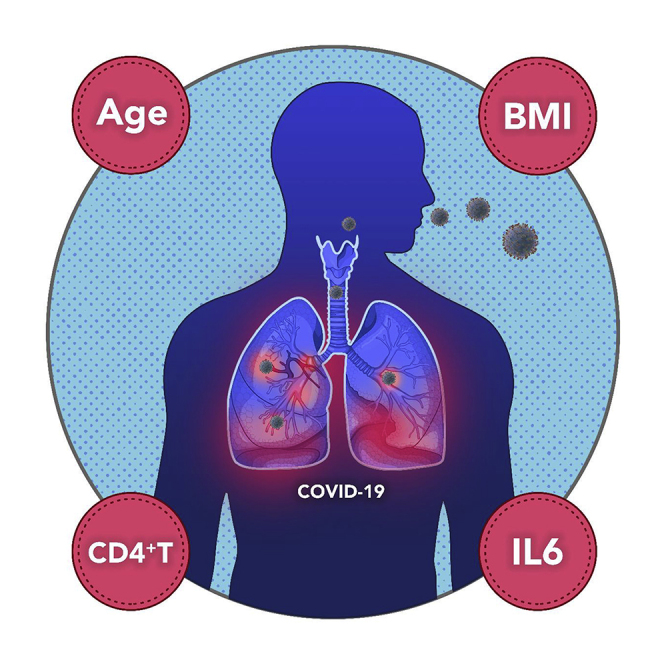
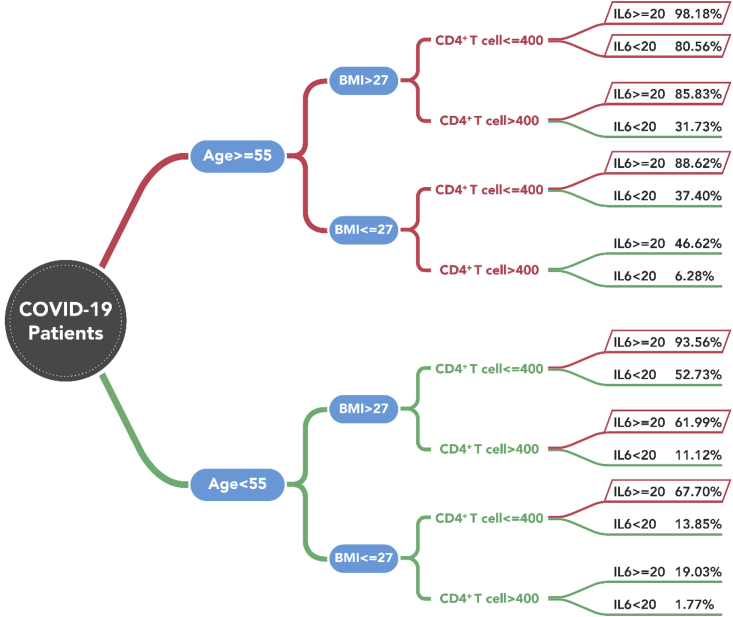
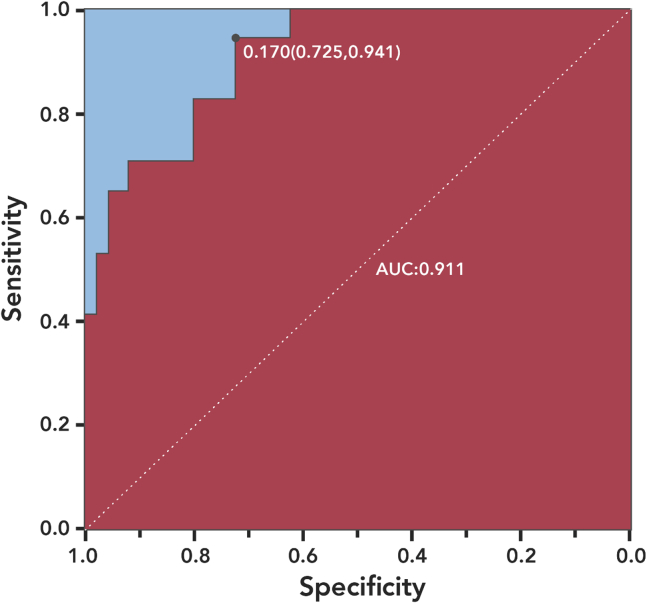
Among 417 COVID-19 patients in Shenzhen, demographic characteristics, clinical manifestations and baseline laboratory tests showed significant differences between mild-moderate cohort and severe-critical cohort.Based on these differences, a convenient mathematical model was established to predict the illness severity of COVID-19. The model includes four parameters: age, BMI, CD4 lymphocytes and IL-6 levels. The AUC of the model is 0.911.The high risk factors for developing to severe COVID-19 are: age ≥ 55 years, BMI > 27 kg / m, IL-6 ≥ 20 pg / ml, CD4 T cell ≤ 400 count / μ L.Among 249 discharged COVID-19 patients, those who recovered after 20 days had a lower count of platelet, a higher level of estimated glomerular filtration rate, and higher level of interleukin-6 and myoglobin than those who recovered within 20 days.
在深圳的417例新冠肺炎患者中,轻 - 中度组和重度 - 危重组在人口统计学特征、临床表现和基线实验室检查方面存在显著差异。基于这些差异,建立了一个便捷的数学模型来预测新冠肺炎的疾病严重程度。该模型包括四个参数:年龄、体重指数(BMI)、CD4淋巴细胞和白细胞介素 - 6(IL - 6)水平。该模型的曲线下面积(AUC)为0.911。发展为重症新冠肺炎的高危因素为:年龄≥55岁、BMI>27kg/m²、IL - 6≥20pg/ml、CD4 T细胞≤400个/μL。在249例出院的新冠肺炎患者中,20天后康复的患者血小板计数较低,估算肾小球滤过率水平较高,白细胞介素 - 6和肌红蛋白水平高于20天内康复的患者。