Division of Environmental Medicine and Population Sciences, Department of Social and Environmental Medicine, Graduate School of Medicine, Osaka University, 2-2 Yamadaoka, Suita 565-0871, Japan.
Department of Food and Life Science, School of Life and Environmental Science, Azabu University, 1-17-71 Fuchinobe, Chuo-ku, Sagamihara, Kanagawa 252-5201, Japan.
Nutrients. 2021 Feb 27;13(3):780. doi: 10.3390/nu13030780.
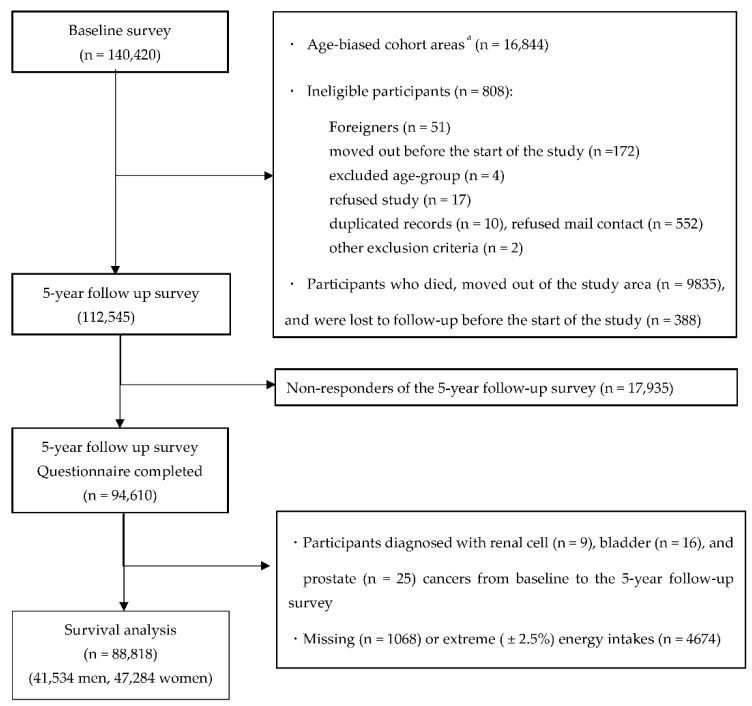
Acrylamide can be carcinogenic to humans. However, the association between the acrylamide and the risks of renal cell, prostate, and bladder cancers in Asians has not been assessed. We aimed to investigate this association in the Japan Public Health Center-based Prospective Study data in 88,818 Japanese people (41,534 men and 47,284 women) who completed a food frequency questionnaire in the five-year follow-up survey in 1995 and 1998. A validated food frequency questionnaire was used to assess the dietary acrylamide intake. Cox proportional hazard regression models were used to estimate hazard ratios and 95% confidence intervals (CIs). During a mean follow-up of 15.5 years (15.2 years of prostate cancer), 208 renal cell cancers, 1195 prostate cancers, and 392 bladder cancers were diagnosed. Compared to the lowest quintile of acrylamide intake, the multivariate hazard ratios for the highest quintile were 0.71 (95% CI: 0.38-1.34, for trend = 0.294), 0.96 (95% CI: 0.75-1.22, for trend = 0.726), and 0.87 (95% CI: 0.59-1.29, for trend = 0.491) for renal cell, prostate, and bladder cancers, respectively, in the multivariate-adjusted model. No significant associations were observed in the stratified analyses based on smoking. Dietary acrylamide intake was not associated with the risk of renal cell, prostate, and bladder cancers.
丙烯酰胺可能对人类致癌。然而,尚未评估亚洲人群丙烯酰胺与肾细胞癌、前列腺癌和膀胱癌风险之间的关系。我们旨在使用日本公共卫生中心前瞻性研究的数据进行研究,该研究纳入了 88818 名日本人(男性 41534 人,女性 47284 人),他们在 1995 年和 1998 年的五年随访调查中完成了食物频率问卷。使用验证后的食物频率问卷评估膳食丙烯酰胺摄入量。使用 Cox 比例风险回归模型来估计风险比和 95%置信区间(CI)。在平均 15.5 年(前列腺癌为 15.2 年)的随访期间,诊断出 208 例肾细胞癌、1195 例前列腺癌和 392 例膀胱癌。与丙烯酰胺摄入量最低五分位数相比,最高五分位数的多变量风险比分别为 0.71(95%CI:0.38-1.34,趋势=0.294)、0.96(95%CI:0.75-1.22,趋势=0.726)和 0.87(95%CI:0.59-1.29,趋势=0.491),用于肾细胞癌、前列腺癌和膀胱癌,在多变量调整模型中。在基于吸烟的分层分析中未观察到显著关联。膳食丙烯酰胺摄入量与肾细胞癌、前列腺癌和膀胱癌的风险无关。