Kim Min-Jung, Liu Yi, Oh Song Hee, Ahn Hyo-Won, Kim Seong-Hun, Nelson Gerald
Department of Orthodontics, Graduate School, Kyung Hee University, Seoul, Korea.
Department of Orthodontics, Peking University School of Stomatology, Beijing, China.
Korean J Orthod. 2021 Mar 25;51(2):77-85. doi: 10.4041/kjod.2021.51.2.77.
To evaluate the accuracy of a multi-stage convolutional neural network (CNN) model-based automated identification system for posteroanterior (PA) cephalometric landmarks.
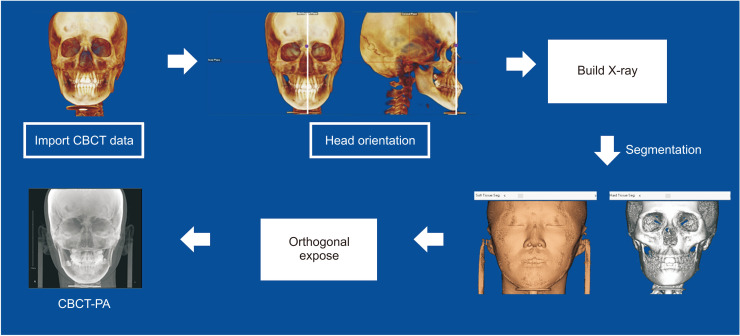
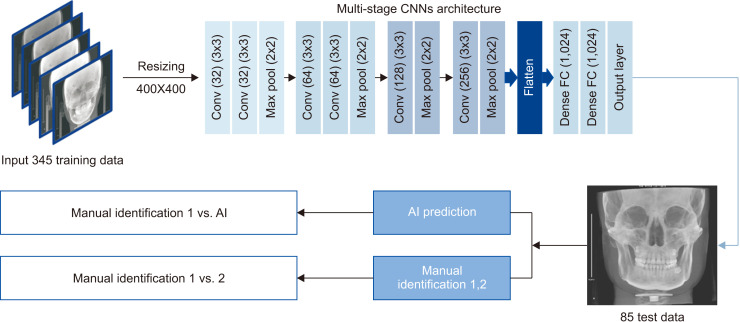
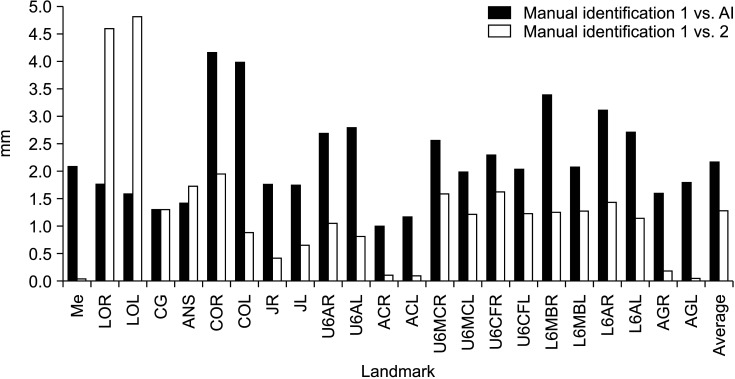
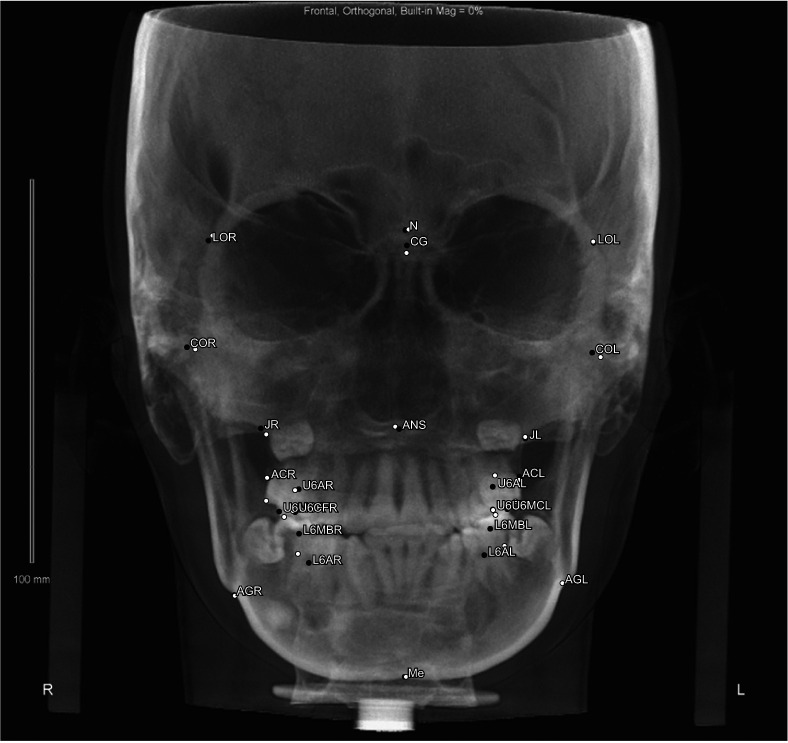
The multi-stage CNN model was implemented with a personal computer. A total of 430 PA-cephalograms synthesized from cone-beam computed tomography scans (CBCT-PA) were selected as samples. Twenty-three landmarks used for Tweemac analysis were manually identified on all CBCT-PA images by a single examiner. Intra-examiner reproducibility was confirmed by repeating the identification on 85 randomly selected images, which were subsequently set as test data, with a two-week interval before training. For initial learning stage of the multi-stage CNN model, the data from 345 of 430 CBCT-PA images were used, after which the multi-stage CNN model was tested with previous 85 images. The first manual identification on these 85 images was set as a truth ground. The mean radial error (MRE) and successful detection rate (SDR) were calculated to evaluate the errors in manual identification and artificial intelligence (AI) prediction.
The AI showed an average MRE of 2.23 ± 2.02 mm with an SDR of 60.88% for errors of 2 mm or lower. However, in a comparison of the repetitive task, the AI predicted landmarks at the same position, while the MRE for the repeated manual identification was 1.31 ± 0.94 mm.
Automated identification for CBCT-synthesized PA cephalometric landmarks did not sufficiently achieve the clinically favorable error range of less than 2 mm. However, AI landmark identification on PA cephalograms showed better consistency than manual identification.
评估基于多阶段卷积神经网络(CNN)模型的前后位(PA)头影测量标志点自动识别系统的准确性。
使用个人计算机实现多阶段CNN模型。从锥形束计算机断层扫描(CBCT-PA)合成的430张PA头颅侧位片被选为样本。由一名检查者在所有CBCT-PA图像上手动识别用于Tweemac分析的23个标志点。通过在85张随机选择的图像上重复识别来确认检查者内的可重复性,这些图像随后被设置为测试数据,在训练前间隔两周。在多阶段CNN模型的初始学习阶段,使用了430张CBCT-PA图像中的345张数据,之后用之前的85张图像对多阶段CNN模型进行测试。将这85张图像上的首次手动识别设置为真值标准。计算平均径向误差(MRE)和成功检测率(SDR)以评估手动识别和人工智能(AI)预测中的误差。
对于2mm或更低的误差,AI显示平均MRE为2.23±2.02mm,SDR为60.88%。然而,在重复任务的比较中,AI预测的标志点在相同位置,而重复手动识别的MRE为1.31±0.94mm。
CBCT合成的PA头影测量标志点的自动识别未能充分达到临床上小于2mm的有利误差范围。然而,PA头颅侧位片上的AI标志点识别显示出比手动识别更好的一致性。