Ouslimane Touria, Et-Taya Lhoussayne, Elmaimouni Lahoucine, Benami Abdellah
LM3ER-OTEA, Department of Physics, Faculty of Sciences and Techniques, Moulay Ismail University of Meknes, BP 509 Boutalamine 52000, Errachidia, Morocco.
ERMAM, Faculté Polydisciplinaire d'Ouarzazate, Université Ibn Zohr, 45000 Ouarzazate, Morocco.
Heliyon. 2021 Mar 1;7(3):e06379. doi: 10.1016/j.heliyon.2021.e06379. eCollection 2021 Mar.
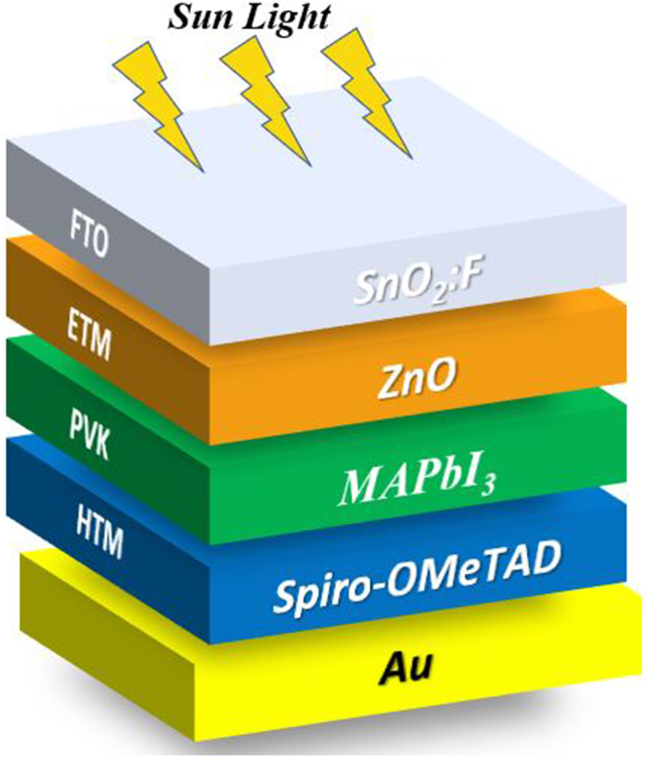
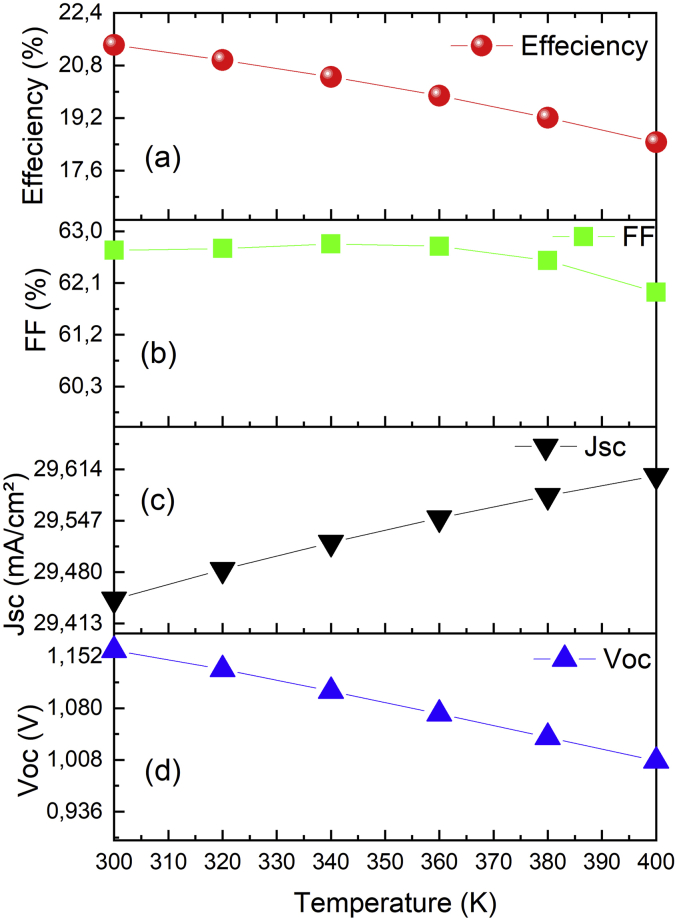
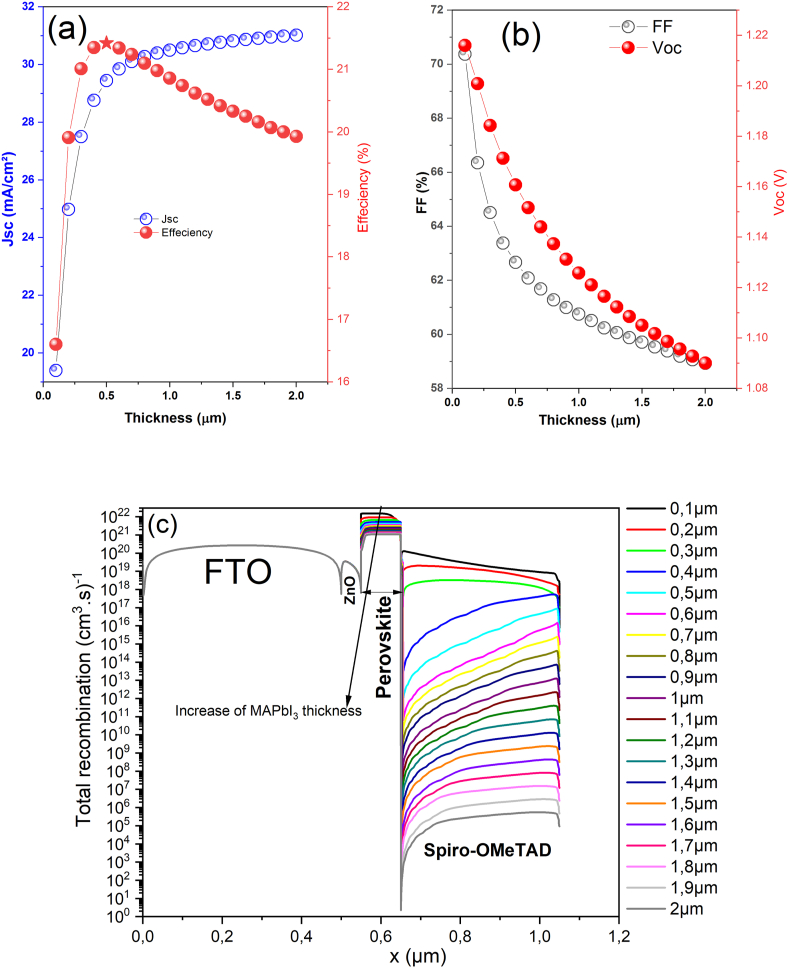
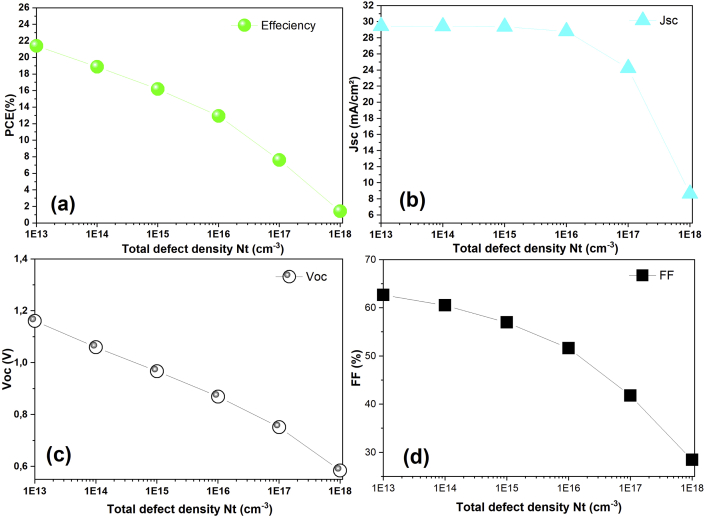
Hybrid organic-inorganic perovskite solar cells (PSCs) are the novel fourth-generation solar cells, with impressive progress in the last few years. MAPbI is a cost-effective material used as an absorber layer in PSCs. Due to the different diffusion length of carriers, the electron transporting material (ETM) plays a vital role in PSCs' performance. ZnO ETM is a promising candidate for low-cost and high-efficiency photovoltaic technology. In this work, the normal n-i-p planar heterojunction structure has been simulated using SCAPS-1D. The influence of various parameters such as the defect density, the thickness of the MAPbI layer, the temperature on fill factor, the open-circuit voltage, the short circuit current density, and the power conversion efficiency are investigated and discussed in detail. We found that a 21.42% efficiency can be obtained under a thickness of around 0.5 μm, and a total defect of 10 cm at ambient temperature. These simulation results will help fabricate low-cost, high-efficiency, and low-temperature PSCs.
有机-无机杂化钙钛矿太阳能电池(PSCs)是新型的第四代太阳能电池,在过去几年中取得了令人瞩目的进展。MAPbI是一种用作PSCs吸收层的具有成本效益的材料。由于载流子的扩散长度不同,电子传输材料(ETM)在PSCs的性能中起着至关重要的作用。ZnO ETM是低成本、高效率光伏技术的一个有前途的候选材料。在这项工作中,使用SCAPS-1D对常规的n-i-p平面异质结结构进行了模拟。详细研究和讨论了各种参数,如缺陷密度、MAPbI层厚度、温度对填充因子、开路电压、短路电流密度和功率转换效率的影响。我们发现,在室温下,当厚度约为0.5μm且总缺陷为10cm时,可以获得21.42%的效率。这些模拟结果将有助于制造低成本、高效率和低温的PSCs。