Cardenas Jorge A, Lu Shiheng, Williams Nicholas X, Doherty James L, Franklin Aaron D
Department of Electrical & Computer Engineering, Duke University, Durham, NC 27708 USA.
IEEE Electron Device Lett. 2021 Mar;42(3):367-370. doi: 10.1109/led.2021.3055787. Epub 2021 Feb 1.
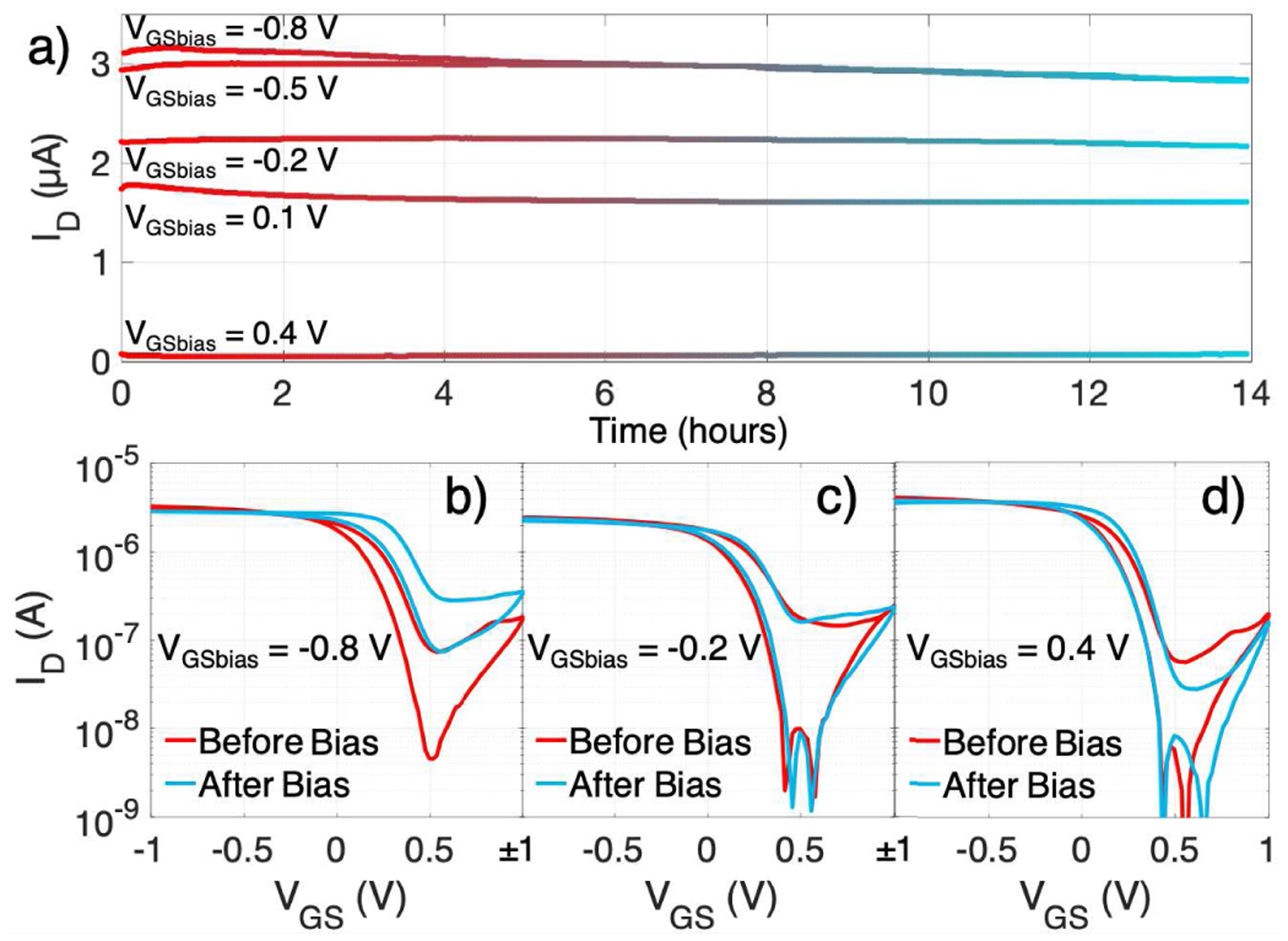
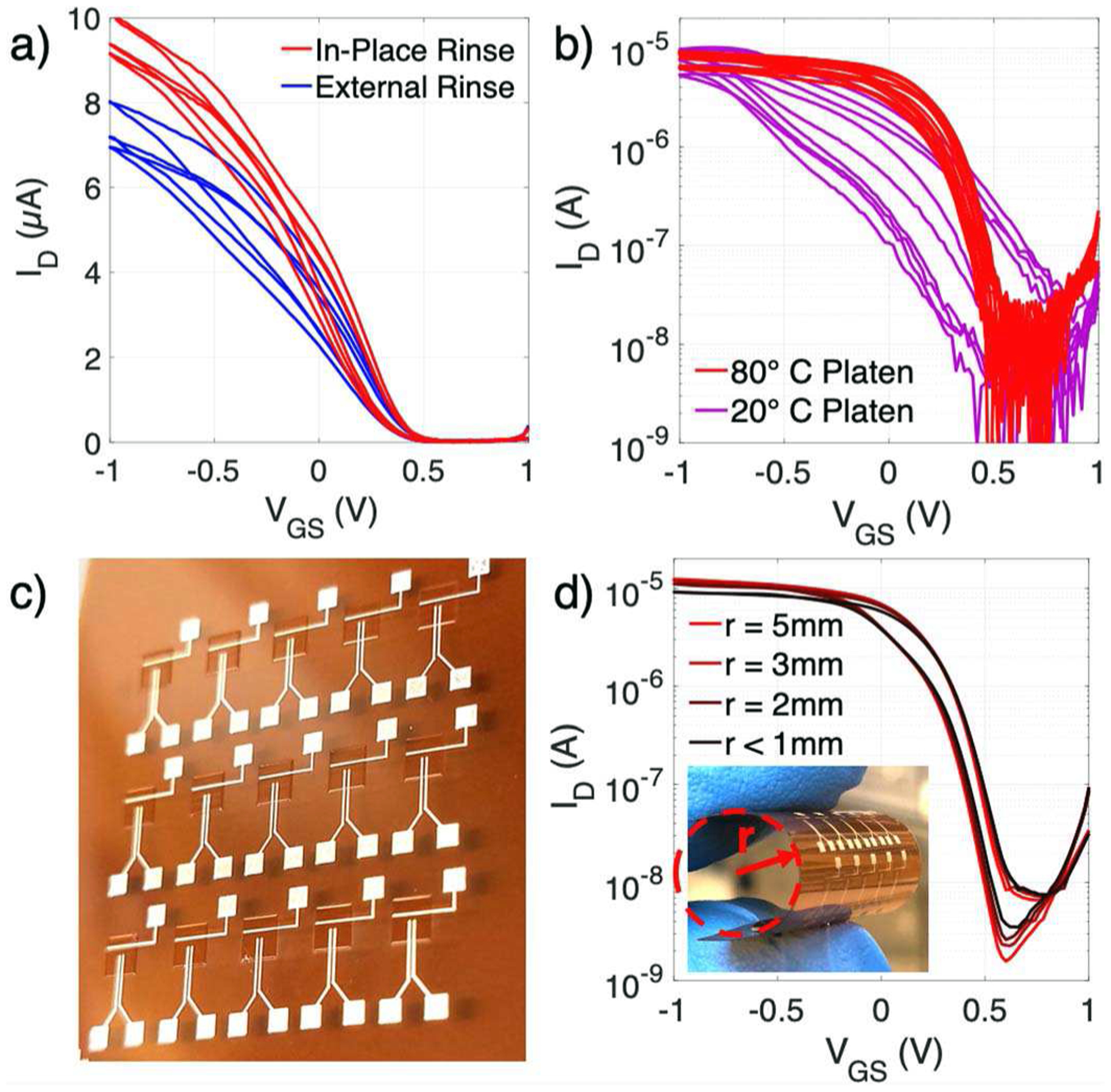
Ion gel-based dielectrics have long been considered for enabling low-voltage operation in printed thin-film transistors (TFTs), but their compatibility with in-place printing (a streamlined, direct-write printing approach where devices never leave the printer mid- or post-process) remains unexplored. Here, we demonstrate a simple and rapid 4-step in-place printing procedure for producing low-voltage electrolyte-gated carbon nanotube (CNT) thin-film transistors at low temperature (80 °C). This process consists of the use of polymer-wrapped CNT inks for printed channels, silver nanowire inks for printed electrodes, and imidazolium-based ion gel inks for printed gate dielectrics. We find that the efficacy of rinsing CNT films and printing an ion gel in-place is optimized using an elevated platen temperature (as opposed to external rinsing or post-process annealing), where resultant devices exhibited on/off-current ratios exceeding 10, mobilities exceeding 10 cmVs, and gate hysteresis of only 0.1 V. Additionally, devices were tested under mechanical strain and long-term bias, showing exceptional flexibility and electrochemical stability over the course of 14-hour bias tests. The findings presented here widen the potential scope of print-in-place (PIP) devices and reveal new avenues of investigation for the improvement of bias stress stability in electrolyte-gated transistors.
基于离子凝胶的电介质长期以来一直被认为可实现印刷薄膜晶体管(TFT)的低电压操作,但其与原位印刷(一种简化的直接写入印刷方法,器件在整个过程中无需离开打印机)的兼容性仍未得到探索。在此,我们展示了一种简单快速的四步原位印刷工艺,用于在低温(80°C)下制造低电压电解质门控碳纳米管(CNT)薄膜晶体管。该工艺包括使用聚合物包裹的CNT墨水印刷沟道、银纳米线墨水印刷电极以及基于咪唑鎓的离子凝胶墨水印刷栅极电介质。我们发现,通过提高压板温度(与外部冲洗或后处理退火相反)来优化冲洗CNT薄膜和原位印刷离子凝胶的效果,由此得到的器件的开/关电流比超过10,迁移率超过10 cm²V⁻¹s⁻¹,栅极滞后仅为0.1 V。此外,对器件进行了机械应变和长期偏置测试,在14小时的偏置测试过程中显示出卓越的柔韧性和电化学稳定性。本文的研究结果拓宽了原位印刷(PIP)器件的潜在范围,并揭示了改善电解质门控晶体管偏置应力稳定性的新研究途径。