Hoffer John, Rashid Rumana, Muhlich Jeremy L, Chen Yu-An, Russell Douglas Peter William, Ruokonen Juha, Krueger Robert, Pfister Hanspeter, Santagata Sandro, Sorger Peter K
Laboratory of Systems Pharmacology, Harvard Medical School, Boston, MA.
Ludwig Center for Cancer Research at Harvard, Harvard Medical School, Boston, MA.
J Open Source Softw. 2020;5(54). doi: 10.21105/joss.02579. Epub 2020 Oct 15.
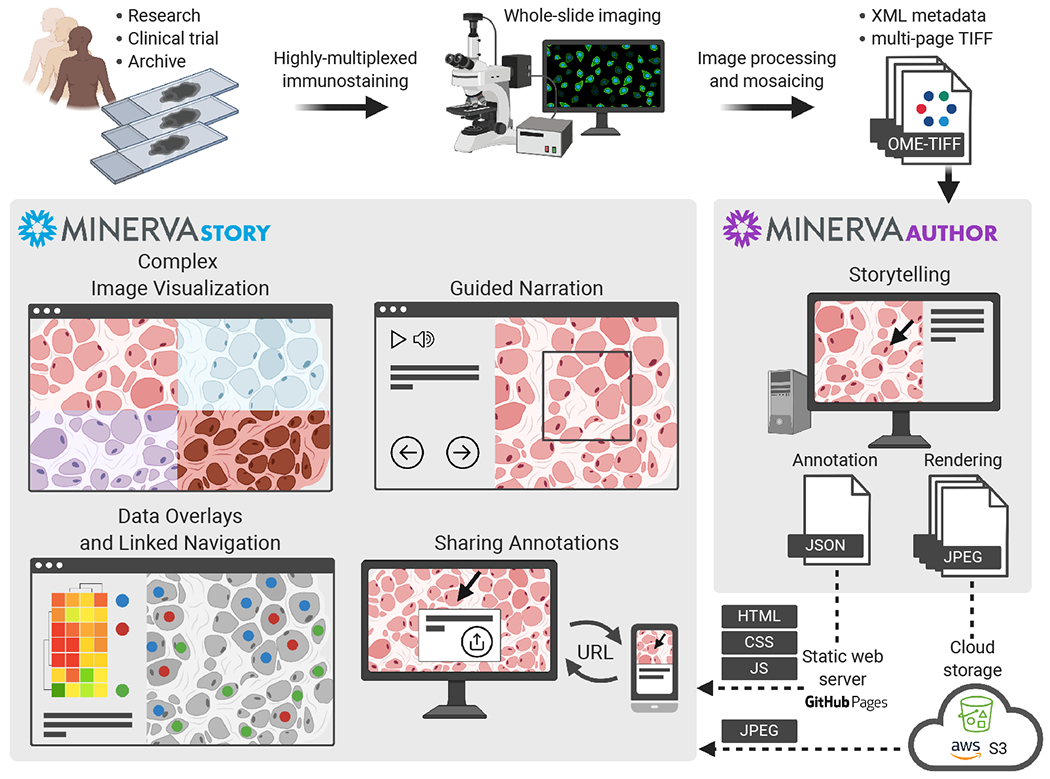
Advances in highly multiplexed tissue imaging are transforming our understanding of human biology by enabling detection and localization of 10-100 proteins at subcellular resolution (Bodenmiller, 2016). Efforts are now underway to create public atlases of multiplexed images of normal and diseased tissues (Rozenblatt-Rosen et al., 2020). Both research and clinical applications of tissue imaging benefit from recording data from complete specimens so that data on cell state and composition can be studied in the context of overall tissue architecture. As a practical matter, specimen size is limited by the dimensions of microscopy slides (2.5 × 7.5 cm or ~2-8 cm of tissue depending on shape). With current microscopy technology, specimens of this size can be imaged at sub-micron resolution across ~60 spectral channels and ~10 cells, resulting in image files of terabyte size. However, the rich detail and multiscale properties of these images pose a substantial computational challenge (Rashid et al., 2020). See Rashid et al. (2020) for an comparison of existing visualization tools targeting these multiplexed tissue images.
高度多重组织成像技术的进步正在改变我们对人类生物学的理解,它能够在亚细胞分辨率下检测和定位10至100种蛋白质(博登米勒,2016年)。目前正在努力创建正常和患病组织的多重图像公共图谱(罗森布拉特-罗森等人,2020年)。组织成像的研究和临床应用都受益于记录完整标本的数据,以便能够在整体组织结构的背景下研究细胞状态和组成的数据。实际上,标本大小受到显微镜载玻片尺寸的限制(2.5×7.5厘米,或根据形状约为2至8厘米的组织)。使用当前的显微镜技术,这种大小的标本可以在约60个光谱通道和约10个细胞上以亚微米分辨率成像,从而产生数TB大小的图像文件。然而,这些图像丰富的细节和多尺度特性带来了巨大的计算挑战(拉希德等人,2020年)。有关针对这些多重组织图像的现有可视化工具的比较,请参阅拉希德等人(2020年)的文章。