Neural Coding Laboratory, Istituto Italiano di Tecnologia, Genova, Italy.
Neural Computation Laboratory, Center for Neuroscience and Cognitive Systems @UniTn, Istituto Italiano di Tecnologia, Rovereto, Italy.
PLoS Comput Biol. 2021 Apr 2;17(4):e1008893. doi: 10.1371/journal.pcbi.1008893. eCollection 2021 Apr.
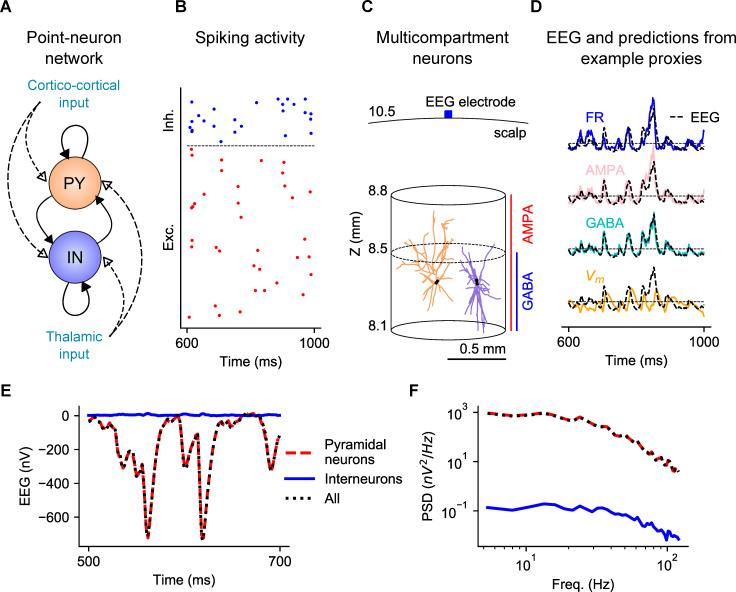
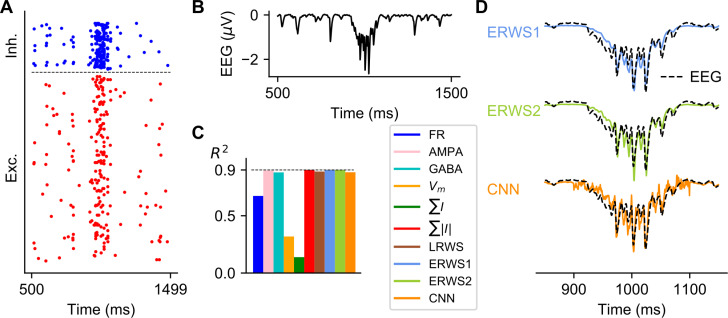
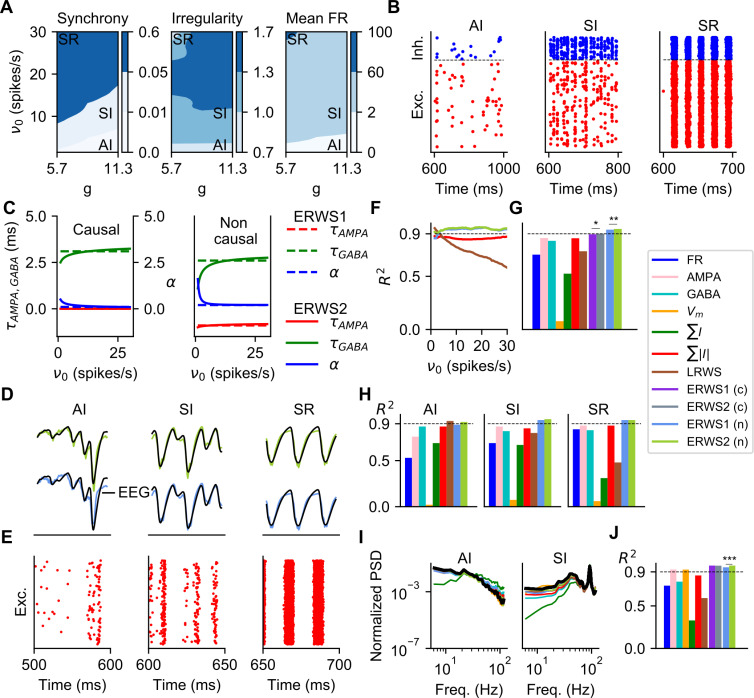
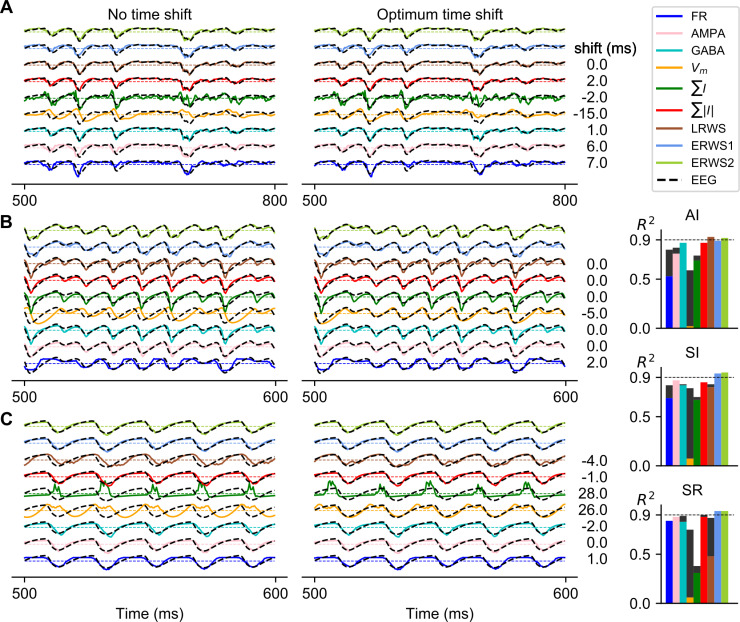
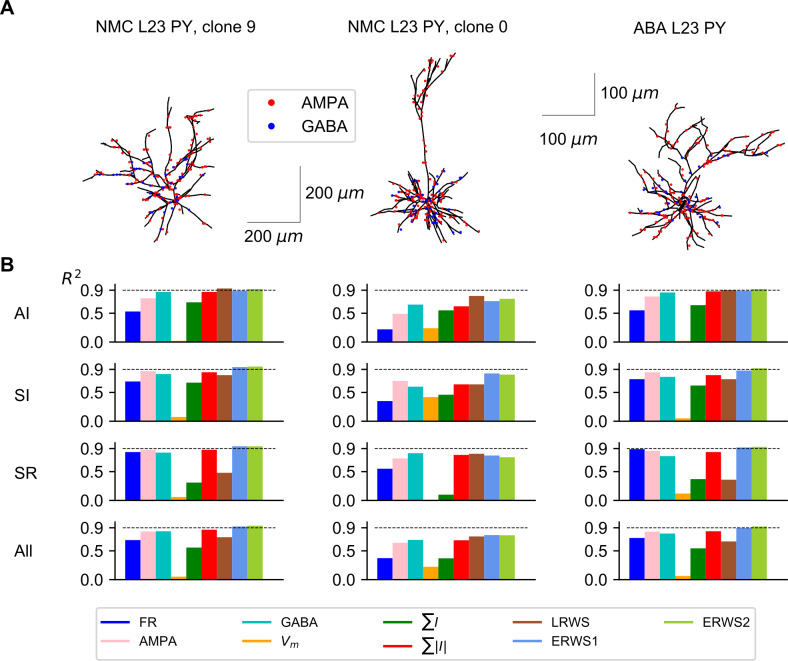
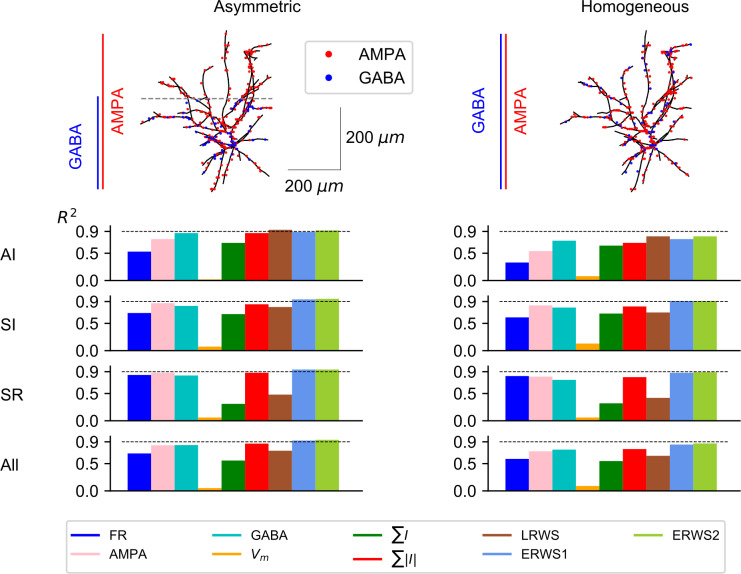
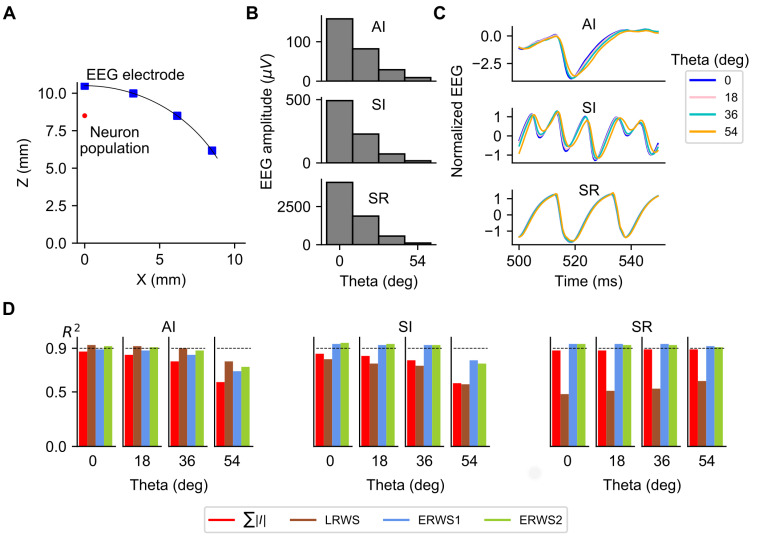
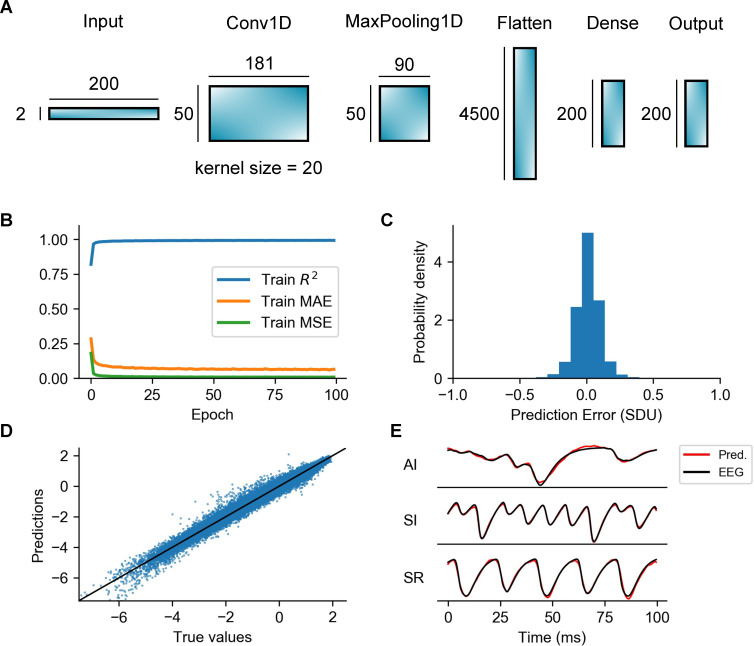
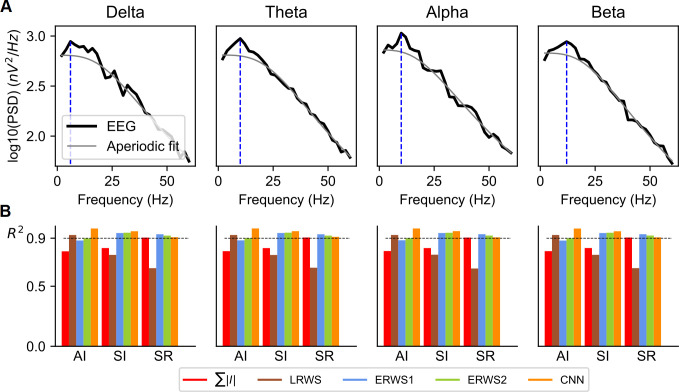
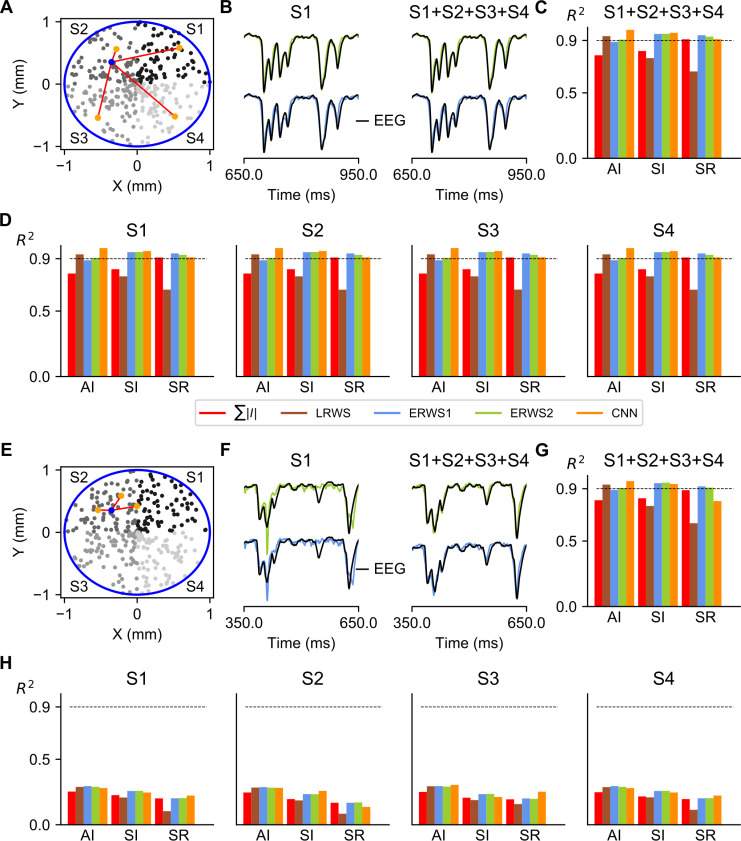
The electroencephalogram (EEG) is a major tool for non-invasively studying brain function and dysfunction. Comparing experimentally recorded EEGs with neural network models is important to better interpret EEGs in terms of neural mechanisms. Most current neural network models use networks of simple point neurons. They capture important properties of cortical dynamics, and are numerically or analytically tractable. However, point neurons cannot generate an EEG, as EEG generation requires spatially separated transmembrane currents. Here, we explored how to compute an accurate approximation of a rodent's EEG with quantities defined in point-neuron network models. We constructed different approximations (or proxies) of the EEG signal that can be computed from networks of leaky integrate-and-fire (LIF) point neurons, such as firing rates, membrane potentials, and combinations of synaptic currents. We then evaluated how well each proxy reconstructed a ground-truth EEG obtained when the synaptic currents of the LIF model network were fed into a three-dimensional network model of multicompartmental neurons with realistic morphologies. Proxies based on linear combinations of AMPA and GABA currents performed better than proxies based on firing rates or membrane potentials. A new class of proxies, based on an optimized linear combination of time-shifted AMPA and GABA currents, provided the most accurate estimate of the EEG over a wide range of network states. The new linear proxies explained 85-95% of the variance of the ground-truth EEG for a wide range of network configurations including different cell morphologies, distributions of presynaptic inputs, positions of the recording electrode, and spatial extensions of the network. Non-linear EEG proxies using a convolutional neural network (CNN) on synaptic currents increased proxy performance by a further 2-8%. Our proxies can be used to easily calculate a biologically realistic EEG signal directly from point-neuron simulations thus facilitating a quantitative comparison between computational models and experimental EEG recordings.
脑电图(EEG)是一种非侵入式研究大脑功能和功能障碍的主要工具。将实验记录的脑电图与神经网络模型进行比较对于根据神经机制更好地解释脑电图非常重要。目前大多数神经网络模型使用简单的点神经元网络。它们捕获了皮质动力学的重要性质,并且在数值上或解析上是可处理的。然而,点神经元不能产生 EEG,因为 EEG 的产生需要空间分离的跨膜电流。在这里,我们探索了如何使用点神经元网络模型中定义的量来计算啮齿动物 EEG 的精确近似值。我们构建了 EEG 信号的不同近似值(或代理),这些近似值可以从漏电积分和放电(LIF)点神经元网络计算得出,例如放电率、膜电位以及突触电流的组合。然后,我们评估了每个代理在将 LIF 模型网络的突触电流馈入具有真实形态的多腔神经元三维网络模型时,重建真实 EEG 的效果如何。基于 AMPA 和 GABA 电流的线性组合的代理比基于放电率或膜电位的代理效果更好。一类新的代理,基于 AMPA 和 GABA 电流的优化线性组合,在广泛的网络状态下提供了 EEG 的最准确估计。新的线性代理解释了地面真实 EEG 的 85-95%的方差对于包括不同细胞形态、突触输入分布、记录电极位置和网络空间扩展在内的各种网络配置。基于突触电流的卷积神经网络(CNN)的非线性 EEG 代理进一步提高了代理性能 2-8%。我们的代理可以从点神经元模拟中轻松计算出具有生物学意义的 EEG 信号,从而便于在计算模型和实验 EEG 记录之间进行定量比较。