Zhang Lin, Gong Wenbing, Li Chuang, Shen Nan, Gui Ying, Bian Yinbing, Kwan Hoi Shan, Cheung Man Kit, Xiao Yang
Institute of Applied Mycology, Huazhong Agricultural University, 430070 Hubei Province, PR China.
Institute of Bast Fiber Crops, Chinese Academy of Agricultural Sciences, Changsha 410205, PR China.
Comput Struct Biotechnol J. 2021 Mar 22;19:1641-1653. doi: 10.1016/j.csbj.2021.03.016. eCollection 2021.
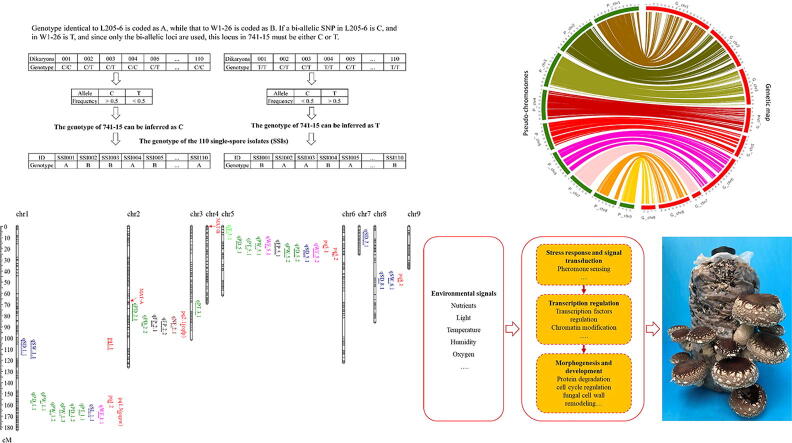
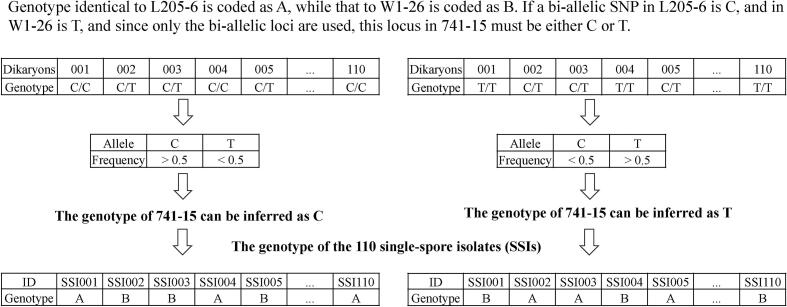
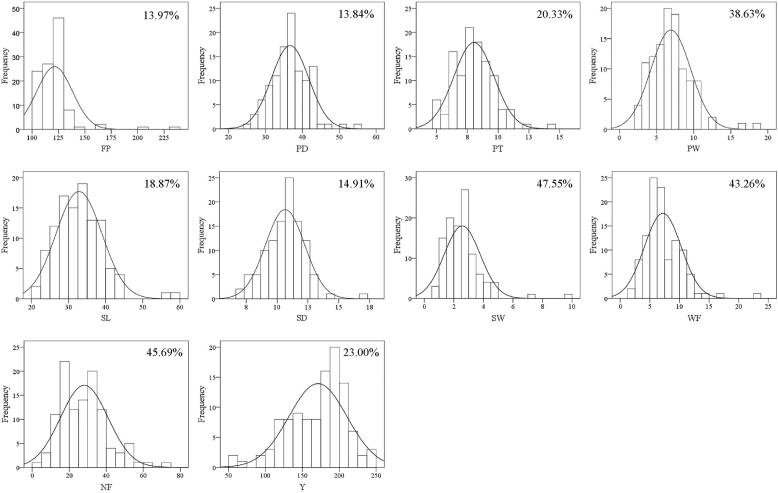
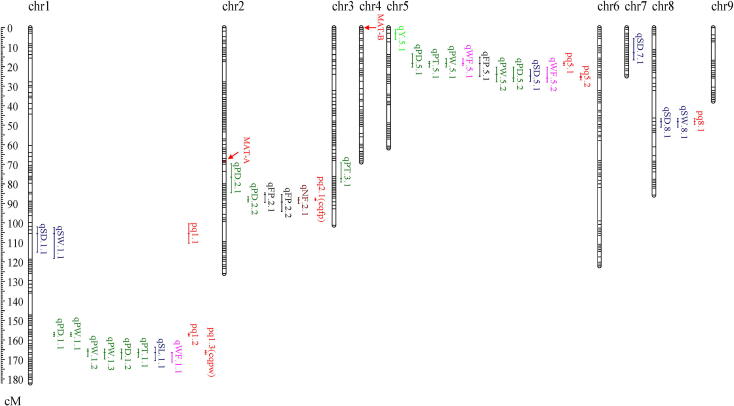
Fruiting body development (FBD) of mushroom-forming fungi has attracted tremendous interest. However, the genetic and molecular basis of FBD is poorly known. Here, using (shiitake) as a model, we deciphered the genetic architecture underlying fruiting body-related traits (FBRTs) by combined genomic, genetic and phenotypic data. Using RNA-Seq of fruiting bodies from 110 dikaryons in a bi-parental mapping population, we constructed an ultra-high-density genetic map of (Lemap2.0) with a total length of 810.14 cM, which covered 81.7% of the shiitake genome. A total of 94 scaffolds of the shiitake genome were aligned to Lemap2.0 and re-anchored into nine pseudo-chromosomes. Then via quantitative trait locus (QTL) analysis, we disclosed an outline of the genetic architecture of FBD in shiitake. Twenty-nine QTLs and three main genomic regions associated with FBD of shiitake were identified. Using -QTL analysis, seven pleiotropic QTLs for multiple traits were detected, which contributed to the correlations of FBRTs. In the mapped QTLs, the expression of 246 genes were found to significantly correlate with the phenotypic traits. Thirty-three of them were involved in FBD and could represent candidate genes controlling the shape and size of fruiting bodies. Collectively, our findings have advanced our understanding of the genetic regulation of FBD in shiitake and mushroom-forming fungi at large.
形成蘑菇的真菌的子实体发育(FBD)引起了极大的关注。然而,FBD的遗传和分子基础却鲜为人知。在此,我们以香菇为模型,通过整合基因组、遗传和表型数据,解析了与子实体相关性状(FBRTs)的遗传结构。利用双亲作图群体中110个双核体的子实体进行RNA测序,我们构建了一个总长为810.14厘摩的香菇超高密度遗传图谱(Lemap2.0),该图谱覆盖了香菇基因组的81.7%。香菇基因组的94个支架被比对到Lemap2.0上,并重新锚定到9条假染色体上。然后,通过数量性状位点(QTL)分析,我们揭示了香菇FBD的遗传结构轮廓。鉴定出29个与香菇FBD相关的QTL和3个主要基因组区域。利用多性状-QTL分析,检测到7个控制多个性状的多效性QTL,它们促成了FBRTs之间的相关性。在定位的QTL中,发现246个基因的表达与表型性状显著相关。其中33个基因参与FBD,可能代表控制子实体形状和大小的候选基因。总的来说,我们的研究结果增进了我们对香菇及大型形成蘑菇的真菌中FBD遗传调控的理解。