Centre for Eye Research Ireland, School of Physics and Clinical and Optometric Sciences, Technological University Dublin, Dublin, Ireland.
School of Mathematical Sciences, Technological University Dublin, Dublin, Ireland.
PLoS One. 2021 Apr 23;16(4):e0250468. doi: 10.1371/journal.pone.0250468. eCollection 2021.
To examine whether data sourced from electronic medical records (EMR) and a large industrial spectacle lens manufacturing database can estimate refractive error distribution within large populations as an alternative to typical population surveys of refractive error.
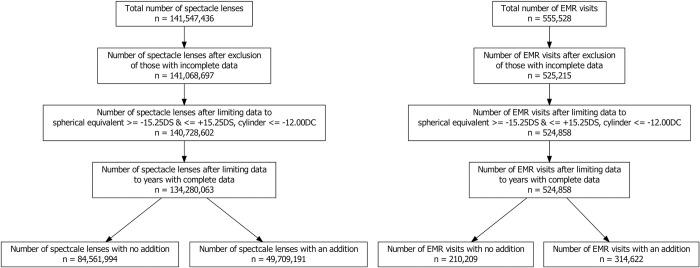
A total of 555,528 patient visits from 28 Irish primary care optometry practices between the years 1980 and 2019 and 141,547,436 spectacle lens sales records from an international European lens manufacturer between the years 1998 and 2016.
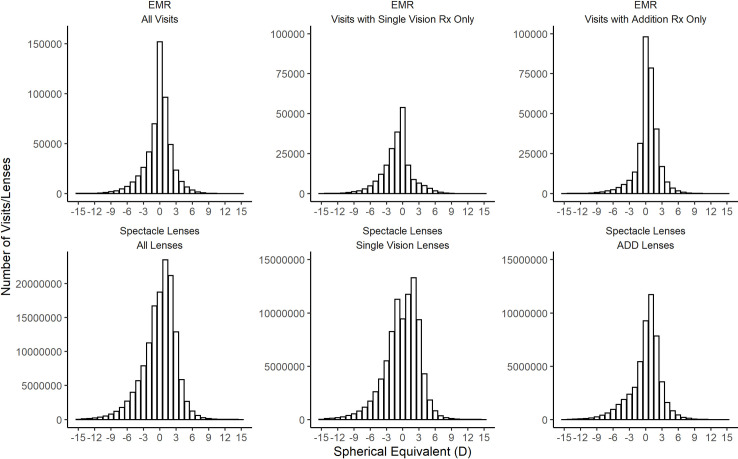
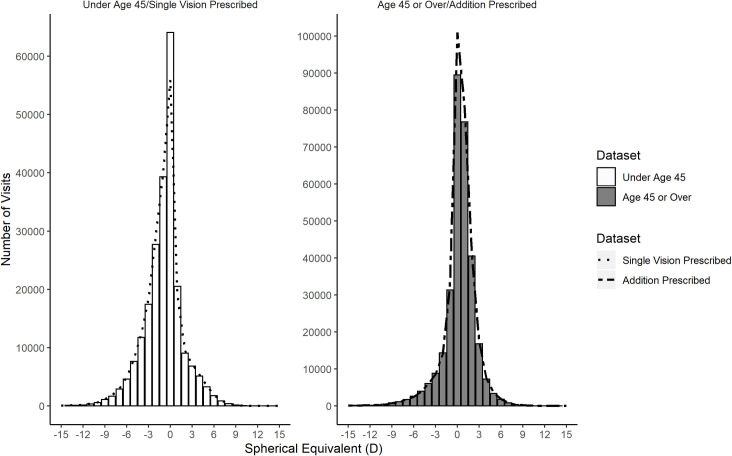
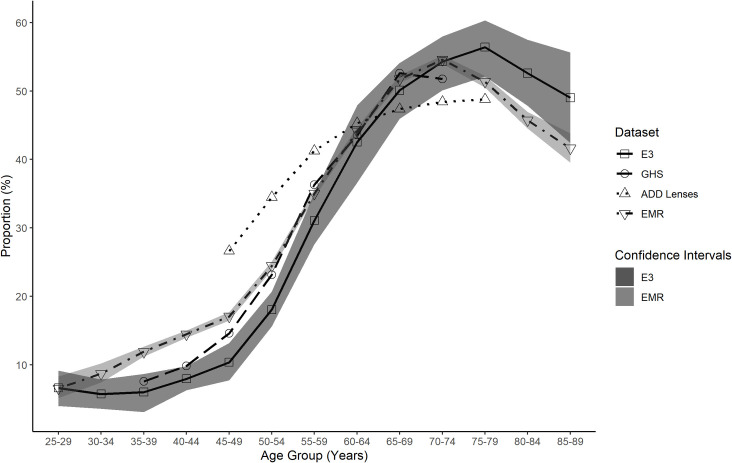
Anonymized EMR data included demographic, refractive and visual acuity values. Anonymized spectacle lens data included refractive data. Spectacle lens data was separated into lenses containing an addition (ADD) and those without an addition (SV). The proportions of refractive errors from the EMR data and ADD lenses were compared to published results from the European Eye Epidemiology (E3) Consortium and the Gutenberg Health Study (GHS).
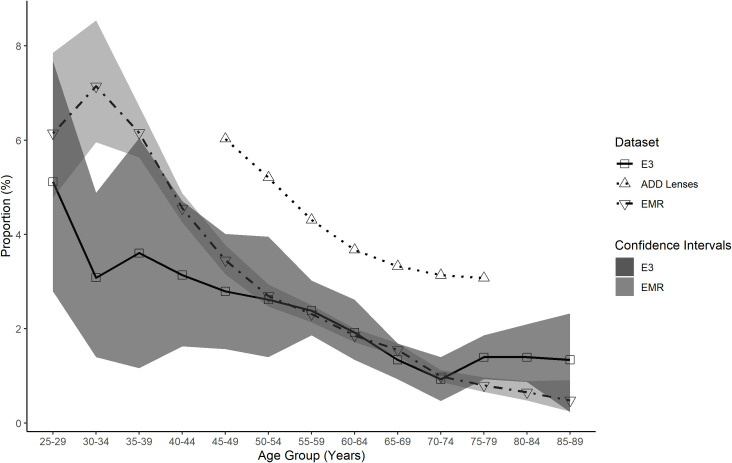
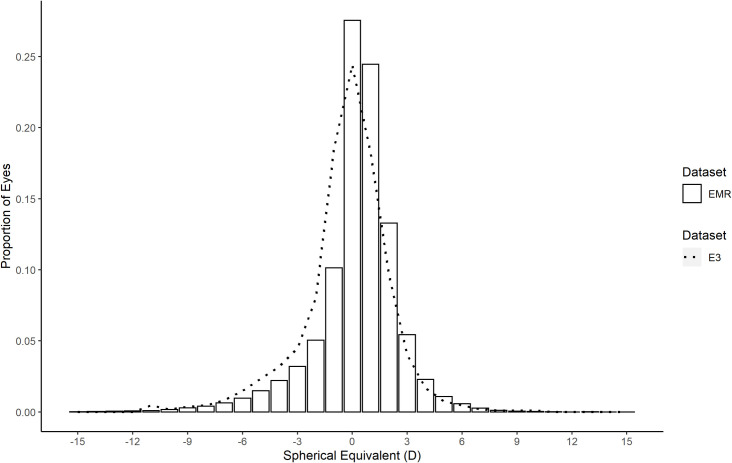
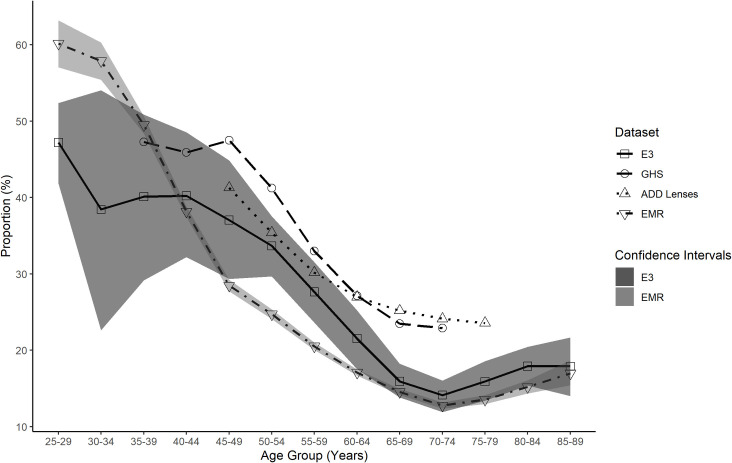
Age and gender matched proportions of refractive error were comparable in the E3 data and the EMR data, with no significant difference in the overall refractive error distribution (χ2 = 527, p = 0.29, DoF = 510). EMR data provided a closer match to the E3 refractive error distribution by age than the ADD lens data. The ADD lens data, however, provided a closer approximation to the E3 data for total myopia prevalence than the GHS data, up to age 64.
The prevalence of refractive error within a population can be estimated using EMR data in the absence of population surveys. Industry derived sales data can also provide insights on the epidemiology of refractive errors in a population over certain age ranges. EMR and industrial data may therefore provide a fast and cost-effective surrogate measure of refractive error distribution that can be used for future health service planning purposes.
研究是否可以使用电子病历(EMR)和大型工业眼镜镜片制造数据库中的数据来估算大人群中的屈光不正分布,以此替代典型的屈光不正人群调查。
1980 年至 2019 年间,28 家爱尔兰初级保健验光实践中的 555,528 次患者就诊记录,以及 1998 年至 2016 年间一家国际欧洲镜片制造商的 141,547,436 副眼镜镜片销售记录。
匿名 EMR 数据包括人口统计学、屈光和视力值。匿名眼镜镜片数据包括屈光数据。将眼镜镜片数据分为含有附加度数(ADD)的镜片和不含附加度数(SV)的镜片。将 EMR 数据和 ADD 镜片的屈光不正比例与欧洲眼流行病学(E3)联盟和古腾堡健康研究(GHS)的已发表结果进行比较。
E3 数据和 EMR 数据的年龄和性别匹配的屈光不正比例具有可比性,整体屈光不正分布无显著差异(χ2 = 527,p = 0.29,自由度(DoF)= 510)。EMR 数据比 ADD 镜片数据更能根据年龄与 E3 屈光不正分布相匹配。然而,ADD 镜片数据在年龄不超过 64 岁时,比 GHS 数据更能接近 E3 数据的总体近视患病率。
在没有人群调查的情况下,可以使用 EMR 数据估算人群中的屈光不正患病率。行业衍生的销售数据也可以提供有关特定年龄范围内人群屈光不正流行病学的见解。因此,EMR 和工业数据可能提供一种快速且具有成本效益的屈光不正分布替代衡量标准,可用于未来的卫生服务规划目的。