Almuqhim Fahad, Saeed Fahad
Knight Foundation School of Computing and Information Sciences, Florida International University, Miami, FL, United States.
Front Comput Neurosci. 2021 Apr 8;15:654315. doi: 10.3389/fncom.2021.654315. eCollection 2021.
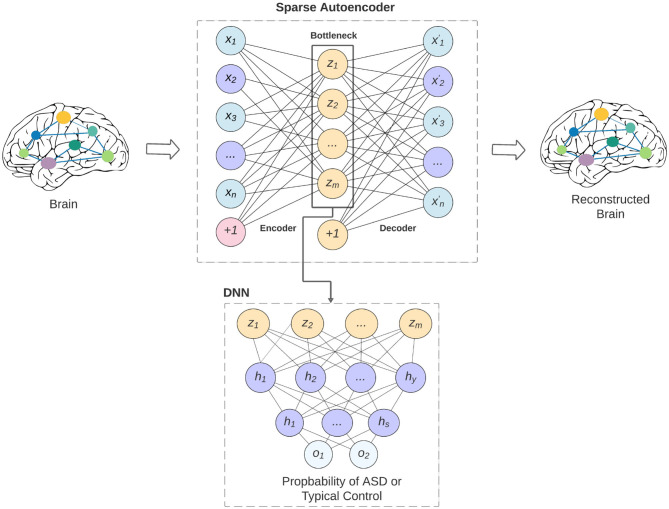
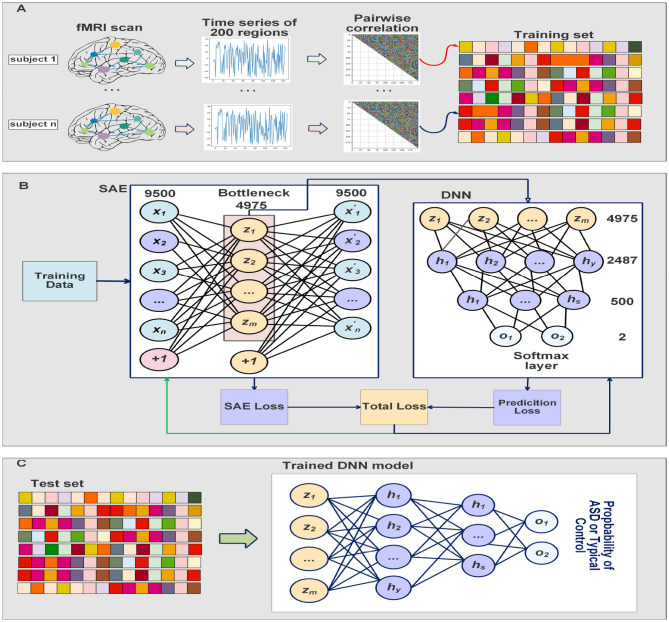
Autism spectrum disorder (ASD) is a heterogenous neurodevelopmental disorder which is characterized by impaired communication, and limited social interactions. The shortcomings of current clinical approaches which are based exclusively on behavioral observation of symptomology, and poor understanding of the neurological mechanisms underlying ASD necessitates the identification of new biomarkers that can aid in study of brain development, and functioning, and can lead to accurate and early detection of ASD. In this paper, we developed a deep-learning model called for classifying patients with ASD from typical control subjects using fMRI data. We designed and implemented a sparse autoencoder (SAE) which results in optimized extraction of features that can be used for classification. These features are then fed into a deep neural network (DNN) which results in superior classification of fMRI brain scans more prone to ASD. Our proposed model is trained to optimize the classifier while improving extracted features based on both reconstructed data error and the classifier error. We evaluated our proposed deep-learning model using publicly available Autism Brain Imaging Data Exchange (ABIDE) dataset collected from 17 different research centers, and include more than 1,035 subjects. Our extensive experimentation demonstrate that exhibits comparable accuracy (70.8%), and superior specificity (79.1%) for the whole dataset as compared to other methods. Further, our experiments demonstrate superior results as compared to other state-of-the-art methods on 12 out of the 17 imaging centers exhibiting superior generalizability across different data acquisition sites and protocols. The implemented code is available on GitHub portal of our lab at: https://github.com/pcdslab/ASD-SAENet.
自闭症谱系障碍(ASD)是一种异质性神经发育障碍,其特征为沟通障碍和社交互动受限。当前临床方法仅基于症状的行为观察,且对ASD潜在神经机制了解不足,这就需要识别新的生物标志物,以帮助研究大脑发育和功能,并能实现ASD的准确早期检测。在本文中,我们开发了一种深度学习模型,用于使用功能磁共振成像(fMRI)数据将ASD患者与典型对照受试者进行分类。我们设计并实现了一种稀疏自动编码器(SAE),其可优化特征提取以用于分类。然后将这些特征输入到深度神经网络(DNN)中,从而对更易患ASD的fMRI脑部扫描进行卓越的分类。我们提出的模型经过训练,可在基于重构数据误差和分类器误差改进提取特征的同时优化分类器。我们使用从17个不同研究中心收集的公开可用自闭症脑成像数据交换(ABIDE)数据集评估了我们提出的深度学习模型,该数据集包含1035多名受试者。我们广泛的实验表明,与其他方法相比,该模型在整个数据集上具有相当的准确率(70.8%)和卓越的特异性(79.1%)。此外,在17个成像中心中的12个中心,我们的实验与其他最先进的方法相比取得了卓越的结果,表明在不同数据采集地点和协议上具有卓越的通用性。实现的代码可在我们实验室的GitHub门户上获取:https://github.com/pcdslab/ASD-SAENet。