Lella Kranthi Kumar, Pja Alphonse
Department of Computer Applications, NIT Tiruchirappalli, Tamil Nadu, India.
AIMS Public Health. 2021 Mar 10;8(2):240-264. doi: 10.3934/publichealth.2021019. eCollection 2021.
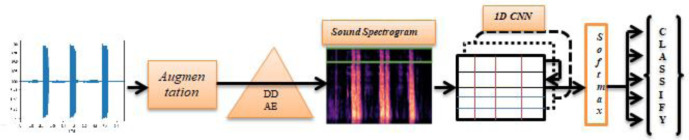
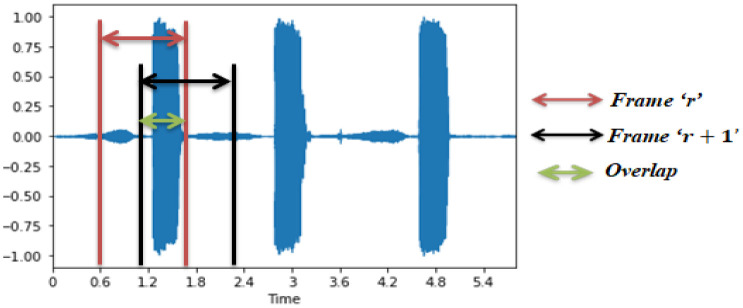
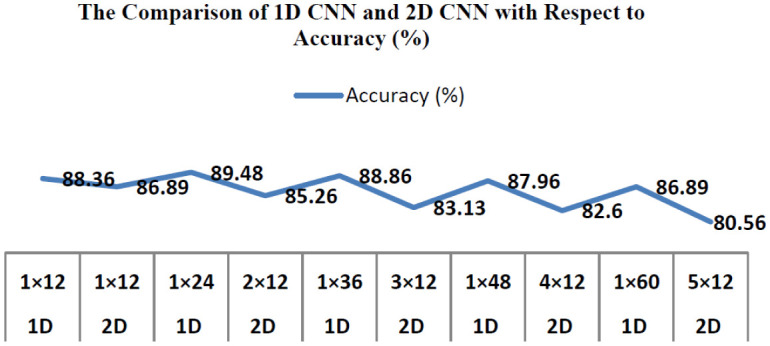
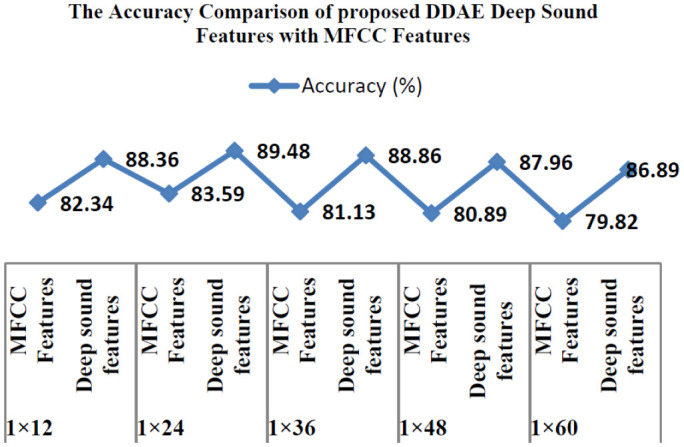
The issue in respiratory sound classification has attained good attention from the clinical scientists and medical researcher's group in the last year to diagnosing COVID-19 disease. To date, various models of Artificial Intelligence (AI) entered into the real-world to detect the COVID-19 disease from human-generated sounds such as voice/speech, cough, and breath. The Convolutional Neural Network (CNN) model is implemented for solving a lot of real-world problems on machines based on Artificial Intelligence (AI). In this context, one dimension (1D) CNN is suggested and implemented to diagnose respiratory diseases of COVID-19 from human respiratory sounds such as a voice, cough, and breath. An augmentation-based mechanism is applied to improve the preprocessing performance of the COVID-19 sounds dataset and to automate COVID-19 disease diagnosis using the 1D convolutional network. Furthermore, a DDAE (Data De-noising Auto Encoder) technique is used to generate deep sound features such as the input function to the 1D CNN instead of adopting the standard input of MFCC (Mel-frequency cepstral coefficient), and it is performed better accuracy and performance than previous models.
As a result, around 4% accuracy is achieved than traditional MFCC. We have classified COVID-19 sounds, asthma sounds, and regular healthy sounds using a 1D CNN classifier and shown around 90% accuracy to detect the COVID-19 disease from respiratory sounds.
A Data De-noising Auto Encoder (DDAE) was adopted to extract the acoustic sound signals in-depth features instead of traditional MFCC. The proposed model improves efficiently to classify COVID-19 sounds for detecting COVID-19 positive symptoms.
去年以来,呼吸音分类问题在临床科学家和医学研究人员群体中受到了高度关注,以用于诊断新冠肺炎疾病。迄今为止,各种人工智能(AI)模型已进入现实世界,用于从人声、咳嗽和呼吸等人为产生的声音中检测新冠肺炎疾病。卷积神经网络(CNN)模型被用于解决基于人工智能(AI)的机器上的许多现实世界问题。在此背景下,建议并实施一维(1D)CNN,以从人声、咳嗽和呼吸等人类呼吸音中诊断新冠肺炎的呼吸系统疾病。一种基于增强的机制被应用于提高新冠肺炎声音数据集的预处理性能,并使用一维卷积网络实现新冠肺炎疾病诊断的自动化。此外,使用数据去噪自动编码器(DDAE)技术来生成深度声音特征,作为一维CNN的输入函数,而不是采用梅尔频率倒谱系数(MFCC)的标准输入,并且它比以前的模型具有更高的准确性和性能。
结果表明,与传统的MFCC相比,准确率提高了约4%。我们使用一维CNN分类器对新冠肺炎声音、哮喘声音和正常健康声音进行了分类,从呼吸音中检测新冠肺炎疾病的准确率约为90%。
采用数据去噪自动编码器(DDAE)来提取声学声音信号的深度特征,而不是传统的MFCC。所提出的模型有效地提高了对新冠肺炎声音的分类能力,以检测新冠肺炎阳性症状。