Dumas Guillaume, Fairhurst Merle T
CHU Sainte-Justine Research Center, Department of Psychiatry, University of Montreal, Quebec, Canada.
Mila - Quebec Artificial Intelligence Institute, University of Montreal, Quebec, Canada.
R Soc Open Sci. 2021 May 12;8(5):210138. doi: 10.1098/rsos.210138.
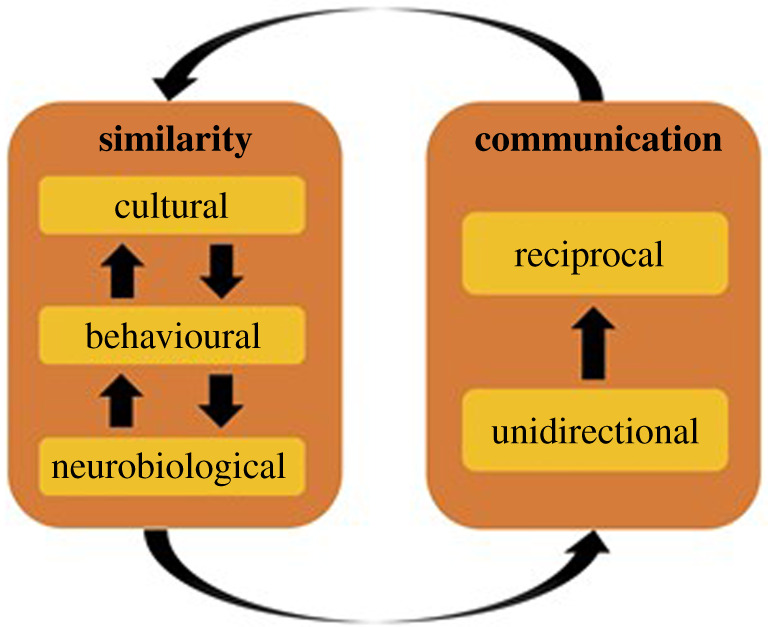
Recent accounts of social cognition focus on we do things together, suggesting that becoming aligned relies on a reciprocal exchange of information. The next step is to develop richer computational methods that quantify the degree of coupling and describe the nature of the information exchange. We put forward a definition of coupling, comparing it to related terminology and detail, available computational methods and the level of organization to which they pertain, presenting them as a hierarchy from weakest to richest forms of coupling. The rationale is that a temporally coherent link between two dynamical systems at the lowest level of organization sustains mutual adaptation and alignment at the highest level. Postulating that when we do things together, we do so dynamically over time and we argue that to determine and measure instances of true reciprocity in social exchanges is key. Along with this computationally rich definition of coupling, we present challenges for the field to be tackled by a diverse community working towards a dynamic account of social cognition.
近期关于社会认知的论述聚焦于我们共同做事情,这表明达成协调一致依赖于信息的相互交换。下一步是开发更丰富的计算方法,以量化耦合程度并描述信息交换的本质。我们提出了耦合的定义,将其与相关术语进行比较并详细阐述,介绍了可用的计算方法及其所适用的组织层次,将它们呈现为一个从最弱到最丰富耦合形式的层次结构。其基本原理是,在最低组织层次上两个动态系统之间的时间连贯联系维持着最高层次上的相互适应和协调一致。我们假定,当我们共同做事情时,是随着时间动态进行的,并且我们认为确定和衡量社会交换中真正互惠的实例是关键。除了这种计算上丰富的耦合定义之外,我们还提出了该领域面临的挑战,需要一个多元化的群体共同努力,以形成关于社会认知的动态解释。