Niño Michael D, Hearne Brittany N, Cai Tianji
Department of Sociology and Criminology University of Arkansas 1 University of Arkansas, Fayetteville, AR, 72701, USA.
Department of Sociology University of Macau Avenida da Universidade Taipa, Macau, China.
SSM Popul Health. 2021 Sep;15:100824. doi: 10.1016/j.ssmph.2021.100824. Epub 2021 May 27.
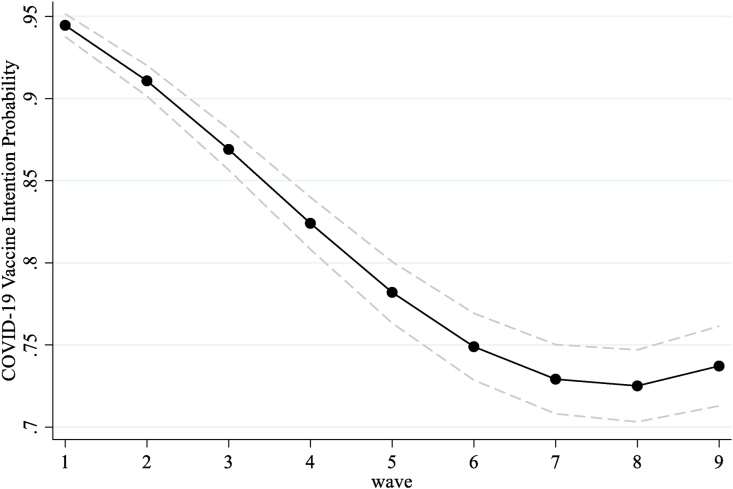
Research examining whether intentions to get a COVID-19 vaccine change over time is scarce. Moreover, the deep and pervasive history of medical racism in the U.S. has created a context in which some racial and ethnic groups exhibit greater levels of COVID-19 vaccine hesitancy; yet few researchers have attempted to determine whether these patterns persist with time. The purpose of this study was twofold: (a.) assess the role of time in COVID-19 vaccine intentions from April 2020 to January 2021, and (b.) examine whether race and ethnicity shape COVID-19 vaccine intention trajectories. Data were drawn from 9 waves of the Understanding America Study ( = 5023), a national probability panel study of U.S. adults. Multilevel logistic regression models were used to assess overall COVID-19 vaccine intention trajectories and trajectories by race and ethnicity. Results demonstrate intentions to get a COVID-19 vaccine significantly decreased from April 2020 to November 2020, but by January 2021, intentions to get a COVID-19 vaccine slightly increased. Findings also show trajectories significantly differed by racial and ethnic background. Asian/Pacific Islanders had the highest probability of likely getting a COVID-19 vaccine at baseline, followed by Whites and Latina/os. Black Americans exhibited the lowest probability of likely getting vaccinated, and, in most cases, the gap between Black Americans and other racial groups grew over time. Key findings from this study demonstrate that, among U.S. adults, time and race and ethnicity play significant roles in COVID-19 vaccine intentions. Understanding the role of time and race and racism in shaping COVID-19 vaccine intention trajectories can help government agencies and public health experts tasked with administrating vaccines better understand disparities in vaccine uptake.
关于接种新冠疫苗的意愿是否会随时间变化的研究很少。此外,美国医学种族主义深刻而普遍的历史背景导致一些种族和族裔群体对新冠疫苗的犹豫程度更高;然而,很少有研究人员试图确定这些模式是否会随着时间持续存在。本研究的目的有两个:(a)评估2020年4月至2021年1月期间时间对新冠疫苗接种意愿的作用,以及(b)研究种族和族裔是否会影响新冠疫苗接种意愿轨迹。数据来自“了解美国研究”的9个波次(n = 5023),这是一项针对美国成年人的全国概率面板研究。使用多层逻辑回归模型来评估总体新冠疫苗接种意愿轨迹以及按种族和族裔划分的轨迹。结果表明,2020年4月至2020年11月期间,接种新冠疫苗的意愿显著下降,但到2021年1月,接种新冠疫苗的意愿略有上升。研究结果还表明,不同种族和族裔背景的轨迹存在显著差异。亚太岛民在基线时接种新冠疫苗的可能性最高,其次是白人和拉丁裔。非裔美国人接种疫苗的可能性最低,而且在大多数情况下,非裔美国人和其他种族群体之间的差距随着时间的推移而扩大。本研究的主要发现表明,在美国成年人中,时间、种族和族裔在新冠疫苗接种意愿中起着重要作用。了解时间、种族和种族主义在塑造新冠疫苗接种意愿轨迹中的作用,可以帮助负责管理疫苗的政府机构和公共卫生专家更好地理解疫苗接种率的差异。