School of Psychology and Public Health, La Trobe University, Plenty Rd, Bundoora, VIC, Australia.
School of Management, College of Business, RMIT University, Melbourne, Australia.
BMC Psychol. 2021 Jun 4;9(1):93. doi: 10.1186/s40359-021-00593-8.
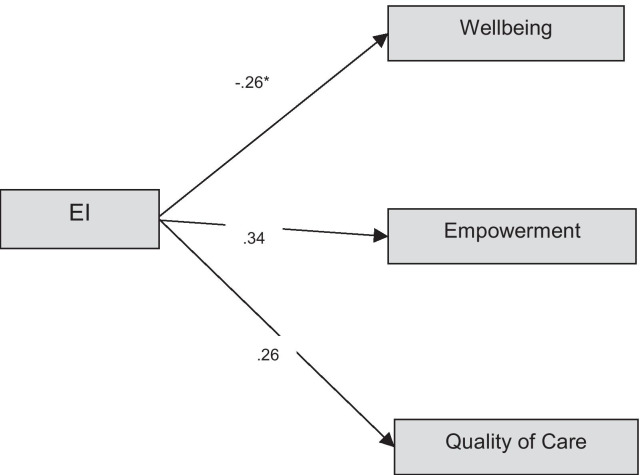
The study explored the role of emotional intelligence (EI) on employees' perceived wellbeing and empowerment, as well as their performance, by measuring their quality of care.
The baseline data for the present project was collected from 78 staff of a Victorian aged care organization in Australia. Self-administered surveys were used to assess participants' emotional intelligence, general well-being, psychological empowerment, quality of care, and demographic characteristics. The model fit was assessed using structural equation modelling by AMOS (v 24) software.
The evaluated model confirmed that emotional intelligence predicts the employees' psychological empowerment, wellbeing, and quality of care in a statistically significant way.
The current research indicates that employees with higher EI will more likely deliver a better quality of patient care. Present research extends the current knowledge of the psychological empowerment and wellbeing of employees with a particular focus on emotional intelligence as an antecedent in an under-investigated setting like aged care setting in Australia.
本研究通过衡量护理质量,探讨了情绪智力(EI)对员工感知幸福感和赋权以及绩效的影响。
本研究的基线数据来自澳大利亚维多利亚州一家老年护理机构的 78 名员工。采用自我管理的问卷调查评估参与者的情绪智力、一般幸福感、心理赋权、护理质量和人口统计学特征。使用 AMOS(v 24)软件的结构方程模型评估模型拟合度。
评估的模型证实,情绪智力以统计学上显著的方式预测员工的心理赋权、幸福感和护理质量。
目前的研究表明,情绪智力较高的员工更有可能提供更好的患者护理质量。本研究扩展了关于员工心理赋权和幸福感的现有知识,特别关注情绪智力作为澳大利亚老年护理等研究不足环境中的一个先行因素。