Sanabria-Díaz José M, Aguiar-Quintana Teresa, Araujo-Cabrera Yasmina
Faculty of law, Department of Public Law, University of Las Palmas de Gran Canaria (Canary Islands), Spain.
Institute of Tourism and Sustainable Economic Development (Tides), Faculty of Economy, Business and Tourism, Department of Business Administration and Tourism, University of Las Palmas de Gran Canaria (Canary Islands), Spain.
Int J Hosp Manag. 2021 Aug;97:102988. doi: 10.1016/j.ijhm.2021.102988. Epub 2021 May 28.
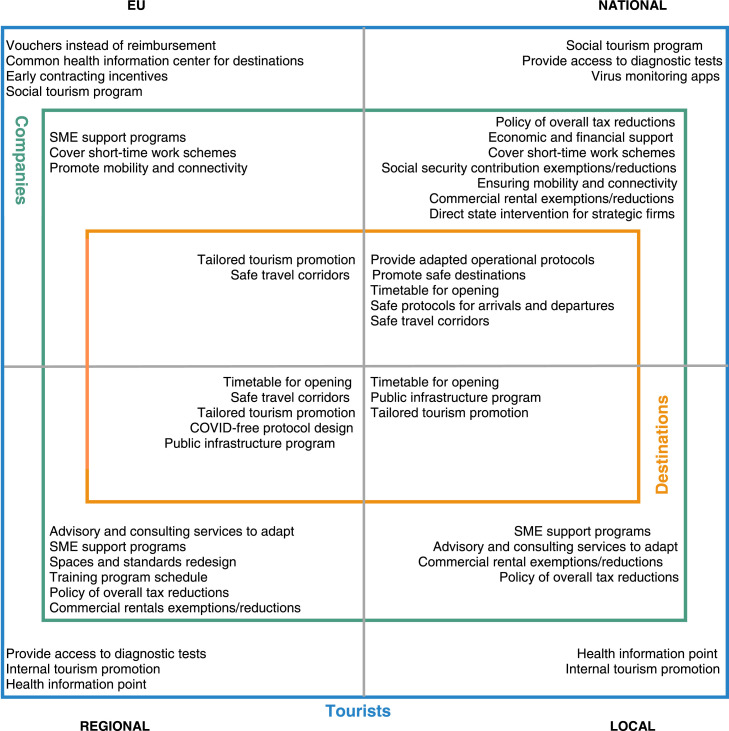
The COVID-19 pandemic has caused a "zero tourism" situation throughout the world with unpredictable consequences. Several authors analyzed the economic impacts of the COVID-19 pandemic during the second trimester of 2020, but none of them have specifically examined European Union countries and the joint actions taken to fight the pandemic. Using a case study methodology, this paper presents a literature review of the most up-to-date studies on the impacts of the COVID-19 global pandemic. Secondly, we specify the different public intervention measures implemented by the European Union in accordance with supranational governance theory and stakeholder theory. Finally, we set out the different COVID-19-related public rescue strategies for the tourism and hospitality sector at the individual level (for tourists), at the business level (for touristic companies) and at the destination level (for the European Union countries), from the perspective of stakeholders. The main contribution of our research is therefore to explore the public strategies to rescue the tourism and hospitality sector in the context of the European Union.
新冠疫情在全球造成了“零旅游”局面,后果难以预测。几位作者分析了2020年第二季度新冠疫情的经济影响,但他们都没有专门研究欧盟国家以及为抗击疫情而采取的联合行动。本文采用案例研究方法,对关于新冠疫情全球大流行影响的最新研究进行了文献综述。其次,我们根据超国家治理理论和利益相关者理论,详细说明了欧盟实施的不同公共干预措施。最后,我们从利益相关者的角度,阐述了针对旅游和酒店业在个人层面(针对游客)、企业层面(针对旅游公司)和目的地层面(针对欧盟国家)的与新冠疫情相关的不同公共救援策略。因此,我们研究的主要贡献在于探索欧盟背景下拯救旅游和酒店业的公共策略。