Department of Crop and Forest Sciences, University of Lleida-Agrotecnio CERCA Center, Lleida, Spain.
Instituto de Tecnologia Química e Biológica António Xavier, Universidade Nova de Lisboa, Oeiras, Portugal.
Plant Biotechnol J. 2021 Oct;19(10):1901-1920. doi: 10.1111/pbi.13657. Epub 2021 Jul 19.
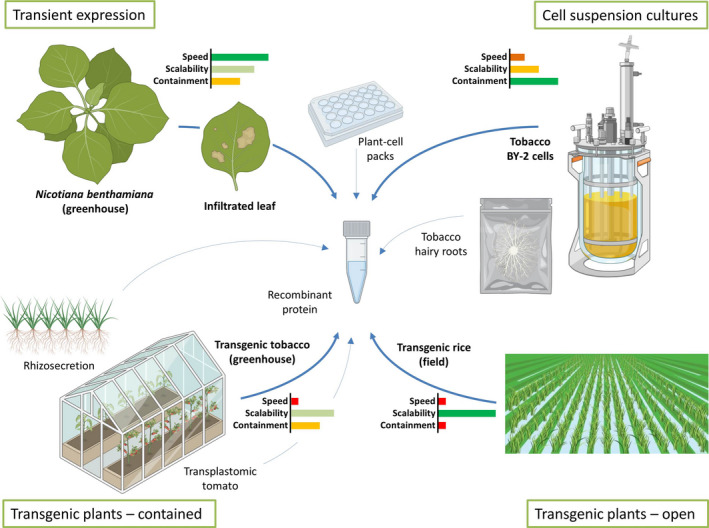
Infectious diseases, also known as transmissible or communicable diseases, are caused by pathogens or parasites that spread in communities by direct contact with infected individuals or contaminated materials, through droplets and aerosols, or via vectors such as insects. Such diseases cause ˜17% of all human deaths and their management and control places an immense burden on healthcare systems worldwide. Traditional approaches for the prevention and control of infectious diseases include vaccination programmes, hygiene measures and drugs that suppress the pathogen, treat the disease symptoms or attenuate aggressive reactions of the host immune system. The provision of vaccines and biologic drugs such as antibodies is hampered by the high cost and limited scalability of traditional manufacturing platforms based on microbial and animal cells, particularly in developing countries where infectious diseases are prevalent and poorly controlled. Molecular farming, which uses plants for protein expression, is a promising strategy to address the drawbacks of current manufacturing platforms. In this review article, we consider the potential of molecular farming to address healthcare demands for the most prevalent and important epidemic and pandemic diseases, focussing on recent outbreaks of high-mortality coronavirus infections and diseases that disproportionately affect the developing world.
传染病,又称传染性或传染性疾病,是由病原体或寄生虫引起的,通过直接接触感染者或受污染的材料、飞沫和气溶胶,或通过昆虫等媒介在社区中传播。这些疾病导致全球所有人类死亡的 17%左右,其管理和控制给全球医疗系统带来了巨大负担。传染病的传统预防和控制方法包括疫苗接种计划、卫生措施和抑制病原体的药物、治疗疾病症状或减轻宿主免疫系统的剧烈反应的药物。疫苗和生物药物(如抗体)的提供受到基于微生物和动物细胞的传统制造平台的高成本和有限可扩展性的限制,特别是在传染病流行且控制不力的发展中国家。利用植物进行蛋白质表达的分子农业是解决当前制造平台缺陷的一种有前途的策略。在这篇综述文章中,我们考虑了分子农业在满足最普遍和最重要的传染病和大流行疾病的医疗需求方面的潜力,重点关注高死亡率冠状病毒感染和不成比例地影响发展中国家的疾病的最新爆发。