Scott Nick, Saul Allan, Spelman Tim, Stoove Mark, Pedrana Alisa, Saeri Alexander, Grundy Emily, Smith Liam, Toole Michael, McIntyre Chandini Raina, Crabb Brendan S, Hellard Margaret
The Burnet Institute, Melbourne, Australia.
Department of Epidemiology and Preventive Medicine, Monash University, Melbourne, Australia.
PLoS One. 2021 Jul 21;16(7):e0253510. doi: 10.1371/journal.pone.0253510. eCollection 2021.
Whilst evidence of use of face masks in reducing COVID-19 cases is increasing, the impact of mandatory use across a large population has been difficult to assess. Introduction of mandatory mask use on July 22, 2020 during a resurgence of COVID-19 in Melbourne, Australia created a situation that facilitated an assessment of the impact of the policy on the epidemic growth rate as its introduction occurred in the absence of other changes to restrictions.
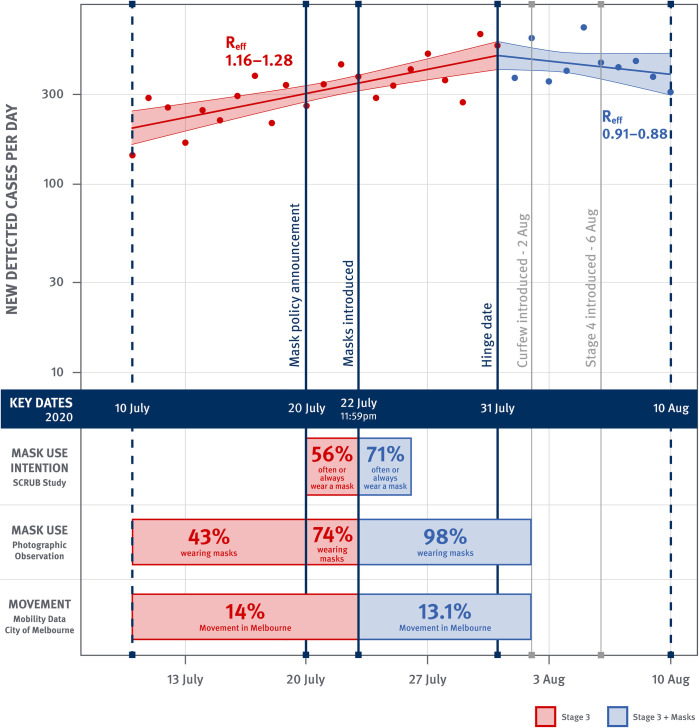
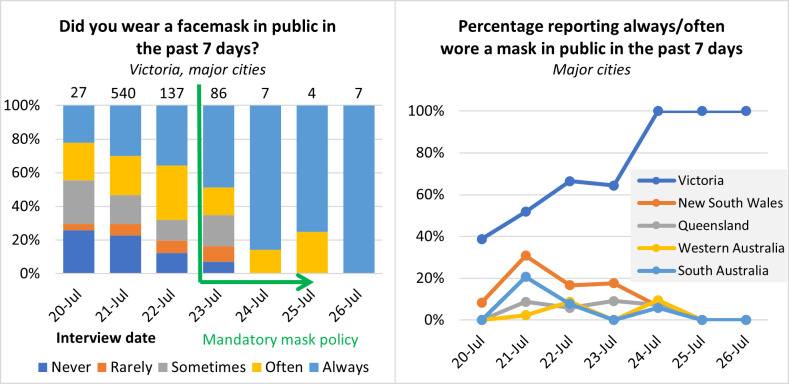
Exponential epidemic growth or decay rates in daily COVID-19 diagnoses were estimated using a non-weighted linear regression of the natural logarithm of the daily cases against time, using a linear spline model with one knot (lspline package in R v 3.6.3). The model's two linear segments pivot around the hinge day, on which the mask policy began to take effect, 8 days following the introduction of the policy. We used two forms of data to assess change in mask usage: images of people wearing masks in public places obtained from a major media outlet and population-based survey data. Potential confounding factors (including daily COVID-19 tests, number of COVID-19 cases among population subsets affected differentially by the mask policy-e.g., healthcare workers) were examined for their impact on the results. Daily cases fitted an exponential growth in the first log-linear segment (k = +0.042, s.e. = 0.007), and fitted an exponential decay in the second (k = -0.023, s.e. = 0.017) log-linear segment. Over a range of reported serial intervals for SARS-CoV-2 infection, these growth rates correspond to a 22-33% reduction in an effective reproduction ratio before and after mandatory mask use. Analysis of images of people in public spaces showed mask usage rose from approximately 43% to 97%. Analysis of survey data found that on the third day before policy introduction, 44% of participants reported "often" or "always" wearing a mask; on the fourth day after, 100% reported "always" doing so. No potentially confounding factors were associated with the observed change in growth rates.
The mandatory mask use policy substantially increased public use of masks and was associated with a significant decline in new COVID-19 cases after introduction of the policy. This study strongly supports the use of masks for controlling epidemics in the broader community.
虽然口罩在减少新冠病毒病例方面的使用证据越来越多,但在大量人群中强制使用口罩的影响却难以评估。2020年7月22日,在澳大利亚墨尔本新冠疫情复发期间引入强制口罩使用政策,创造了一种便于评估该政策对疫情增长率影响的情况,因为该政策出台时没有其他限制措施的变化。
使用每日病例自然对数对时间的非加权线性回归,采用带有一个节点的线性样条模型(R v 3.6.3中的lspline包),估计每日新冠病毒诊断中的指数疫情增长或衰减率。该模型的两个线性段围绕关键日枢转,在政策出台8天后,口罩政策开始生效。我们使用两种形式的数据来评估口罩使用情况的变化:从一家主要媒体获得的公共场所人们佩戴口罩的图像以及基于人群的调查数据。研究了潜在的混杂因素(包括每日新冠病毒检测、口罩政策对不同人群子集(如医护人员)中新冠病毒病例数的影响)对结果的影响。每日病例在第一个对数线性段拟合指数增长(k = +0.042,标准误 = 0.007),在第二个对数线性段拟合指数衰减(k = -0.023,标准误 = 0.017)。在一系列报告的新冠病毒感染潜伏期范围内,这些增长率对应于强制使用口罩前后有效繁殖率降低22%-33%。对公共场所人们图像的分析表明,口罩使用率从约43%上升到97%。对调查数据的分析发现,在政策出台前第三天,44%的参与者报告“经常”或“总是”佩戴口罩;在政策出台后第四天,100%的参与者报告“总是”佩戴口罩。没有潜在的混杂因素与观察到的增长率变化相关。
强制口罩使用政策大幅增加了公众对口罩的使用,并与政策出台后新冠病毒新病例数的显著下降相关。本研究有力支持在更广泛社区中使用口罩来控制疫情。