Guangdong Eye Institute, Department of Ophthalmology, Guangdong Provincial People's Hospital, Guangdong Academy of Medical Sciences, Guangzhou, China.
Second School of Clinical Medicine, Southern Medical University, Guangzhou, China.
Br J Ophthalmol. 2023 Jan;107(1):109-115. doi: 10.1136/bjophthalmol-2021-318844. Epub 2021 Aug 4.
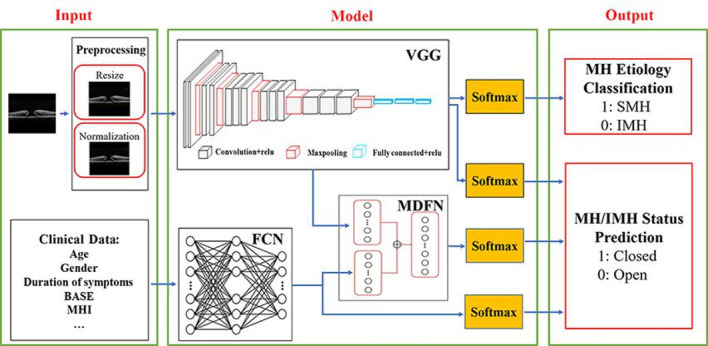
To develop a deep learning (DL) model for automatic classification of macular hole (MH) aetiology (idiopathic or secondary), and a multimodal deep fusion network (MDFN) model for reliable prediction of MH status (closed or open) at 1 month after vitrectomy and internal limiting membrane peeling (VILMP).
In this multicentre retrospective cohort study, a total of 330 MH eyes with 1082 optical coherence tomography (OCT) images and 3300 clinical data enrolled from four ophthalmic centres were used to train, validate and externally test the DL and MDFN models. 266 eyes from three centres were randomly split by eye-level into a training set (80%) and a validation set (20%). In the external testing dataset, 64 eyes were included from the remaining centre. All eyes underwent macular OCT scanning at baseline and 1 month after VILMP. The area under the receiver operated characteristic curve (AUC), accuracy, specificity and sensitivity were used to evaluate the performance of the models.
In the external testing set, the AUC, accuracy, specificity and sensitivity of the MH aetiology classification model were 0.965, 0.950, 0.870 and 0.938, respectively; the AUC, accuracy, specificity and sensitivity of the postoperative MH status prediction model were 0.904, 0.825, 0.977 and 0.766, respectively; the AUC, accuracy, specificity and sensitivity of the postoperative idiopathic MH status prediction model were 0.947, 0.875, 0.815 and 0.979, respectively.
Our DL-based models can accurately classify the MH aetiology and predict the MH status after VILMP. These models would help ophthalmologists in diagnosis and surgical planning of MH.
开发一种深度学习(DL)模型,用于自动分类黄斑裂孔(MH)的病因(特发性或继发性),并开发一种多模态深度学习融合网络(MDFN)模型,用于可靠预测玻璃体切割联合内界膜剥除(VILMP)后 1 个月 MH 的状态(闭合或开放)。
本研究为多中心回顾性队列研究,共纳入来自四个眼科中心的 330 只 MH 眼(1082 个光学相干断层扫描(OCT)图像和 3300 份临床资料),用于训练、验证和外部测试 DL 和 MDFN 模型。三个中心的 266 只眼按眼水平随机分为训练集(80%)和验证集(20%)。在外部测试数据集,还纳入了来自剩余一个中心的 64 只眼。所有眼均在基线和 VILMP 后 1 个月行黄斑 OCT 扫描。采用受试者工作特征曲线下面积(AUC)、准确率、特异度和敏感度评估模型性能。
在外部测试集中,MH 病因分类模型的 AUC、准确率、特异度和敏感度分别为 0.965、0.950、0.870 和 0.938;术后 MH 状态预测模型的 AUC、准确率、特异度和敏感度分别为 0.904、0.825、0.977 和 0.766;术后特发性 MH 状态预测模型的 AUC、准确率、特异度和敏感度分别为 0.947、0.875、0.815 和 0.979。
我们基于 DL 的模型可准确分类 MH 病因并预测 VILMP 后 MH 状态。这些模型将有助于眼科医生进行 MH 的诊断和手术规划。