Dewey Marley J, Harley Brendan A C
Dept of Materials Science and Engineering, University of Illinois at Urbana-Champaign, Urbana, IL 61801, USA.
Carl R. Woese Institute for Genomic Biology, University of Illinois at Urbana-Champaign, Urbana, IL 61801, USA.
RSC Adv. 2021;11(29):17809-17827. doi: 10.1039/d1ra02557k. Epub 2021 May 17.
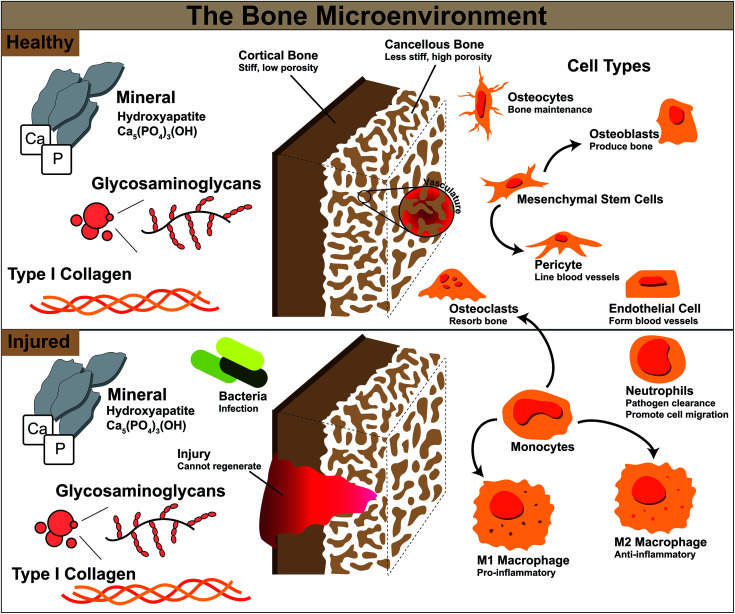
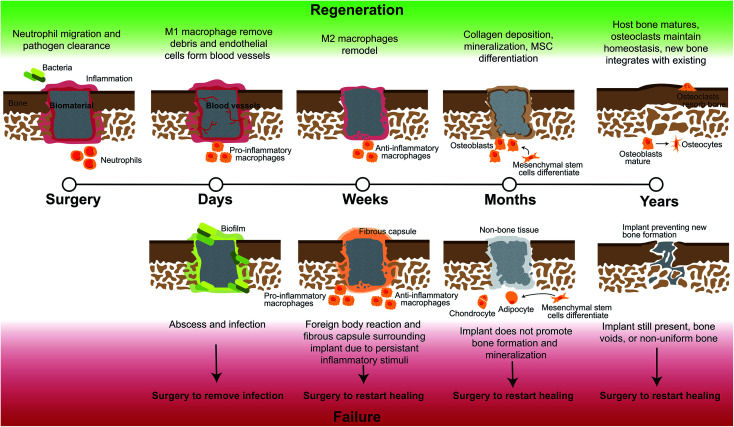
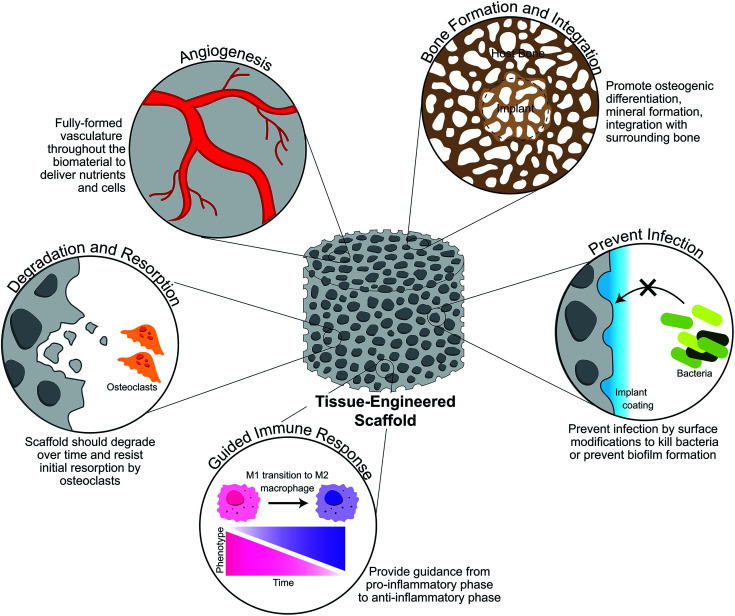
Biomaterial design to repair craniomaxillofacial defects has largely focused on promoting bone regeneration, while there are many additional factors that influence this process. The bone microenvironment is complex, with various mechanical property differences between cortical and cancellous bone, a unique porous architecture, and multiple cell types that must maintain homeostasis. This complex environment includes a vascular architecture to deliver cells and nutrients, osteoblasts which form new bone, osteoclasts which resorb excess bone, and upon injury, inflammatory cells and bacteria which can lead to failure to repair. To create biomaterials able to regenerate these large missing portions of bone on par with autograft materials, design of these materials must include methods to overcome multiple obstacles to effective, efficient bone regeneration. These obstacles include infection and biofilm formation on the biomaterial surface, fibrous tissue formation resulting from ill-fitting implants or persistent inflammation, non-bone tissue formation such as cartilage from improper biomaterial signals to cells, and voids in bone infill or lengthy implant degradation times. Novel biomaterial designs may provide approaches to effectively induce osteogenesis and new bone formation, include design motifs that facilitate surgical handling, intraoperative modification and promote conformal fitting within complex defect geometries, induce a pro-healing immune response, and prevent bacterial infection. In this review, we discuss the bone injury microenvironment and methods of biomaterial design to overcome these obstacles, which if unaddressed, may result in failure of the implant to regenerate host bone.
用于修复颅颌面缺损的生物材料设计主要集中在促进骨再生方面,然而还有许多其他因素会影响这一过程。骨微环境很复杂,皮质骨和松质骨之间存在各种力学性能差异,具有独特的多孔结构,并且有多种细胞类型必须维持体内平衡。这种复杂的环境包括一个用于输送细胞和营养物质的血管结构、形成新骨的成骨细胞、吸收多余骨的破骨细胞,以及在受伤时会导致修复失败的炎性细胞和细菌。为了制造出能够与自体移植材料相媲美的、再生这些大面积骨缺损的生物材料,这些材料的设计必须包括克服有效、高效骨再生的多个障碍的方法。这些障碍包括生物材料表面的感染和生物膜形成、植入物不合适或持续性炎症导致的纤维组织形成、生物材料向细胞发出的不适当信号导致的非骨组织形成(如软骨),以及骨填充中的空隙或植入物降解时间过长。新型生物材料设计可能提供有效诱导成骨和新骨形成的方法,包括便于手术操作、术中修改并促进在复杂缺损几何形状内贴合的设计图案,诱导促愈合的免疫反应,并预防细菌感染。在这篇综述中,我们讨论了骨损伤微环境以及克服这些障碍的生物材料设计方法,如果这些障碍得不到解决,可能会导致植入物无法再生宿主骨。