Department of Physics of Molecular Imaging Systems, Institute for Experimental Molecular Imaging, RWTH Aachen University, Aachen, Germany.
Department of Nuclear Medicine, University of Duisburg-Essen, Duisburg, Germany.
Eur J Nucl Med Mol Imaging. 2022 Jan;49(2):445-459. doi: 10.1007/s00259-021-05536-4. Epub 2021 Oct 14.
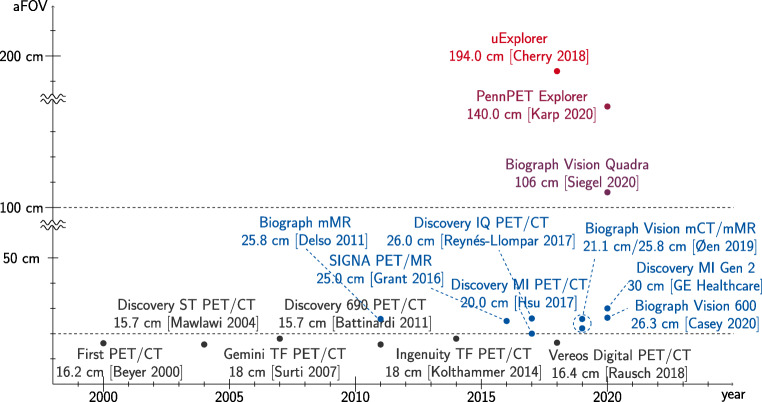
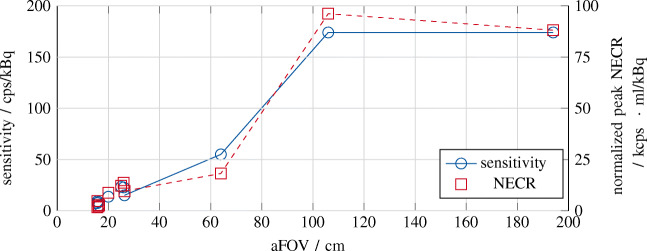
Purpose Since the 1990s, PET has been successfully combined with MR or CT systems. In the past years, especially PET systems have seen a trend towards an enlarged axial field of view (FOV), up to a factor of ten. Methods Conducting a thorough literature research, we summarize the status quo of contemporary total-body (TB) PET/CT scanners and give an outlook on possible future developments. Results Currently, three human TB PET/CT systems have been developed: The PennPET Explorer, the uExplorer, and the Biograph Vision Quadra realize aFOVs between 1 and 2 m and show a tremendous increase in system sensitivity related to their longer gantries. Conclusion The increased system sensitivity paves the way for short-term, low-dose, and dynamic TB imaging as well as new examination methods in almost all areas of imaging.
目的 自 20 世纪 90 年代以来,PET 已成功与 MR 或 CT 系统结合。在过去的几年中,特别是 PET 系统呈现出轴向视野(FOV)扩大的趋势,最大可达十倍。
方法 进行全面的文献研究,我们总结了当代全身(TB)PET/CT 扫描仪的现状,并展望了未来可能的发展。
结果 目前已经开发出三种人体 TB PET/CT 系统:PennPET Explorer、uExplorer 和 Biograph Vision Quadra,其 FOV 在 1 到 2 米之间,由于更长的龙门架,系统灵敏度大大提高。
结论 系统灵敏度的提高为短期、低剂量和动态 TB 成像以及成像几乎所有领域的新检查方法铺平了道路。