Institute of Structural and Molecular Biology, University College London, London, UK.
Institute of Structural and Molecular Biology, Birkbeck College, University of London, London, UK.
Nat Chem. 2021 Dec;13(12):1214-1220. doi: 10.1038/s41557-021-00796-x. Epub 2021 Oct 14.
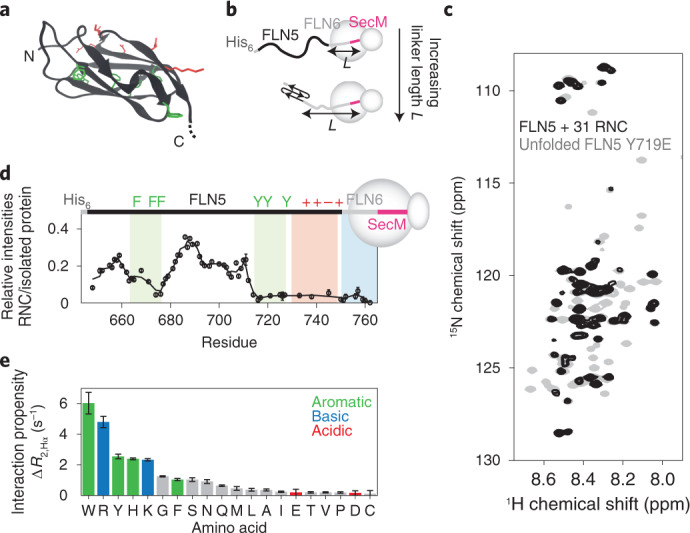
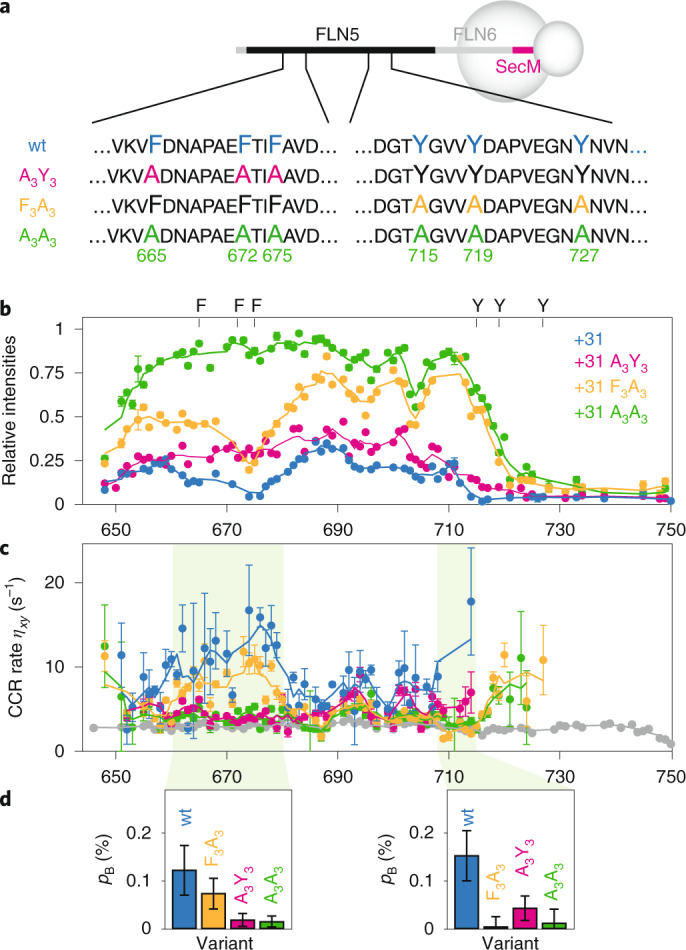
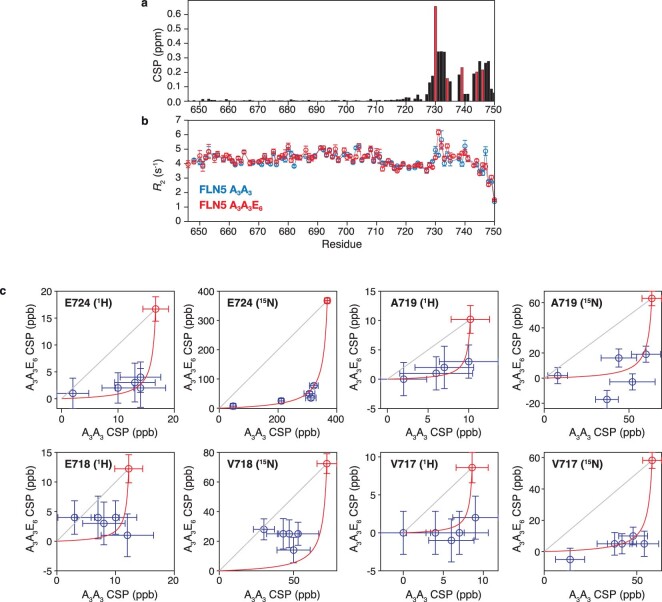
Most proteins begin to fold during biosynthesis on the ribosome. It has been suggested that interactions between the emerging polypeptide and the ribosome surface might allow the ribosome itself to modulate co-translational folding. Here we combine protein engineering and NMR spectroscopy to characterize a series of interactions between the ribosome surface and unfolded nascent chains of the immunoglobulin-like FLN5 filamin domain. The strongest interactions are found for a C-terminal segment that is essential for folding, and we demonstrate quantitative agreement between the strength of this interaction and the energetics of the co-translational folding process itself. Mutations in this region that reduce the extent of binding result in a shift in the co-translational folding equilibrium towards the native state. Our results therefore demonstrate that a competition between folding and binding provides a simple, dynamic mechanism for the modulation of co-translational folding by the ribosome.
大多数蛋白质在核糖体上的生物合成过程中开始折叠。有人提出,新生多肽与核糖体表面之间的相互作用可能允许核糖体本身调节共翻译折叠。在这里,我们结合蛋白质工程和 NMR 光谱学来描述核糖体表面和免疫球蛋白样 FLN5 细丝蛋白域的未折叠新生链之间的一系列相互作用。最强的相互作用发生在折叠所必需的 C 末端片段上,我们证明了这种相互作用的强度与共翻译折叠过程本身的能量之间存在定量一致性。该区域中减少结合程度的突变导致共翻译折叠平衡向天然状态转移。因此,我们的结果表明,折叠和结合之间的竞争为核糖体对共翻译折叠的调节提供了一种简单、动态的机制。