Khademi Zeinab, Milajerdi Alireza, Larijani Bagher, Esmaillzadeh Ahmad
Students' Scientific Research Center, Tehran University of Medical Sciences, Tehran, Iran.
Department of Community Nutrition, School of Nutritional Sciences and Dietetics, Tehran University of Medical Sciences, Tehran, Iran.
Front Nutr. 2021 Oct 1;8:707795. doi: 10.3389/fnut.2021.707795. eCollection 2021.
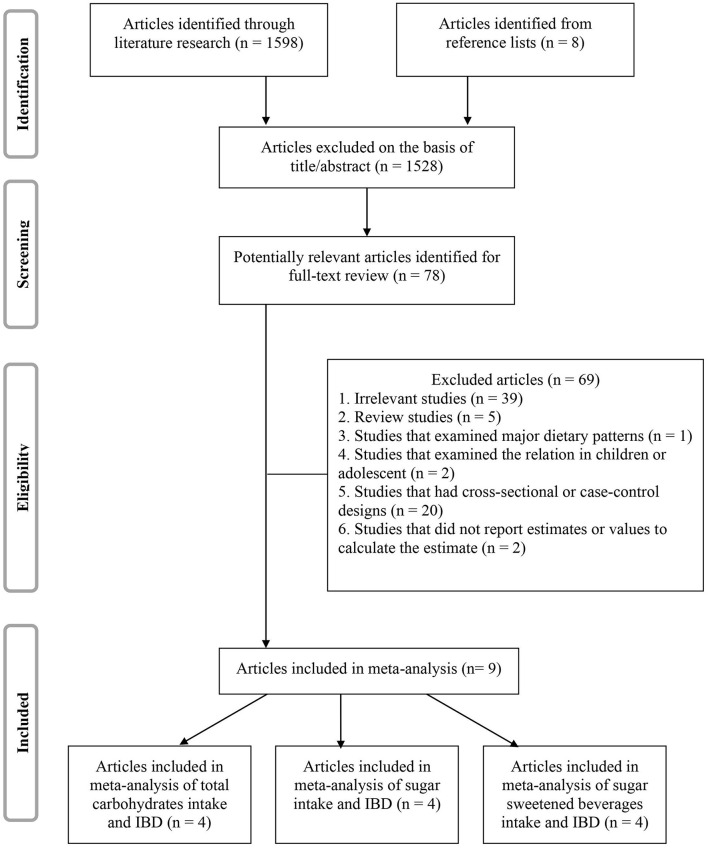
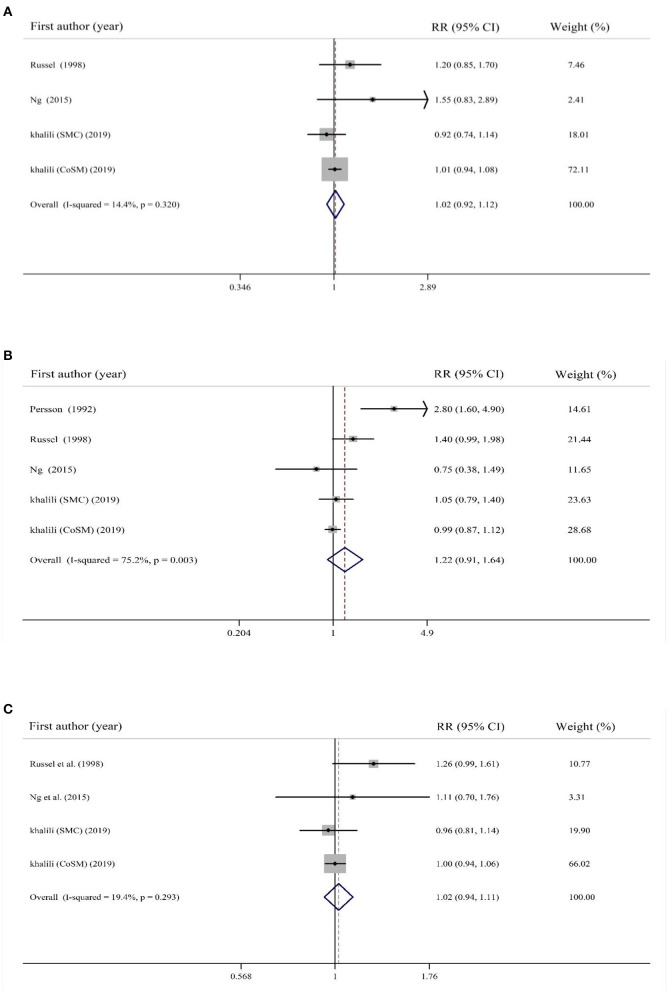
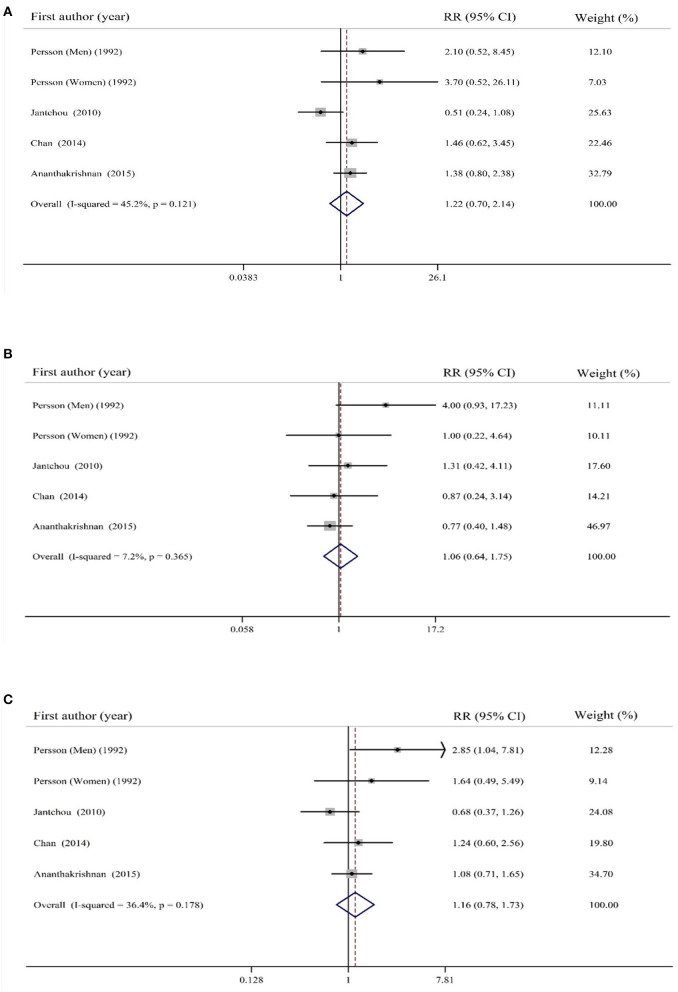
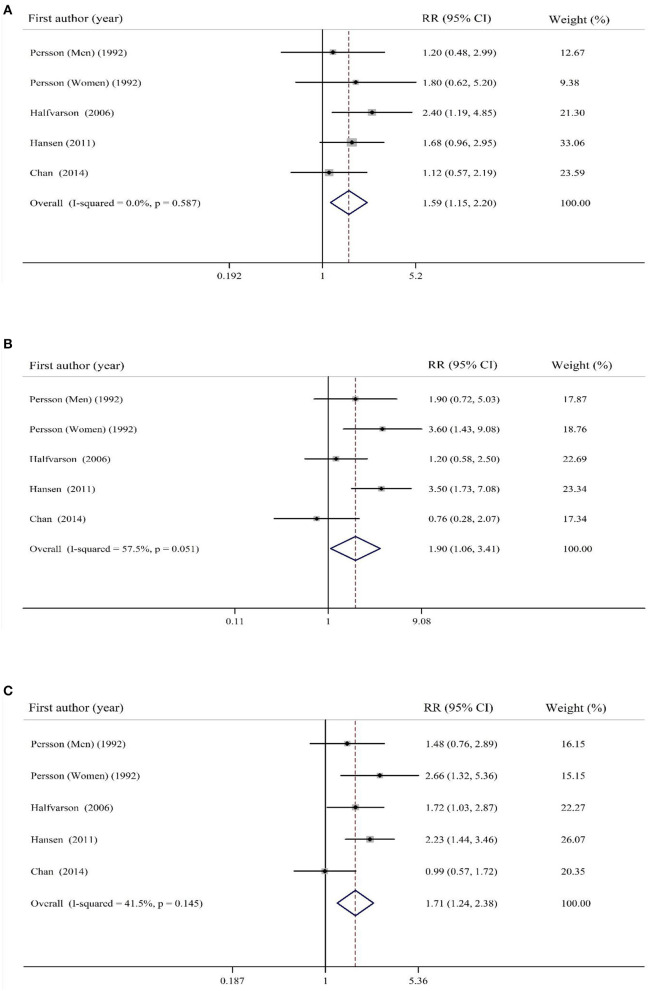
No earlier study has summarized findings from prospective cohort studies on the association of dietary carbohydrates, sugar, and sugar-sweetened beverages (SSBs) consumption and risk of inflammatory bowel disease (IBD). The current study was done to quantitatively summarize earlier information from prospective cohort studies on the link between dietary carbohydrates, sugar, and SSBs intake with risk of IBD. Relevant studies published up to June 2021 were searched through PubMed, Medline, SCOPUS, EMBASE, and Google Scholar with the use of relevant keywords. All prospective cohort studies investigating the association of dietary carbohydrates, sugar, and SSBs consumption with risk of IBD were included. Combining 5 effect sizes from 4 cohort studies, no significant association was found between dietary intake of carbohydrates and risk of ulcerative colitis (UC) (RR: 1.22; 95% CI: 0.70-2.14). The same findings were obtained for risk of Crohn's disease (CD) (RR: 1.06; 95% CI: 0.64-1.75) based on 4 studies with 5 effect sizes. A significant positive association was observed between sugar intake and risk of UC (RR: 1.59; 95% CI: 1.15-2.20), as well as CD (RR: 1.90; 95% CI: 1.06-3.41) when 5 effect sizes from 4 cohort studies were combined. The overall effect size, based on 4 estimates, revealed no significant association between SSBs consumption and risk of UC (RR: 1.02; 95% CI: 0.92-1.12) and CD (RR: 1.22; 95% CI: 0.91-1.64). Summarizing earlier studies, sugar intake was found to be associated with increased risk of IBD and its subtypes. Any significant association between dietary intake of carbohydrates and SSBs and risk of IBD and its subtypes was not found.
此前尚无研究总结前瞻性队列研究中关于膳食碳水化合物、糖及含糖饮料(SSB)的摄入与炎症性肠病(IBD)风险之间关联的结果。本研究旨在定量总结前瞻性队列研究中关于膳食碳水化合物、糖及SSB的摄入与IBD风险之间联系的早期信息。通过使用相关关键词,在PubMed、Medline、SCOPUS、EMBASE和谷歌学术上检索截至2021年6月发表的相关研究。纳入所有调查膳食碳水化合物、糖及SSB的摄入与IBD风险之间关联的前瞻性队列研究。综合4项队列研究的5个效应量,未发现碳水化合物的膳食摄入量与溃疡性结肠炎(UC)风险之间存在显著关联(风险比:1.22;95%置信区间:0.70 - 2.14)。基于4项研究的5个效应量,对于克罗恩病(CD)风险也得到了相同的结果(风险比:1.06;95%置信区间:0.64 - 1.75)。当综合4项队列研究的5个效应量时,观察到糖的摄入量与UC风险(风险比:1.59;95%置信区间:1.15 - 2.20)以及CD风险(风险比:1.90;95%置信区间:1.06 - 3.41)之间存在显著正相关。基于4项估计值的总体效应量显示,SSB的摄入量与UC风险(风险比:1.02;95%置信区间:0.92 - 1.12)和CD风险(风险比:1.22;95%置信区间:0.91 - 1.64)之间无显著关联。总结早期研究发现,糖的摄入量与IBD及其亚型风险增加有关。未发现碳水化合物和SSB的膳食摄入量与IBD及其亚型风险之间存在任何显著关联。