Huang Xiuyu, Zhou Nan, Choi Kup-Sze
Centre for Smart Health, The Hong Kong Polytechnic University, Hong Kong, Hong Kong SAR, China.
College of Control Engineering, Chengdu University of Information Technology, Chengdu, China.
Front Neurosci. 2021 Oct 22;15:760979. doi: 10.3389/fnins.2021.760979. eCollection 2021.
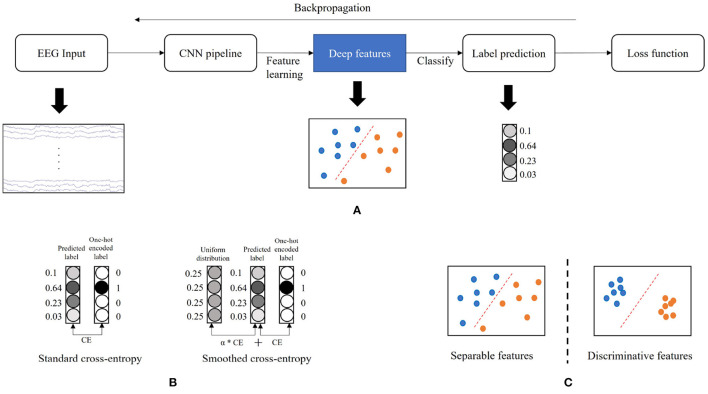
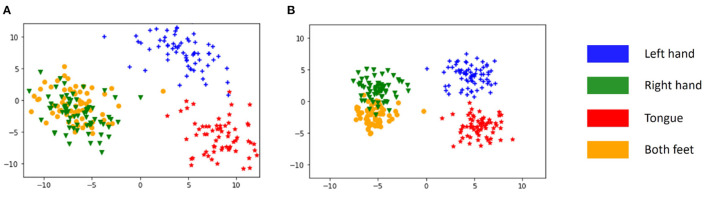
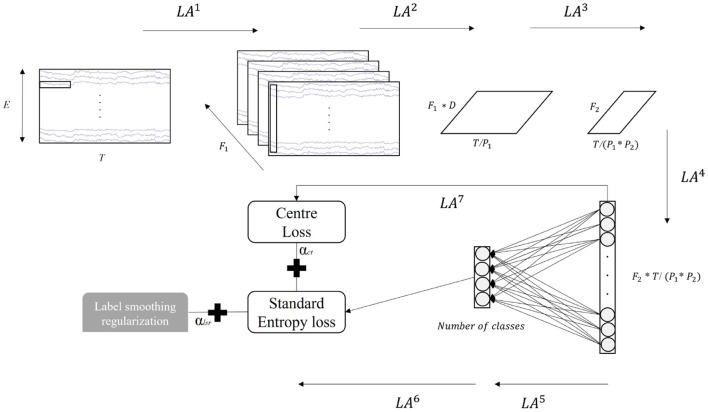
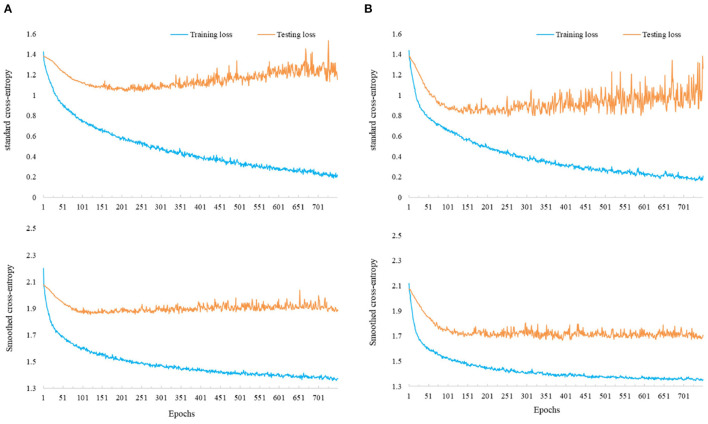
Convolutional neural networks (CNNs) have been widely applied to the motor imagery (MI) classification field, significantly improving the state-of-the-art (SoA) performance in terms of classification accuracy. Although innovative model structures are thoroughly explored, little attention was drawn toward the objective function. In most of the available CNNs in the MI area, the standard cross-entropy loss is usually performed as the objective function, which only ensures deep feature separability. Corresponding to the limitation of current objective functions, a new loss function with a combination of smoothed cross-entropy (with label smoothing) and center loss is proposed as the supervision signal for the model in the MI recognition task. Specifically, the smoothed cross-entropy is calculated by the entropy between the predicted labels and the one-hot hard labels regularized by a noise of uniform distribution. The center loss learns a deep feature center for each class and minimizes the distance between deep features and their corresponding centers. The proposed loss tries to optimize the model in two learning objectives, preventing overconfident predictions and increasing deep feature discriminative capacity (interclass separability and intraclass invariant), which guarantee the effectiveness of MI recognition models. We conduct extensive experiments on two well-known benchmarks (BCI competition IV-2a and IV-2b) to evaluate our method. The result indicates that the proposed approach achieves better performance than other SoA models on both datasets. The proposed learning scheme offers a more robust optimization for the CNN model in the MI classification task, simultaneously decreasing the risk of overfitting and increasing the discriminative power of deeply learned features.
卷积神经网络(CNNs)已被广泛应用于运动想象(MI)分类领域,在分类准确率方面显著提高了当前的先进(SoA)性能。尽管对创新的模型结构进行了深入探索,但对目标函数的关注却很少。在MI领域现有的大多数CNN中,标准交叉熵损失通常作为目标函数,这仅确保了深度特征的可分离性。针对当前目标函数的局限性,提出了一种将平滑交叉熵(带标签平滑)和中心损失相结合的新损失函数,作为MI识别任务中模型的监督信号。具体而言,平滑交叉熵通过预测标签与由均匀分布噪声正则化的独热硬标签之间的熵来计算。中心损失为每个类别学习一个深度特征中心,并最小化深度特征与其对应中心之间的距离。所提出的损失试图在两个学习目标中优化模型,防止过度自信的预测并提高深度特征的判别能力(类间可分离性和类内不变性),这保证了MI识别模型的有效性。我们在两个著名的基准数据集(BCI竞赛IV-2a和IV-2b)上进行了广泛的实验来评估我们的方法。结果表明,所提出的方法在两个数据集上都比其他SoA模型取得了更好的性能。所提出的学习方案为MI分类任务中的CNN模型提供了更稳健的优化,同时降低了过拟合的风险并提高了深度特征的判别能力。