Umbrello Steven, van de Poel Ibo
Institute for Ethics and Emerging Technologies, University of Turin, Via Sant'Ottavio, 20, 10124 Turin, Italy.
Delft University of Technology, Faculty of Technology, Policy and Management, Jaffalaan 5, 2628 BX Delft, The Netherlands.
AI Ethics. 2021;1(3):283-296. doi: 10.1007/s43681-021-00038-3. Epub 2021 Feb 1.
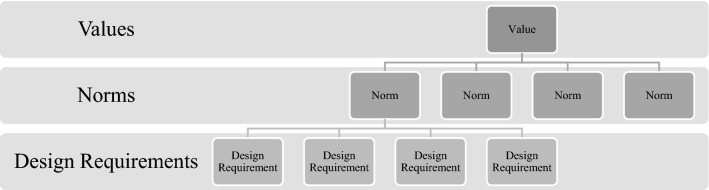
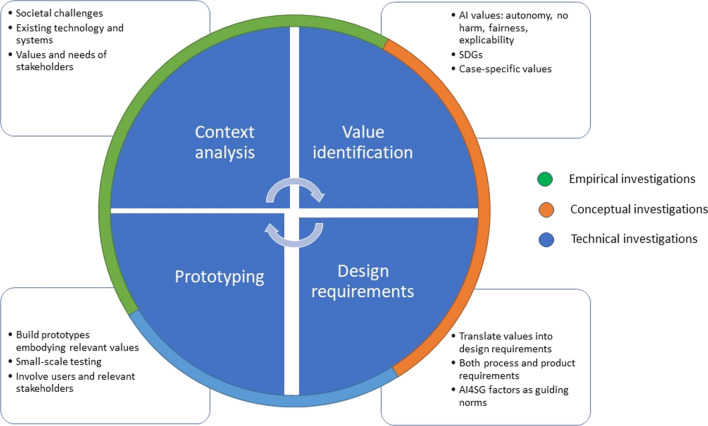
Value sensitive design (VSD) is an established method for integrating values into technical design. It has been applied to different technologies and, more recently, to artificial intelligence (AI). We argue that AI poses a number of challenges specific to VSD that require a somewhat modified VSD approach. Machine learning (ML), in particular, poses two challenges. First, humans may not understand how an AI system learns certain things. This requires paying attention to values such as transparency, explicability, and accountability. Second, ML may lead to AI systems adapting in ways that 'disembody' the values embedded in them. To address this, we propose a threefold modified VSD approach: (1) integrating a known set of VSD principles (AI4SG) as design norms from which more specific design requirements can be derived; (2) distinguishing between values that are promoted and respected by the design to ensure outcomes that not only do no harm but also contribute to good, and (3) extending the VSD process to encompass the whole life cycle of an AI technology to monitor unintended value consequences and redesign as needed. We illustrate our VSD for AI approach with an example use case of a SARS-CoV-2 contact tracing app.
价值敏感设计(VSD)是一种将价值观融入技术设计的既定方法。它已应用于不同的技术,最近还应用于人工智能(AI)。我们认为,人工智能给价值敏感设计带来了一些特定挑战,需要对价值敏感设计方法进行一定程度的修改。特别是机器学习(ML)带来了两个挑战。第一,人类可能不理解人工智能系统是如何学习某些东西的。这就需要关注透明度、可解释性和可问责性等价值观。第二,机器学习可能导致人工智能系统以“脱离”其嵌入价值观的方式进行适应。为了解决这个问题,我们提出了一种三重修改后的价值敏感设计方法:(1)将一组已知的价值敏感设计原则(AI4SG)作为设计规范进行整合,从中可以推导出更具体的设计要求;(2)区分设计所促进和尊重的价值观,以确保结果不仅无害,而且有助于实现良好目标;(3)扩展价值敏感设计过程,以涵盖人工智能技术的整个生命周期,监测意外的价值后果,并根据需要进行重新设计。我们用一个SARS-CoV-2接触者追踪应用程序的示例用例来说明我们的人工智能价值敏感设计方法。