Institute of Biomedicine, Faculty of Medicine, University of Turku, Kiinanmyllynkatu 10, Turku 20520, Finland.
College of Engineering, Effat University, Jeddah 22332, Saudi Arabia.
J Healthc Eng. 2021 Nov 9;2021:1970769. doi: 10.1155/2021/1970769. eCollection 2021.
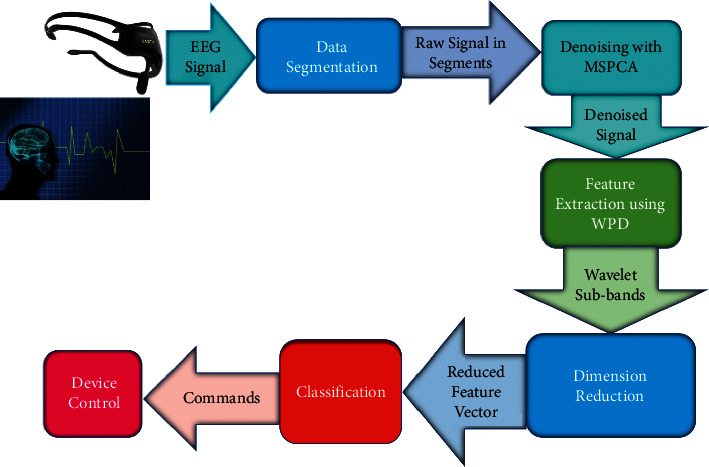
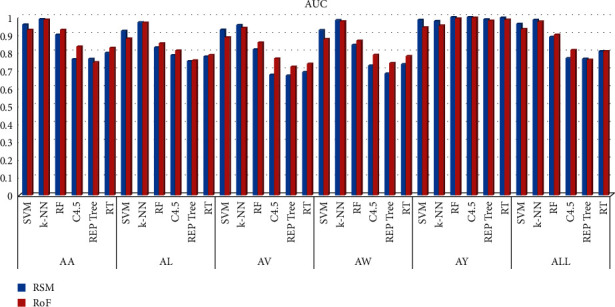
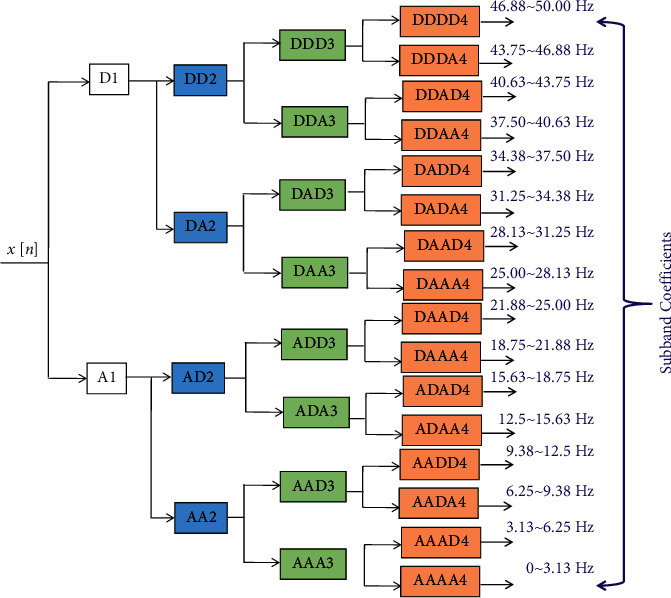
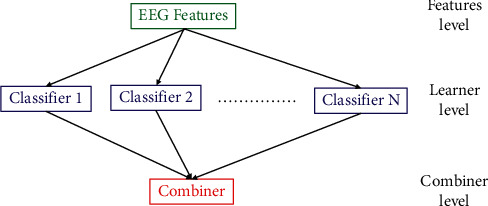
The Brain-Computer Interface (BCI) permits persons with impairments to interact with the real world without using the neuromuscular pathways. BCIs are based on artificial intelligence piloted systems. They collect brain activity patterns linked to the mental process and transform them into commands for actuators. The potential application of BCI systems is in the rehabilitation centres. In this context, a novel method is devised for automated identification of the Motor Imagery (MI) tasks. The contribution is an effective hybridization of the Multiscale Principal Component Analysis (MSPCA), Wavelet Packet Decomposition (WPD), statistical features extraction from subbands, and ensemble learning-based classifiers for categorization of the MI tasks. The intended electroencephalogram (EEG) signals are segmented and denoised. The denoising is achieved with a Daubechies algorithm-based wavelet transform (WT) incorporated in the MSPCA. The WT with the 5th level of decomposition is used. Onward, the Wavelet Packet Decomposition (WPD), with the 4th level of decomposition, is used for subbands formation. The statistical features are selected from each subband, namely, mean absolute value, average power, standard deviation, skewness, and kurtosis. Also, ratios of absolute mean values of adjacent subbands are computed and concatenated with other extracted features. Finally, the ensemble machine learning approach is used for the classification of MI tasks. The usefulness is evaluated by using the BCI competition III, MI dataset IVa. Results revealed that the suggested ensemble learning approach yields the highest classification accuracies of 98.69% and 94.83%, respectively, for the cases of subject-dependent and subject-independent problems.
脑机接口(BCI)允许有损伤的人无需使用神经肌肉通路即可与现实世界互动。BCI 基于人工智能制导系统。它们收集与心理过程相关的大脑活动模式,并将其转化为执行器的命令。BCI 系统的潜在应用是在康复中心。在这种情况下,设计了一种用于自动识别运动想象(MI)任务的新方法。该方法的贡献在于,有效地将多尺度主成分分析(MSPCA)、小波包分解(WPD)、子带统计特征提取以及基于集成学习的分类器进行融合,以对 MI 任务进行分类。所意图的脑电图(EEG)信号被分段和去噪。去噪是通过基于 Daubechies 算法的小波变换(WT)与 MSPCA 相结合来实现的。使用 5 级分解的 WT。接下来,使用 4 级分解的小波包分解(WPD)用于子带形成。从每个子带中选择统计特征,即绝对值、平均功率、标准差、偏度和峰度。此外,还计算相邻子带的绝对值平均值的比率,并将其与其他提取的特征串联。最后,使用集成机器学习方法对 MI 任务进行分类。通过使用 BCI 竞赛 III、MI 数据集 IVa 来评估其有用性。结果表明,所提出的集成学习方法在主体相关和主体无关问题的情况下分别产生了 98.69%和 94.83%的最高分类准确率。