Deng Liming, Chen Bo, Zhan Chenyi, Yu Haitao, Zheng Jiuyi, Bao Wenming, Deng Tuo, Zheng Chongming, Wu Lijun, Yang Yunjun, Yu Zhengping, Wang Yi, Chen Gang
Department of Hepatobiliary Surgery, The First Affiliated Hospital of Wenzhou Medical University, Wenzhou, China.
Key Laboratory of Diagnosis and Treatment of Severe Hepato-Pancreatic Diseases of Zhejiang Province, The First Affiliated Hospital of Wenzhou Medical University, Wenzhou, China.
Front Oncol. 2021 Nov 19;11:744311. doi: 10.3389/fonc.2021.744311. eCollection 2021.
Intrahepatic cholangiocarcinoma (ICC) is a highly aggressive malignant tumor with a poor prognosis. This study aimed to establish a novel clinical-radiomics model for predicting the prognosis of ICC after radical hepatectomy.
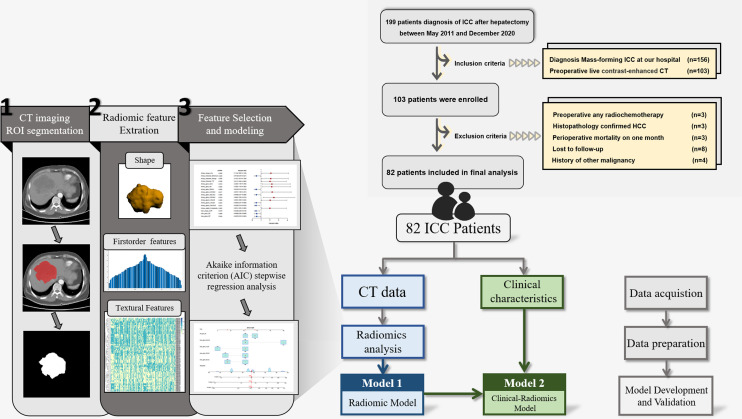
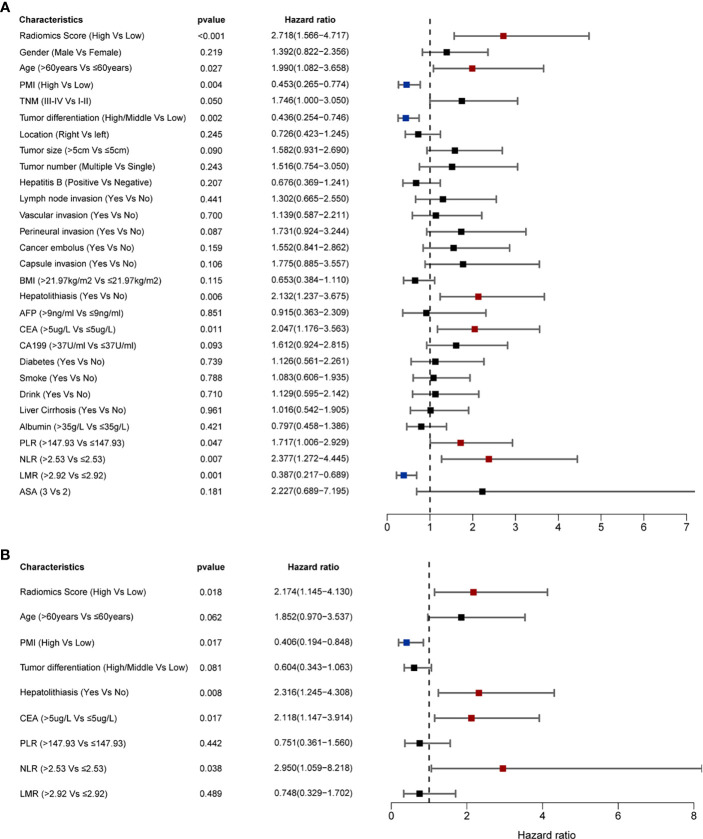
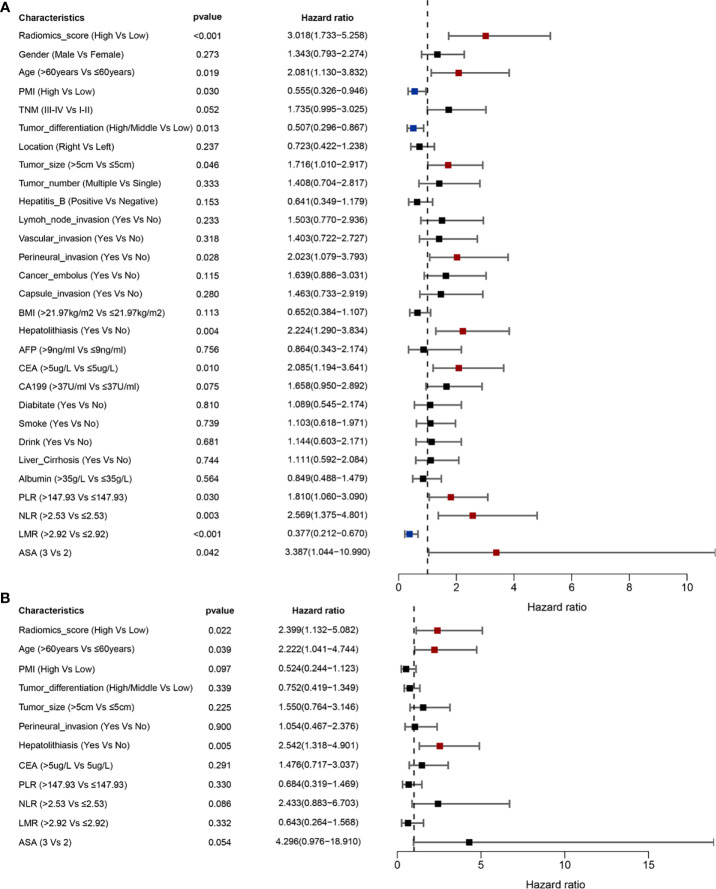
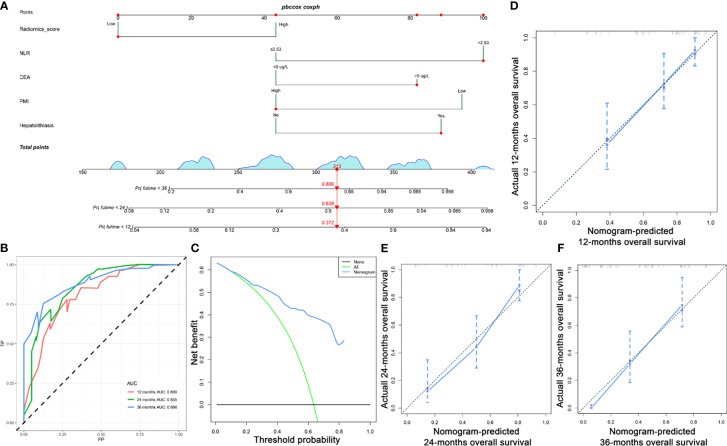
A clinical-radiomics model was established for 82 cases of ICC treated with radical hepatectomy in our hospital from May 2011 to December 2020. Radiomics features were extracted from venous-phase and arterial-phase images of computed tomography. Kaplan-Meier survival analysis was generated to compare overall survival (OS) between different groups. The independent factors were identified by univariate and multivariate Cox regression analyses. Nomogram performance was evaluated regarding discrimination, calibration, and clinical utility. C-index and area under the curve (AUC) were utilized to compare the predictive performance between the clinical-radiomics model and conventional staging systems.
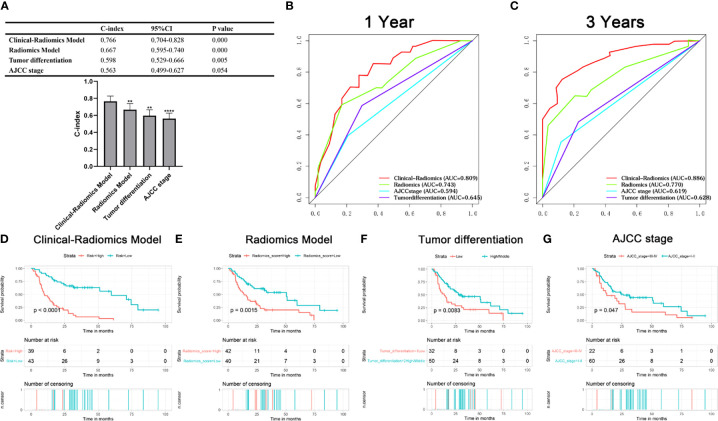
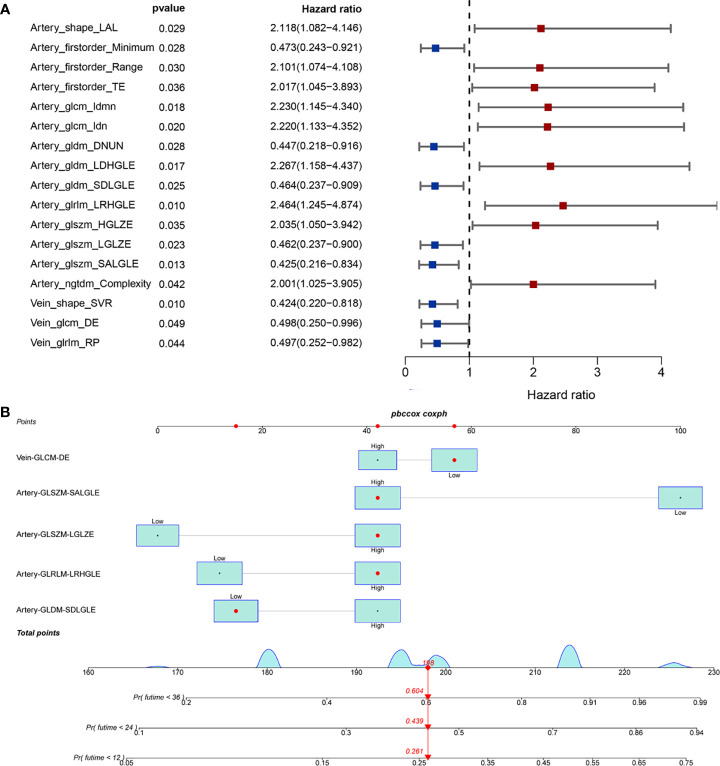
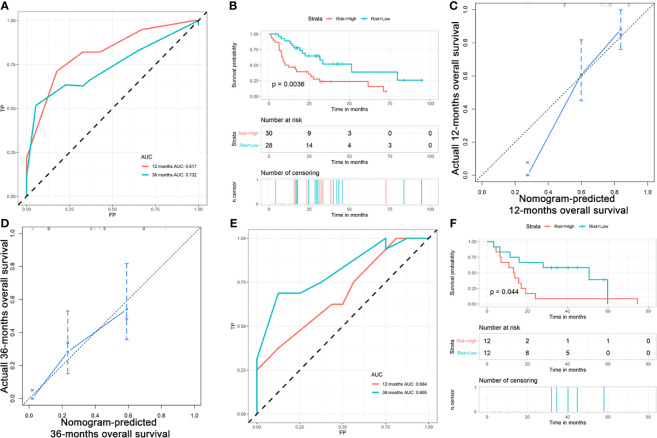
The radiomics model included five features. The AUC of the radiomics model was 0.817 in the training cohort, and 0.684 in the validation cohort. The clinical-radiomics model included psoas muscle index, radiomics score, hepatolithiasis, carcinoembryonic antigen, and neutrophil/lymphocyte ratio. The reliable C-index of the model was 0.768, which was higher than that of other models. The AUC of the model for predicting OS at 1, and 3 years was 0.809 and 0.886, which was significantly higher than that of the American Joint Committee on Cancer 8 staging system (0.594 and 0.619), radiomics model (0.743 and 0.770), and tumor differentiation (0.645 and 0.628). After stratification according to the constructed model, the median OS was 59.8 months for low-risk ICC patients and 10.1 months for high-risk patients ( 0.0001).
The clinical-radiomics model integrating sarcopenia, clinical features, and radiomics score was accurate for prognostic prediction for mass-forming ICC patients. It provided an individualized prognostic evaluation in patients with mass-forming ICC and could helped surgeons with clinical decision-making.
肝内胆管癌(ICC)是一种侵袭性很强的恶性肿瘤,预后较差。本研究旨在建立一种新的临床-影像组学模型,用于预测根治性肝切除术后ICC的预后。
对2011年5月至2020年12月在我院接受根治性肝切除的82例ICC患者建立临床-影像组学模型。从计算机断层扫描的静脉期和动脉期图像中提取影像组学特征。采用Kaplan-Meier生存分析比较不同组的总生存期(OS)。通过单因素和多因素Cox回归分析确定独立因素。对列线图的性能进行辨别、校准和临床实用性评估。利用C指数和曲线下面积(AUC)比较临床-影像组学模型与传统分期系统之间的预测性能。
影像组学模型包括五个特征。影像组学模型在训练队列中的AUC为0.817,在验证队列中的AUC为0.684。临床-影像组学模型包括腰大肌指数、影像组学评分、肝内胆管结石、癌胚抗原和中性粒细胞/淋巴细胞比值。该模型可靠的C指数为0.768,高于其他模型。该模型预测1年和3年OS的AUC分别为0.809和0.886,显著高于美国癌症联合委员会第8版分期系统(0.594和0.619)、影像组学模型(0.743和0.770)以及肿瘤分化(0.645和0.628)。根据构建的模型进行分层后,低风险ICC患者的中位OS为59.8个月,高风险患者为10.1个月(P<0.0001)。
整合肌肉减少症、临床特征和影像组学评分的临床-影像组学模型对肿块型ICC患者的预后预测准确。它为肿块型ICC患者提供了个体化的预后评估,并有助于外科医生进行临床决策。