Zazzaro Gaetano, Martone Francesco, Romano Gianpaolo, Pavone Luigi
CIRA-Italian Aerospace Research Centre, 81043 Capua, Italy.
IRCCS Neuromed, 86077 Pozzilli, Italy.
J Clin Med. 2021 Dec 20;10(24):5982. doi: 10.3390/jcm10245982.
The aim of this study was to evaluate the performance of an automated COVID-19 detection method based on a transfer learning technique that makes use of chest computed tomography (CT) images.
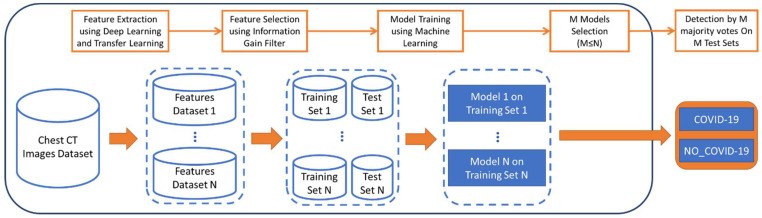
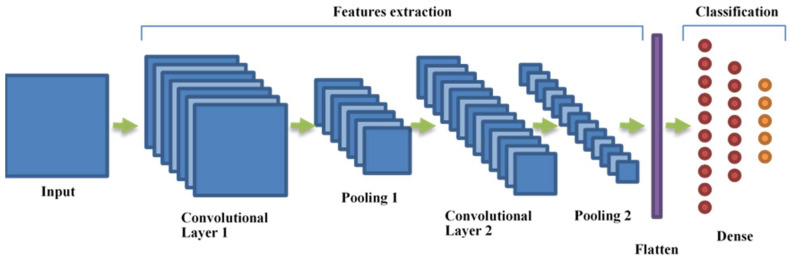
In this study, we used a publicly available multiclass CT scan dataset containing 4171 CT scans of 210 different patients. In particular, we extracted features from the CT images using a set of convolutional neural networks (CNNs) that had been pretrained on the ImageNet dataset as feature extractors, and we then selected a subset of these features using the Information Gain filter. The resulting feature vectors were then used to train a set of k Nearest Neighbors classifiers with 10-fold cross validation to assess the classification performance of the features that had been extracted by each CNN. Finally, a majority voting approach was used to classify each image into two different classes: COVID-19 and NO COVID-19.
A total of 414 images of the test set (10% of the complete dataset) were correctly classified, and only 4 were misclassified, yielding a final classification accuracy of 99.04%.
The high performance that was achieved by the method could make it feasible option that could be used to assist radiologists in COVID-19 diagnosis through the use of CT images.
本研究的目的是评估一种基于迁移学习技术的自动化新冠病毒检测方法的性能,该技术利用胸部计算机断层扫描(CT)图像。
在本研究中,我们使用了一个公开可用的多类CT扫描数据集,其中包含210名不同患者的4171次CT扫描。具体而言,我们使用一组在ImageNet数据集上预训练的卷积神经网络(CNN)作为特征提取器,从CT图像中提取特征,然后使用信息增益滤波器选择这些特征的一个子集。然后,将得到的特征向量用于训练一组k近邻分类器,并进行10折交叉验证,以评估每个CNN提取的特征的分类性能。最后,使用多数投票方法将每个图像分类为两个不同的类别:新冠病毒感染和非新冠病毒感染。
测试集(完整数据集的10%)中的414张图像被正确分类,只有4张被错误分类,最终分类准确率为99.04%。
该方法取得的高性能使其成为一种可行的选择,可用于通过CT图像协助放射科医生进行新冠病毒感染诊断。