Department of Computer Science, HITEC University Taxila, Museum Road, Taxila, Pakistan.
College of Computer Engineering and Sciences, Prince Sattam Bin Abdulaziz University, Al-Kharj, Saudi Arabia.
Behav Neurol. 2021 Dec 27;2021:2560388. doi: 10.1155/2021/2560388. eCollection 2021.
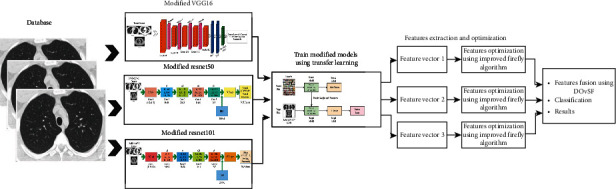
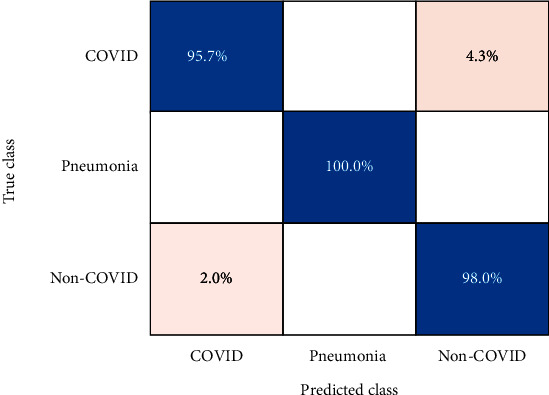
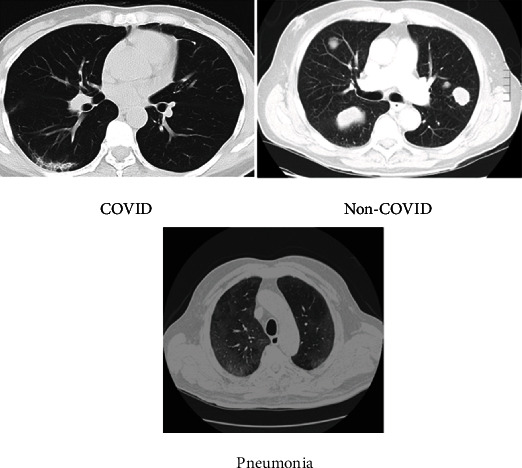
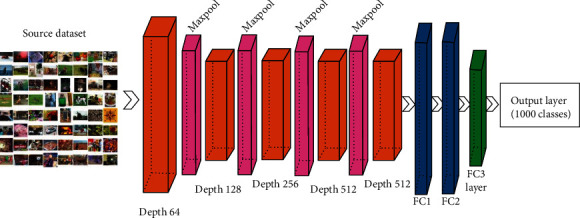
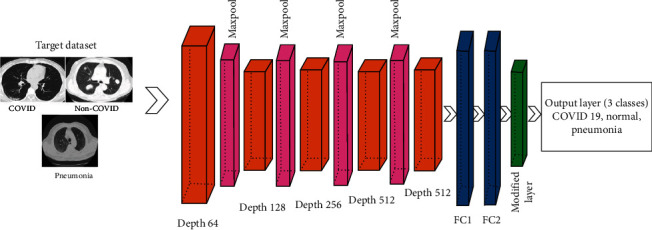
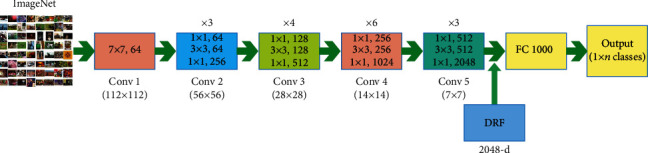
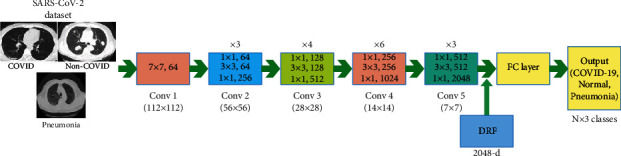
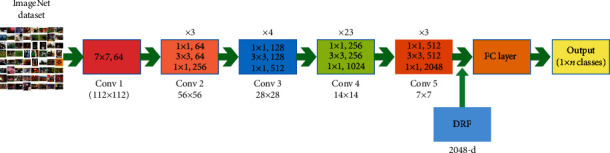
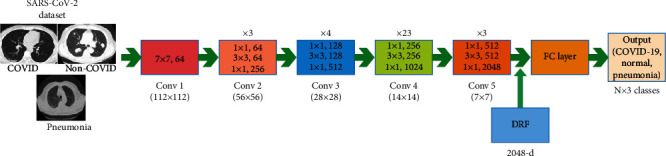
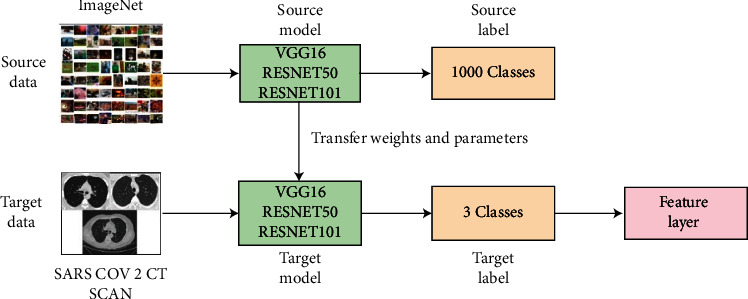
The excessive number of COVID-19 cases reported worldwide so far, supplemented by a high rate of false alarms in its diagnosis using the conventional polymerase chain reaction method, has led to an increased number of high-resolution computed tomography (CT) examinations conducted. The manual inspection of the latter, besides being slow, is susceptible to human errors, especially because of an uncanny resemblance between the CT scans of COVID-19 and those of pneumonia, and therefore demands a proportional increase in the number of expert radiologists. Artificial intelligence-based computer-aided diagnosis of COVID-19 using the CT scans has been recently coined, which has proven its effectiveness in terms of accuracy and computation time. In this work, a similar framework for classification of COVID-19 using CT scans is proposed. The proposed method includes four core steps: (i) preparing a database of three different classes such as COVID-19, pneumonia, and normal; (ii) modifying three pretrained deep learning models such as VGG16, ResNet50, and ResNet101 for the classification of COVID-19-positive scans; (iii) proposing an activation function and improving the firefly algorithm for feature selection; and (iv) fusing optimal selected features using descending order serial approach and classifying using multiclass supervised learning algorithms. We demonstrate that once this method is performed on a publicly available dataset, this system attains an improved accuracy of 97.9% and the computational time is almost 34 (sec).
到目前为止,全球报告的 COVID-19 病例数量过多,加上传统聚合酶链反应方法诊断中的高误报率,导致进行了更多的高分辨率计算机断层扫描 (CT) 检查。后者的手动检查不仅速度慢,而且容易出现人为错误,尤其是因为 COVID-19 的 CT 扫描与肺炎的 CT 扫描非常相似,因此需要相应增加专家放射科医生的数量。最近已经提出了基于人工智能的 COVID-19 计算机辅助 CT 扫描诊断,其在准确性和计算时间方面已被证明是有效的。在这项工作中,提出了一种使用 CT 扫描对 COVID-19 进行分类的类似框架。该方法包括四个核心步骤:(i) 准备三个不同类别的数据库,如 COVID-19、肺炎和正常;(ii) 修改三个预训练的深度学习模型,如 VGG16、ResNet50 和 ResNet101,用于 COVID-19 阳性扫描的分类;(iii) 提出激活函数并改进萤火虫算法进行特征选择;(iv) 使用降序串行方法融合最佳选择的特征,并使用多类监督学习算法进行分类。我们证明,一旦将该方法应用于公开可用的数据集,该系统的准确率可提高到 97.9%,计算时间几乎为 34 秒。