Yan Xiao-Ying, Yin Peng-Wei, Wu Xiao-Meng, Han Jia-Xin
College of Computer Science, Xi'an Shiyou University, Xi'an, China.
School of Electronic Engineering, Xi'an Shiyou University, Xi'an, China.
Front Pharmacol. 2021 Dec 20;12:794205. doi: 10.3389/fphar.2021.794205. eCollection 2021.
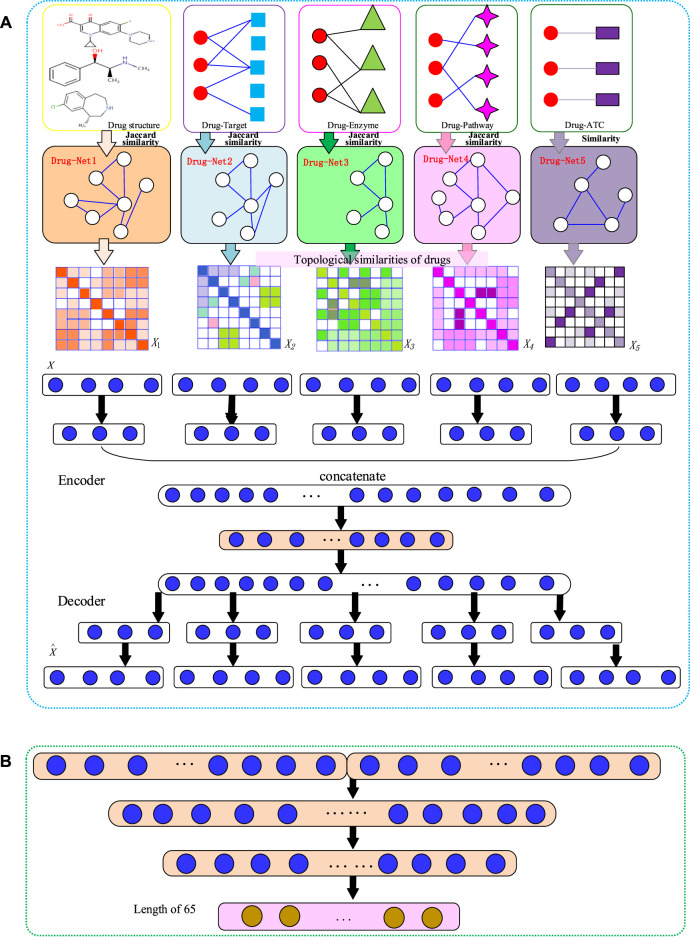
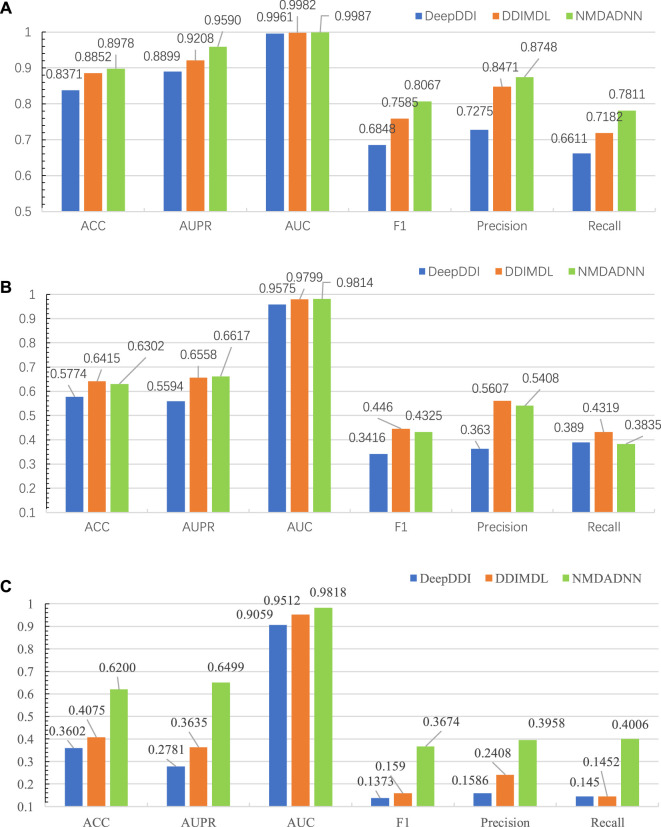
Drug combination therapies are a promising strategy to overcome drug resistance and improve the efficacy of monotherapy in cancer, and it has been shown to lead to a decrease in dose-related toxicities. Except the synergistic reaction between drugs, some antagonistic drug-drug interactions (DDIs) exist, which is the main cause of adverse drug events. Precisely predicting the type of DDI is important for both drug development and more effective drug combination therapy applications. Recently, numerous text mining- and machine learning-based methods have been developed for predicting DDIs. All these methods implicitly utilize the feature of drugs from diverse drug-related properties. However, how to integrate these features more efficiently and improve the accuracy of classification is still a challenge. In this paper, we proposed a novel method (called NMDADNN) to predict the DDI types by integrating five drug-related heterogeneous information sources to extract the unified drug mapping features. NMDADNN first constructs the similarity networks by using the Jaccard coefficient and then implements random walk with restart algorithm and positive pointwise mutual information for extracting the topological similarities. After that, five network-based similarities are unified by using a multimodel deep autoencoder. Finally, NMDADNN implements the deep neural network (DNN) on the unified drug feature to infer the types of DDIs. In comparison with other recent state-of-the-art DNN-based methods, NMDADNN achieves the best results in terms of accuracy, area under the precision-recall curve, area under the ROC curve, F1 score, precision and recall. In addition, many of the promising types of drug-drug pairs predicted by NMDADNN are also confirmed by using the interactions checker tool. These results demonstrate the effectiveness of our NMDADNN method, indicating that NMDADNN has the great potential for predicting DDI types.
药物联合疗法是克服癌症耐药性和提高单药治疗疗效的一种有前景的策略,并且已证明它能降低剂量相关毒性。除了药物之间的协同反应外,还存在一些拮抗药物-药物相互作用(DDIs),这是药物不良事件的主要原因。准确预测DDI的类型对于药物开发和更有效的药物联合治疗应用都很重要。最近,已经开发了许多基于文本挖掘和机器学习的方法来预测DDIs。所有这些方法都隐含地利用了来自不同药物相关属性的药物特征。然而,如何更有效地整合这些特征并提高分类的准确性仍然是一个挑战。在本文中,我们提出了一种新颖的方法(称为NMDADNN),通过整合五个与药物相关的异构信息源来提取统一的药物映射特征,以预测DDI类型。NMDADNN首先使用杰卡德系数构建相似性网络,然后实施带重启的随机游走算法和正点互信息来提取拓扑相似性。之后,使用多模型深度自动编码器统一五个基于网络的相似性。最后,NMDADNN在统一的药物特征上实施深度神经网络(DNN)以推断DDIs的类型。与其他最近基于DNN的先进方法相比,NMDADNN在准确性、精确召回曲线下面积、ROC曲线下面积、F1分数、精确率和召回率方面取得了最佳结果。此外,NMDADNN预测的许多有前景的药物-药物对类型也通过相互作用检查工具得到了证实。这些结果证明了我们的NMDADNN方法的有效性,表明NMDADNN在预测DDI类型方面具有巨大潜力。