Department of Occupational Therapy, I-Shou University, Yanchao Dist., Kaohsiung, 824, Taiwan, R.O.C.
School of Occupational Therapy, National Taiwan University, Zhongzheng Dist., Taipei, 100, Taiwan, R.O.C.
BMC Neurol. 2022 Jan 11;22(1):21. doi: 10.1186/s12883-021-02547-4.
Immersive virtual reality (VR)-based motor control training (VRT) is an innovative approach to improve motor function in patients with stroke. Currently, outcome measures for immersive VRT mainly focus on motor function. However, serum biomarkers help detect precise and subtle physiological changes. Therefore, this study aimed to identify the effects of immersive VRT on inflammation, oxidative stress, neuroplasticity and upper limb motor function in stroke patients.
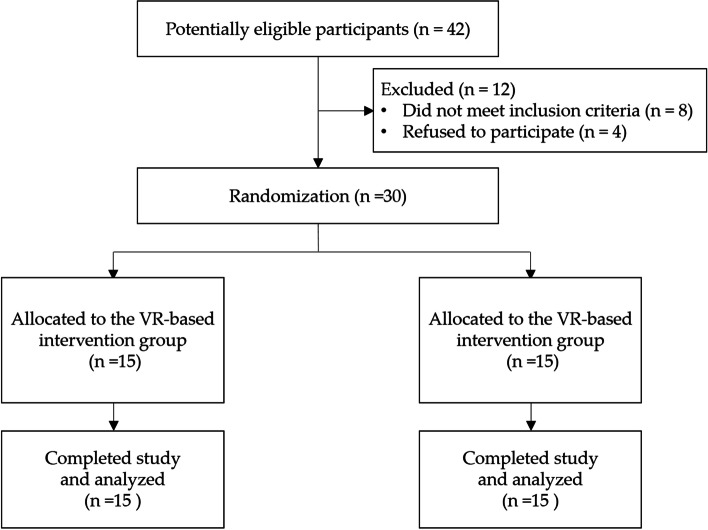
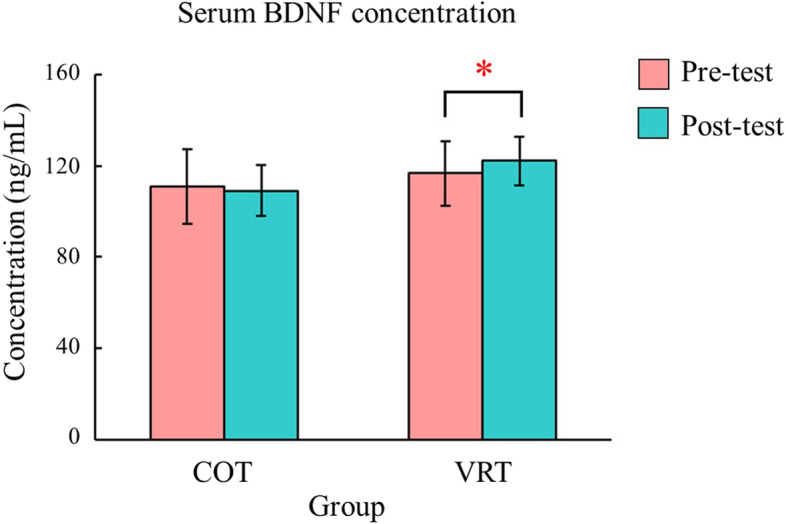
Thirty patients with chronic stroke were randomized to the VRT or conventional occupational therapy (COT) groups. Serum biomarkers including interleukin 6 (IL-6), intracellular adhesion molecule 1 (ICAM-1), heme oxygenase 1 (HO-1), 8-hydroxy-2-deoxyguanosine (8-OHdG), and brain-derived neurotrophic factor (BDNF) were assessed to reflect inflammation, oxidative stress and neuroplasticity. Clinical assessments including active range of motion of the upper limb and the Fugl-Meyer Assessment for upper extremity (FMA-UE) were also used. Two-way mixed analyses of variance (ANOVAs) were used to examine the effects of the intervention (VRT and COT) and time on serum biomarkers and upper limb motor function.
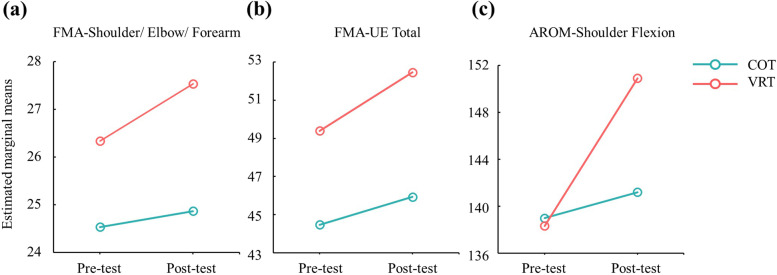
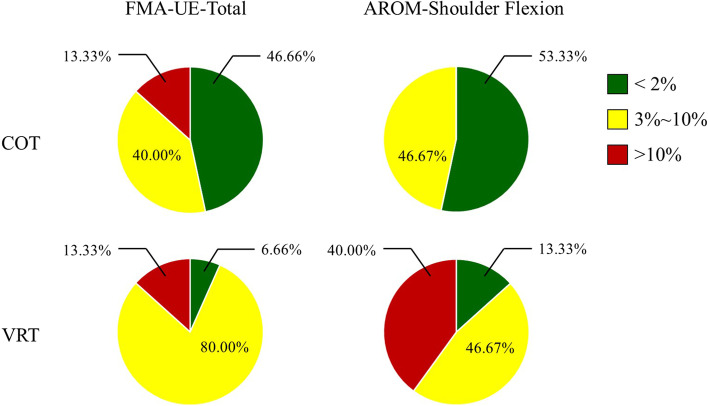
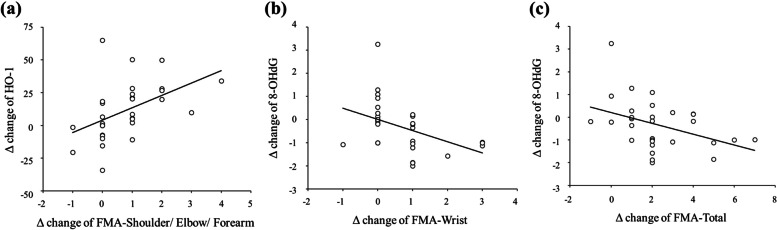
We found significant time effects in serum IL-6 (p = 0.010), HO-1 (p = 0.002), 8-OHdG (p = 0.045), and all items/subscales of the clinical assessments (ps < 0.05), except FMA-UE-Coordination/Speed (p = 0.055). However, significant group effects existed only in items of the AROM-Elbow Extension (p = 0.007) and AROM-Forearm Pronation (p = 0.048). Moreover, significant interactions between time and group existed in item/subscales of FMA-UE-Shoulder/Elbow/Forearm (p = 0.004), FMA-UE-Total score (p = 0.008), and AROM-Shoulder Flexion (p = 0.001).
This was the first study to combine the effectiveness of immersive VRT using serum biomarkers as outcome measures. Our study demonstrated promising results that support the further application of commercial and immersive VR technologies in patients with chronic stroke.
沉浸式虚拟现实(VR)为基础的运动控制训练(VRT)是一种提高中风患者运动功能的创新方法。目前,沉浸式 VR 的结果评估主要集中在运动功能上。然而,血清生物标志物有助于检测精确而微妙的生理变化。因此,本研究旨在确定沉浸式 VRT 对中风患者炎症、氧化应激、神经可塑性和上肢运动功能的影响。
将 30 名慢性中风患者随机分为 VRT 或常规职业治疗(COT)组。评估血清生物标志物,包括白细胞介素 6(IL-6)、细胞间黏附分子 1(ICAM-1)、血红素加氧酶 1(HO-1)、8-羟基-2-脱氧鸟苷(8-OHdG)和脑源性神经营养因子(BDNF),以反映炎症、氧化应激和神经可塑性。还使用上肢主动关节活动度和 Fugl-Meyer 上肢评估(FMA-UE)进行临床评估。采用双向混合方差分析(ANOVA)来检验干预(VRT 和 COT)和时间对血清生物标志物和上肢运动功能的影响。
我们发现血清 IL-6(p=0.010)、HO-1(p=0.002)、8-OHdG(p=0.045)和所有临床评估项目/子量表(p<0.05)的时间效应显著,除了 FMA-UE-协调/速度(p=0.055)。然而,仅在 AROM-肘伸展(p=0.007)和 AROM-前臂旋前(p=0.048)项目中存在显著的组间效应。此外,FMA-UE-肩/肘/前臂(p=0.004)、FMA-UE-总分(p=0.008)和 AROM-肩前屈(p=0.001)的项目/子量表中存在时间和组间的显著交互作用。
这是第一项结合沉浸式 VR 有效性并使用血清生物标志物作为结果评估的研究。我们的研究结果表明,沉浸式 VR 技术具有应用前景,支持在慢性中风患者中进一步应用商业和沉浸式 VR 技术。