Leicester Real World Evidence Unit, Diabetes Research Centre, Leicester, LE5 4PW, UK.
Diabetes Research Centre, Leicester Diabetes Centre, Leicester General Hospital, Leicester, LE5 4PW, UK.
J R Soc Med. 2022 Apr;115(4):138-144. doi: 10.1177/01410768211073923. Epub 2022 Feb 4.
To assess the association between household size and risk of non-severe or severe COVID-19.
A longitudinal observational study.
This study utilised UK Biobank linked to national SARS-CoV-2 laboratory test data.
401,910 individuals with available data on household size in UK Biobank.
Household size was categorised as single occupancy, two-person households and households of three or more. Severe COVID-19 was defined as a positive SARS-CoV-2 test on hospital admission or death with COVID-19 recorded as the underlying cause; and non-severe COVID-19 as a positive test from a community setting. Logistic regression models were fitted to assess associations, adjusting for potential confounders.
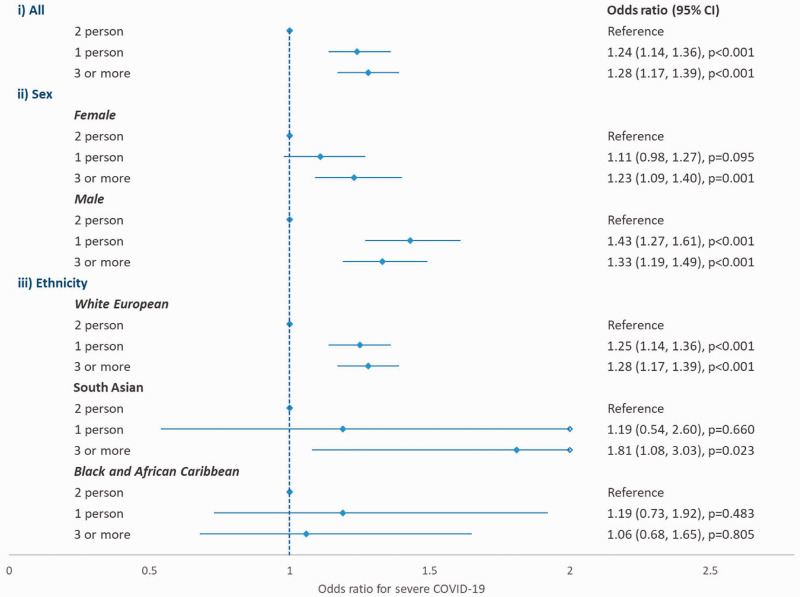
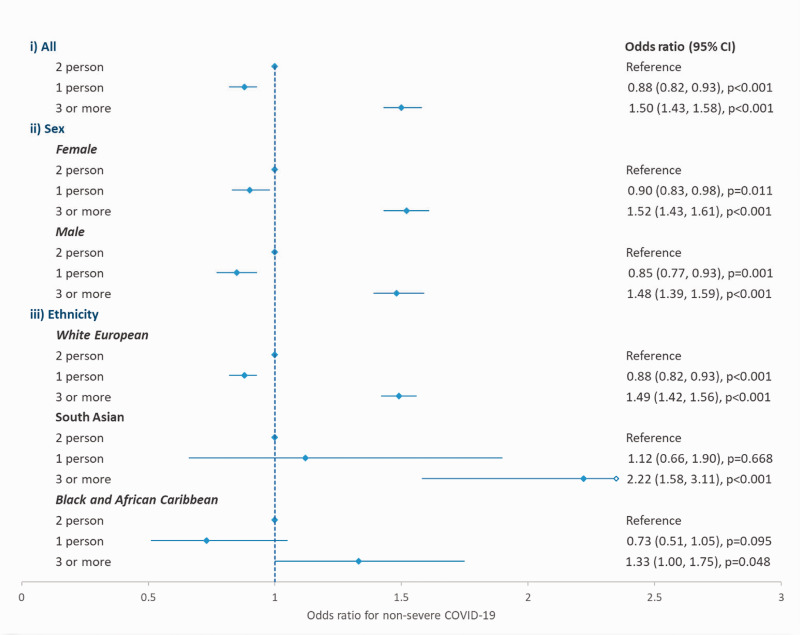
Of 401,910 individuals, 3612 (1%) were identified as having suffered from a severe COVID-19 infection and 11,264 (2.8%) from a non-severe infection, between 16 March 2020 and 16 March 2021. Overall, the odds of severe COVID-19 was significantly higher among individuals living alone (adjusted odds ratio: 1.24 [95% confidence interval: 1.14 to 1.36], or living in a household of three or more individuals (adjusted odds ratio: 1.28 [1.17 to 1.39], when compared to individuals living in a household of two. For non-severe COVID-19 infection, individuals living in a single-occupancy household had lower odds compared to those living in a household of two (adjusted odds ratio: 0.88 [0.82 to 0.93].
Odds of severe or non-severe COVID-19 infection were associated with household size. Increasing understanding of why certain households are more at risk is important for limiting spread of the infection.
评估家庭规模与非重症或重症 COVID-19 风险之间的关联。
纵向观察性研究。
本研究利用英国生物银行(UK Biobank)与国家 SARS-CoV-2 实验室检测数据进行关联。
401910 名在 UK Biobank 中有家庭规模相关数据的个体。
家庭规模分为单人居住、两人家庭和三人或以上家庭。重症 COVID-19 定义为住院时 SARS-CoV-2 检测呈阳性或因 COVID-19 死亡且 COVID-19 被记录为根本死因;非重症 COVID-19 为社区环境中检测呈阳性。使用逻辑回归模型评估关联,并调整潜在混杂因素。
在 401910 名个体中,在 2020 年 3 月 16 日至 2021 年 3 月 16 日期间,有 3612 人(1%)被确诊患有重症 COVID-19 感染,有 11264 人(2.8%)患有非重症感染。总体而言,与居住在两人家庭的个体相比,独居者(调整后的优势比:1.24 [95%置信区间:1.14 至 1.36])或居住在三人或以上家庭的个体(调整后的优势比:1.28 [1.17 至 1.39])发生重症 COVID-19 的可能性明显更高。对于非重症 COVID-19 感染,与居住在两人家庭的个体相比,居住在单人居住家庭的个体发生感染的可能性较低(调整后的优势比:0.88 [0.82 至 0.93])。
重症或非重症 COVID-19 感染的几率与家庭规模有关。增加对某些家庭风险较高的原因的理解对于限制感染的传播非常重要。