Institute of Integrative Biology, ETH Zurich, Zürich, Switzerland.
PLoS One. 2022 Feb 11;17(2):e0263597. doi: 10.1371/journal.pone.0263597. eCollection 2022.
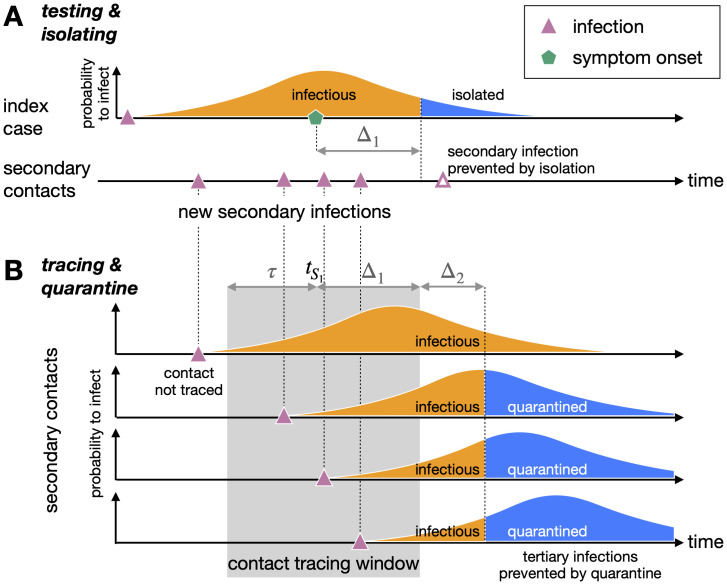
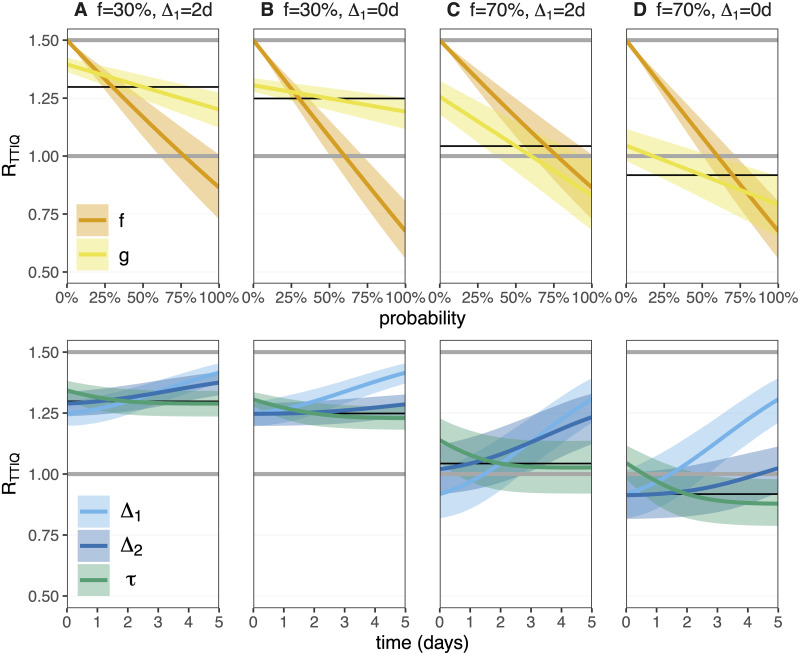
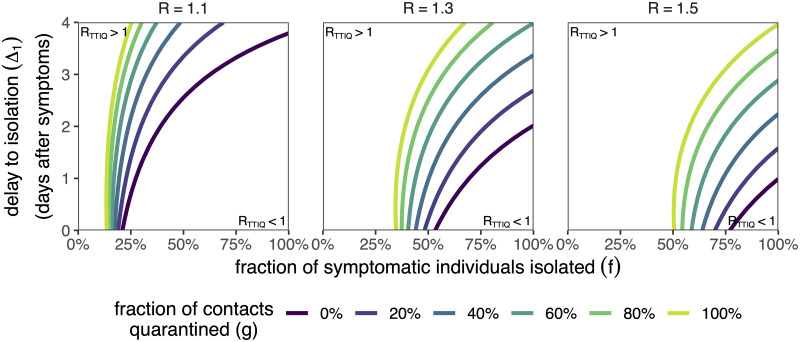
The test-trace-isolate-quarantine (TTIQ) strategy, where confirmed-positive pathogen carriers are isolated from the community and their recent close contacts are identified and pre-emptively quarantined, is used to break chains of transmission during a disease outbreak. The protocol is frequently followed after an individual presents with disease symptoms, at which point they will be tested for the pathogen. This TTIQ strategy, along with hygiene and social distancing measures, make up the non-pharmaceutical interventions that are utilised to suppress the ongoing COVID-19 pandemic. Here we develop a tractable mathematical model of disease transmission and the TTIQ intervention to quantify how the probability of detecting and isolating a case following symptom onset, the fraction of contacts that are identified and quarantined, and the delays inherent to these processes impact epidemic growth. In the model, the timing of disease transmission and symptom onset, as well as the frequency of asymptomatic cases, is based on empirical distributions of SARS-CoV-2 infection dynamics, while the isolation of confirmed cases and quarantine of their contacts is implemented by truncating their respective infectious periods. We find that a successful TTIQ strategy requires intensive testing: the majority of transmission is prevented by isolating symptomatic individuals and doing so in a short amount of time. Despite the lesser impact, additional contact tracing and quarantine increases the parameter space in which an epidemic is controllable and is necessary to control epidemics with a high reproductive number. TTIQ could remain an important intervention for the foreseeable future of the COVID-19 pandemic due to slow vaccine rollout and highly-transmissible variants with the potential for vaccine escape. Our results can be used to assess how TTIQ can be improved and optimised, and the methodology represents an improvement over previous quantification methods that is applicable to future epidemic scenarios.
测试-追踪-隔离-检疫(TTIQ)策略,即将确诊阳性病源携带者从社区中隔离出来,并确定和预先隔离其近期的密切接触者,用于在疾病爆发期间打破传播链。在个体出现疾病症状后,通常会遵循这一 TTIO 策略,此时他们将接受病原体检测。这种 TTIQ 策略,以及卫生和社交距离措施,构成了用于抑制正在进行的 COVID-19 大流行的非药物干预措施。在这里,我们开发了一种可处理的疾病传播和 TTIQ 干预的数学模型,以量化检测和隔离症状出现后病例的概率、确定和隔离的接触者的比例以及这些过程固有的延迟如何影响疫情的增长。在该模型中,疾病传播和症状出现的时间以及无症状病例的频率是基于 SARS-CoV-2 感染动力学的经验分布,而确诊病例的隔离和其接触者的隔离则通过截断其各自的感染期来实现。我们发现,成功的 TTIQ 策略需要密集的检测:通过在短时间内隔离有症状的个体,可以防止大多数传播。尽管影响较小,但额外的接触者追踪和隔离会增加可控制疫情的参数空间,并且对于具有疫苗逃逸潜力的高繁殖数的疫情是必要的。由于疫苗接种进展缓慢以及具有疫苗逃逸潜力的高度传染性变体,TTIQ 可能在可预见的未来仍将是 COVID-19 大流行的重要干预措施。我们的结果可用于评估如何改进和优化 TTIQ,并且该方法代表了对以往量化方法的改进,适用于未来的疫情场景。