Jonik Szymon, Marchel Michał, Grabowski Marcin, Opolski Grzegorz, Mazurek Tomasz
Department of Cardiology, Medical University of Warsaw, Banacha 1a Str., 01-267 Warsaw, Poland.
Biology (Basel). 2022 Feb 11;11(2):288. doi: 10.3390/biology11020288.
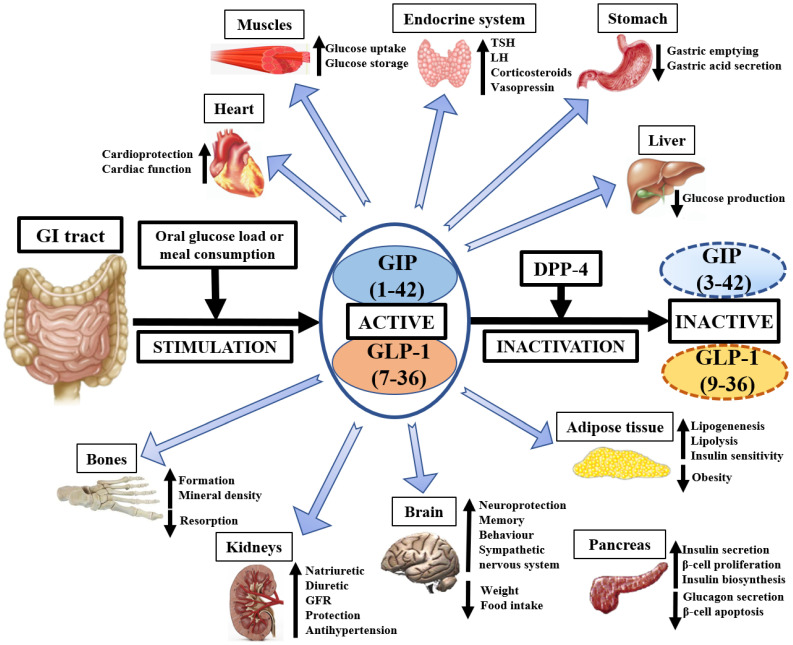
Coronary artery disease (CAD), which is the manifestation of atherosclerosis in coronary arteries, is the most common single cause of death and is responsible for disabilities of millions of people worldwide. Despite numerous dedicated clinical studies and an enormous effort to develop diagnostic and therapeutic methods, coronary atherosclerosis remains one of the most serious medical problems of the modern world. Hence, new markers are still being sought to identify and manage CAD optimally. Trying to face this problem, we have raised the question of the most predominant gastrointestinal hormones; glucose-dependent insulinotropic polypeptide (GIP) and glucagon-like peptide-1 (GLP-1), mainly involved in carbohydrates disorders, could be also used as new markers of incidence, clinical course, and recurrence of CAD and are related to extent and severity of atherosclerosis and myocardial ischemia. We describe GIP and GLP-1 as expressed in many animal and human tissues, known to be connected to inflammation and related to enormous noncardiac and cardiovascular (CV) diseases. In animals, GIP and GLP-1 improve endothelial function and lead to reduced atherosclerotic plaque macrophage infiltration and stabilize atherosclerotic lesions by directly blocking monocyte migration. Moreover, in humans, GIPR activation induces the pro-atherosclerotic factors ET-1 (endothelin-1) and OPN (osteopontin) but also has anti-atherosclerotic effects through secretion of NO (nitric oxide). Furthermore, four large clinical trials showed a significant reduction in composite of CV death, MI, and stroke in long-term follow-up using GLP-1 analogs for DM 2 patients: liraglutide in LEADER, semaglutide in SUSTAIN-6, dulaglutide in REWIND and albiglutide in HARMONY. However, very little is known about GIP metabolism in the acute phase of myocardial ischemia or for stable patients with CAD, which constitutes a direction for future research. This review aims to comprehensively discuss the impact of GIP and GLP-1 on atherosclerosis and CAD and its potential therapeutic implications.
冠状动脉疾病(CAD)是冠状动脉粥样硬化的表现,是最常见的单一死因,也是全球数百万人致残的原因。尽管有众多专门的临床研究以及为开发诊断和治疗方法付出了巨大努力,但冠状动脉粥样硬化仍然是现代世界最严重的医学问题之一。因此,仍在寻找新的标志物以优化CAD的识别和管理。为解决这一问题,我们提出了最主要的胃肠激素的问题;主要参与碳水化合物紊乱的葡萄糖依赖性促胰岛素多肽(GIP)和胰高血糖素样肽-1(GLP-1),也可作为CAD发病率、临床病程和复发的新标志物,并且与动脉粥样硬化和心肌缺血的程度及严重程度相关。我们描述了GIP和GLP-1在许多动物和人体组织中的表达,已知它们与炎症有关,并且与大量非心脏和心血管(CV)疾病相关。在动物中,GIP和GLP-1可改善内皮功能,减少动脉粥样硬化斑块中的巨噬细胞浸润,并通过直接阻止单核细胞迁移来稳定动脉粥样硬化病变。此外,在人类中,GIPR激活会诱导促动脉粥样硬化因子内皮素-1(ET-1)和骨桥蛋白(OPN),但也通过分泌一氧化氮(NO)产生抗动脉粥样硬化作用。此外,四项大型临床试验表明,在对2型糖尿病患者进行长期随访时,使用GLP-1类似物可显著降低心血管死亡、心肌梗死和中风的综合发生率:LEADER试验中的利拉鲁肽、SUSTAIN-6试验中的司美格鲁肽、REWIND试验中的度拉鲁肽以及HARMONY试验中的阿必鲁肽。然而,对于心肌缺血急性期或CAD稳定患者的GIP代谢知之甚少,这构成了未来研究的一个方向。本综述旨在全面讨论GIP和GLP-1对动脉粥样硬化和CAD的影响及其潜在的治疗意义。