Radulescu Denisa-Maria, Neacsu Ionela Andreea, Grumezescu Alexandru-Mihai, Andronescu Ecaterina
Department of Science and Engineering of Oxide Materials and Nanomaterials, Faculty of Applied Chemistry and Materials Science, University Politehnica of Bucharest, 011061 Bucharest, Romania.
Academy of Romanian Scientists, 54 Independentei, 050094 Bucharest, Romania.
Polymers (Basel). 2022 Feb 18;14(4):799. doi: 10.3390/polym14040799.
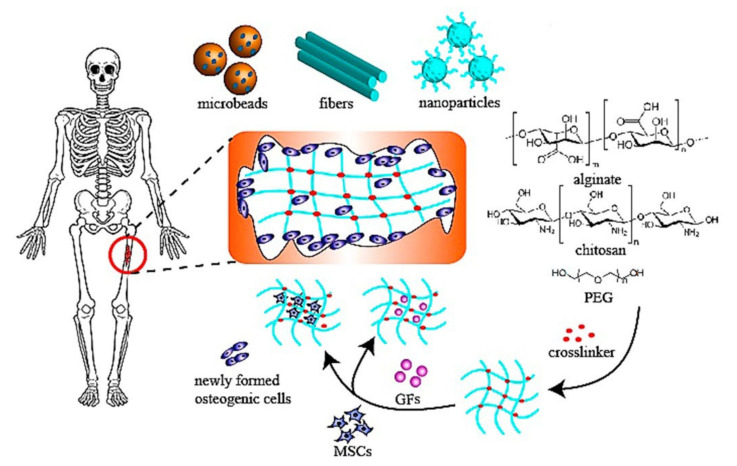
In recent years, biomaterials development and characterization for new applications in regenerative medicine or controlled release represent one of the biggest challenges. Tissue engineering is one of the most intensively studied domain where hydrogels are considered optimum applications in the biomedical field. The delicate nature of hydrogels and their low mechanical strength limit their exploitation in tissue engineering. Hence, developing new, stronger, and more stable hydrogels with increased biocompatibility, is essential. However, both natural and synthetic polymers possess many limitations. Hydrogels based on natural polymers offer particularly high biocompatibility and biodegradability, low immunogenicity, excellent cytocompatibility, variable, and controllable solubility. At the same time, they have poor mechanical properties, high production costs, and low reproducibility. Synthetic polymers come to their aid through superior mechanical strength, high reproducibility, reduced costs, and the ability to regulate their composition to improve processes such as hydrolysis or biodegradation over variable periods. The development of hydrogels based on mixtures of synthetic and natural polymers can lead to the optimization of their properties to obtain ideal scaffolds. Also, incorporating different nanoparticles can improve the hydrogel's stability and obtain several biological effects. In this regard, essential oils and drug molecules facilitate the desired biological effect or even produce a synergistic effect. This study's main purpose is to establish the main properties needed to develop sustainable polymeric scaffolds. These scaffolds can be applied in tissue engineering to improve the tissue regeneration process without producing other side effects to the environment.
近年来,用于再生医学或控释新应用的生物材料开发与表征是最大的挑战之一。组织工程是研究最深入的领域之一,水凝胶被认为是生物医学领域的最佳应用。水凝胶的脆弱性质及其低机械强度限制了它们在组织工程中的应用。因此,开发具有更高生物相容性的新型、更强且更稳定的水凝胶至关重要。然而,天然和合成聚合物都有许多局限性。基于天然聚合物的水凝胶具有特别高的生物相容性和生物降解性、低免疫原性、出色的细胞相容性、可变且可控的溶解性。同时,它们的机械性能差、生产成本高且重现性低。合成聚合物通过卓越的机械强度、高重现性、降低成本以及调节其组成以在不同时间段改善诸如水解或生物降解等过程的能力来提供帮助。基于合成和天然聚合物混合物的水凝胶的开发可导致其性能优化以获得理想的支架。此外,掺入不同的纳米颗粒可提高水凝胶的稳定性并获得多种生物学效应。在这方面,精油和药物分子促进所需的生物学效应甚至产生协同效应。本研究的主要目的是确定开发可持续聚合物支架所需的主要特性。这些支架可应用于组织工程以改善组织再生过程而不对环境产生其他副作用。