Department of Biomedical Engineering, Universiti Malaya, 50603 Kuala Lumpur, Malaysia.
Faculty of Medicine, Universiti Malaya, 50603 Kuala Lumpur, Malaysia.
J Healthc Eng. 2022 Feb 18;2022:4138666. doi: 10.1155/2022/4138666. eCollection 2022.
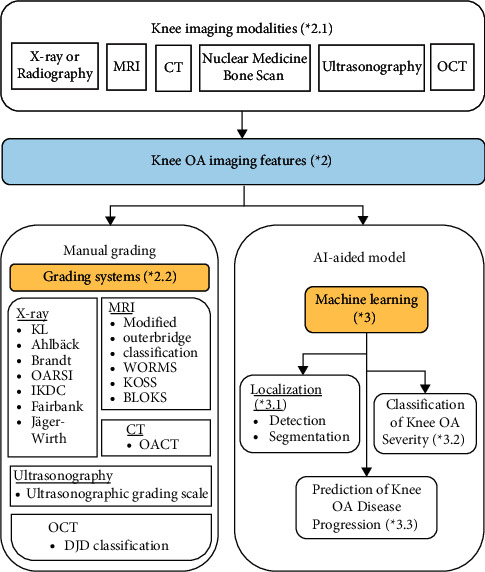
Knee osteoarthritis (OA) is a deliberating joint disorder characterized by cartilage loss that can be captured by imaging modalities and translated into imaging features. Observing imaging features is a well-known objective assessment for knee OA disorder. However, the variety of imaging features is rarely discussed. This study reviews knee OA imaging features with respect to different imaging modalities for traditional OA diagnosis and updates recent image-based machine learning approaches for knee OA diagnosis and prognosis. Although most studies recognized X-ray as standard imaging option for knee OA diagnosis, the imaging features are limited to bony changes and less sensitive to short-term OA changes. Researchers have recommended the usage of MRI to study the hidden OA-related radiomic features in soft tissues and bony structures. Furthermore, ultrasound imaging features should be explored to make it more feasible for point-of-care diagnosis. Traditional knee OA diagnosis mainly relies on manual interpretation of medical images based on the Kellgren-Lawrence (KL) grading scheme, but this approach is consistently prone to human resource and time constraints and less effective for OA prevention. Recent studies revealed the capability of machine learning approaches in automating knee OA diagnosis and prognosis, through three major tasks: knee joint localization (detection and segmentation), classification of OA severity, and prediction of disease progression. AI-aided diagnostic models improved the quality of knee OA diagnosis significantly in terms of time taken, reproducibility, and accuracy. Prognostic ability was demonstrated by several prediction models in terms of estimating possible OA onset, OA deterioration, progressive pain, progressive structural change, progressive structural change with pain, and time to total knee replacement (TKR) incidence. Despite research gaps, machine learning techniques still manifest huge potential to work on demanding tasks such as early knee OA detection and estimation of future disease events, as well as fundamental tasks such as discovering the new imaging features and establishment of novel OA status measure. Continuous machine learning model enhancement may favour the discovery of new OA treatment in future.
膝骨关节炎(OA)是一种严重的关节疾病,其特征为软骨丢失,可通过影像学模式捕捉,并转化为影像学特征。观察影像学特征是一种众所周知的膝骨关节炎疾病的客观评估方法。然而,很少有研究探讨影像学特征的多样性。本研究回顾了不同影像学模式在传统 OA 诊断中的膝骨关节炎影像学特征,并更新了基于图像的机器学习方法在膝骨关节炎诊断和预后中的应用。虽然大多数研究都认为 X 射线是膝骨关节炎诊断的标准影像学选择,但影像学特征仅限于骨骼变化,对短期 OA 变化的敏感性较低。研究人员建议使用 MRI 来研究软组织和骨骼结构中隐藏的与 OA 相关的放射组学特征。此外,应探索超声影像学特征,使其更适用于即时诊断。传统的膝骨关节炎诊断主要依赖于基于 Kellgren-Lawrence(KL)分级方案的医学图像的人工解读,但这种方法一直受到人力资源和时间限制的影响,对 OA 的预防效果较差。最近的研究表明,机器学习方法在自动化膝骨关节炎诊断和预后方面具有一定的能力,主要通过三大任务实现:膝关节定位(检测和分割)、OA 严重程度分类和疾病进展预测。人工智能辅助诊断模型在时间、可重复性和准确性方面显著提高了膝骨关节炎诊断的质量。通过几个预测模型,在预测可能的 OA 发病、OA 恶化、进行性疼痛、进行性结构变化、伴有疼痛的进行性结构变化以及全膝关节置换(TKR)发生率方面,展示了预后能力。尽管存在研究空白,但机器学习技术在处理早期膝骨关节炎检测和估计未来疾病事件等艰巨任务以及发现新的影像学特征和建立新的 OA 状态衡量标准等基本任务方面仍具有巨大潜力。持续的机器学习模型增强可能有利于未来发现新的 OA 治疗方法。