Gao Yue, Wang Shuai, Shi Biying, Wang Yuxuan, Chen Yimeng, Wang Xuanyi, Lee Eui-Seok, Jiang Heng-Bo
The CONVERSATIONALIST Club, School of Stomatology, Shandong First Medical University & Shandong Academy of Medical Sciences, Tai'an 271016, China.
Department of Oral and Maxillofacial Surgery, Graduate School of Clinical Dentistry, Korea University, Seoul 08308, Korea.
Polymers (Basel). 2022 Feb 23;14(5):871. doi: 10.3390/polym14050871.
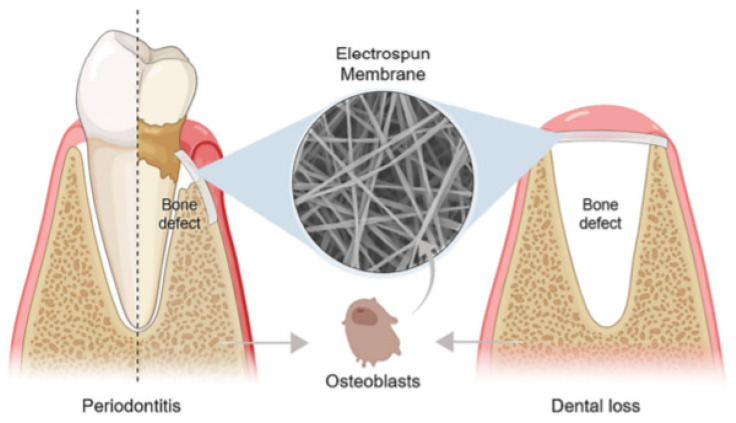
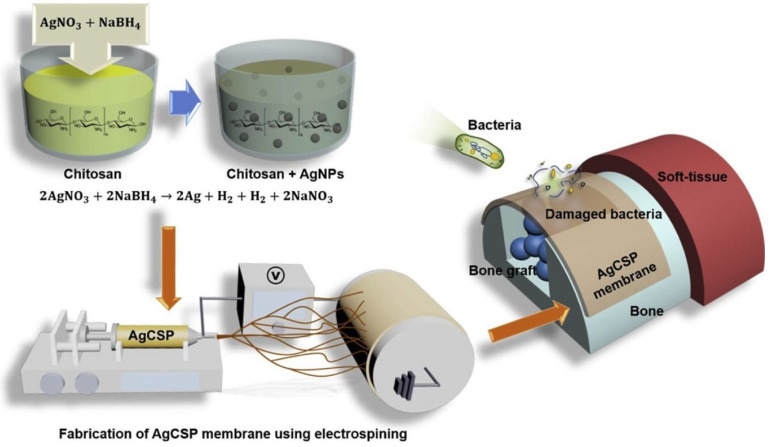
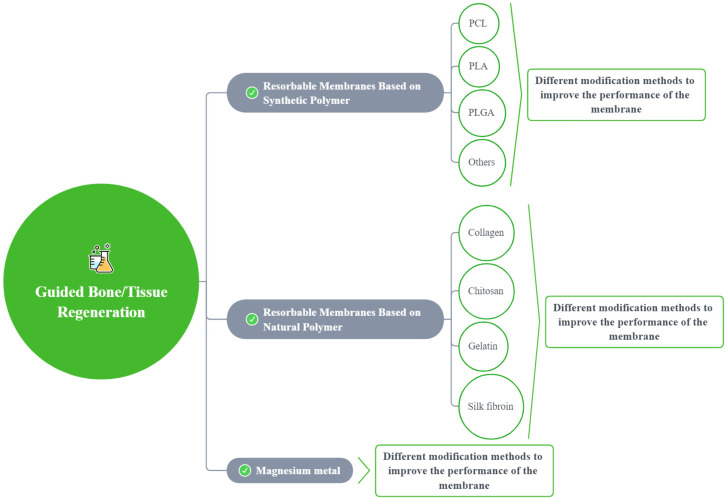
Guided tissue/bone regeneration (GTR/GBR) is commonly applied in dentistry to aid in the regeneration of bone/tissue at a defective location, where the assistive material eventually degrades to be substituted with newly produced tissue. Membranes separate the rapidly propagating soft tissue from the slow-growing bone tissue for optimal tissue regeneration results. A broad membrane exposure area, biocompatibility, hardness, ductility, cell occlusion, membrane void ratio, tissue integration, and clinical manageability are essential functional properties of a GTR/GBR membrane, although no single modern membrane conforms to all of the necessary characteristics. This review considers ongoing bone/tissue regeneration engineering research and the GTR/GBR materials described in this review fulfill all of the basic ISO requirements for human use, as determined through risk analysis and rigorous testing. Novel modified materials are in the early stages of development and could be classified as synthetic polymer membranes, biological extraction synthetic polymer membranes, or metal membranes. Cell attachment, proliferation, and subsequent tissue development are influenced by the physical features of GTR/GBR membrane materials, including pore size, porosity, and mechanical strength. According to the latest advances, key attributes of nanofillers introduced into a polymer matrix include suitable surface area, better mechanical capacity, and stability, which enhances cell adhesion, proliferation, and differentiation. Therefore, it is essential to construct a bionic membrane that satisfies the requirements for the mechanical barrier, the degradation rate, osteogenesis, and clinical operability.
引导组织/骨再生(GTR/GBR)在牙科领域中被广泛应用,以促进缺损部位的骨/组织再生,辅助材料最终会降解,被新生成的组织所替代。膜将快速增殖的软组织与生长缓慢的骨组织分隔开,以获得最佳的组织再生效果。尽管没有一种现代膜能符合所有必要特性,但大面积的膜暴露区域、生物相容性、硬度、延展性、细胞封闭性、膜孔隙率、组织整合性和临床可操作性是GTR/GBR膜的基本功能特性。本综述考虑了正在进行的骨/组织再生工程研究,且本综述中描述的GTR/GBR材料均符合通过风险分析和严格测试确定的所有基本的人类使用ISO要求。新型改性材料正处于开发的早期阶段,可分为合成聚合物膜、生物提取合成聚合物膜或金属膜。GTR/GBR膜材料的物理特性,包括孔径、孔隙率和机械强度,会影响细胞附着、增殖以及随后的组织发育。根据最新进展,引入聚合物基质中的纳米填料的关键属性包括合适的表面积、更好的机械性能和稳定性,这会增强细胞黏附、增殖和分化。因此,构建一种满足机械屏障、降解速率、成骨作用和临床可操作性要求的仿生膜至关重要。